The following notes on Bell, Book and Candle were written by Josh Martin, the Cinematheque’s project assistant and a PhD candidate in the Department of Communication Arts at UW-Madison. A recently restored 4K DCP of Bell, Book and Candle will screen at the Cinematheque on Saturday, September 12, 7 p.m., 4070 Vilas Hall, 821 University Ave. Admission is free!
By Josh Martin
Early in 1958, James Stewart and Kim Novak starred together in Alfred Hitchcock’s Vertigo for Paramount Pictures. By the time of production, Stewart and Hitchcock were already regular collaborators, working together on a trio of films throughout the actor’s prosperous post-war period: Rope (1948), Rear Window (1954), and The Man Who Knew Too Much (1956). Alongside his brutal, hard-edged Westerns with Anthony Mann (and perhaps even his downtrodden, embittered everyman in Frank Capra’s It’s a Wonderful Life), Stewart’s collaborations with Hitchcock further complicated his screen image, adding healthy doses of acidity and sexual dysfunction to his folksy demeanor and easy charm. As such, Stewart was a natural fit for the role of a disturbed detective with acrophobia, who soon finds himself helplessly fixated on the beautiful woman (Novak) he has been tasked with investigating. Novak, in a unique dual role, emerged as the latest – and perhaps the most definitive – in a long line of blonde-haired leading ladies in Hitchcock’s work, successfully functioning as both the film’s most tragic figure and a carefully constructed image of femininity, designed to seduce and destroy the hapless Stewart.
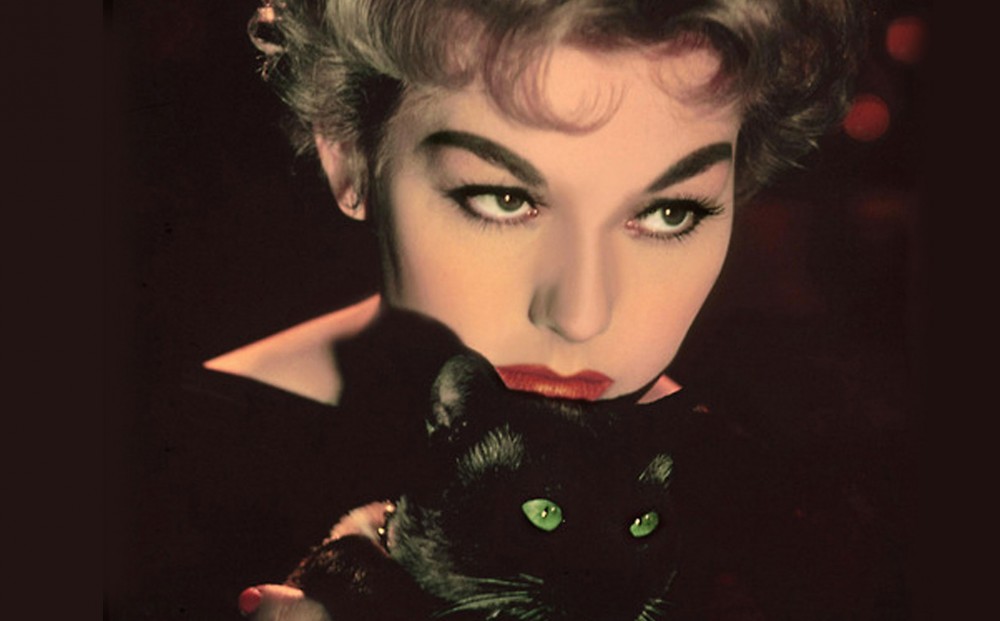
Indifferently received at the time, Vertigo is, of course, now considered a titanic classic of Hollywood cinema, an odyssey of obsession that ventures to terrifying places in its study of masculine ego, control, and perversion. Though Stewart and Novak are undoubtedly best remembered for their walks through the California Redwoods in Hitchcock’s masterwork, Vertigo was not their only screen pairing – indeed, the two were re-teamed before their first collaboration even hit theaters. Later in 1958, Stewart would go on to fall under Novak’s spell again – this time in a very literal sense – in Bell, Book and Candle, a more familiarly pleasing Hollywood love story that still retains a healthy dose of supernatural strangeness (and some amusing echoes with their previous work together). Set during the snowy Christmas season in Greenwich Village, Novak plays Gillian Holroyd, a lonely young woman who spends her days as the owner of a shop dedicated to African art, with only her beloved cat Pyewacket for a companion. On occasion, Gillian pops down to the popular Zodiac Club with her Aunt Queenie (Elsa Lanchester) and brother Nicky (a delightful Jack Lemmon, on the cusp of his legendary work with Billy Wilder). The secret of the Holroyds? They’re all witches and warlocks, and the hip Greenwich club scene actually serves as a hangout spot for magical denizens of all stripes.
Just above Gillian’s shop lives Shep Henderson (Stewart), a handsome and affable book publisher soon to be married to Merle Kittredge (Janice Rule), a snobbish college classmate detested by Gillian. What’s a girl to do when she’s feeling lonely during the holidays? Well, if you’re Gillian, the answer is simple: you cast a love spell, of course. Soon enough, Shep has fallen head-over-heels in love with Gillian, abruptly abandoning his plans to marry Merle. Things get a little more complicated with the arrival of Sidney Redlitch (Ernie Kovacs), the alcoholic author of a popular tome called Magic in Mexico, summoned by Gillian late one night. Nicky, ever the showman, begins sharing secrets with the curious author, bringing Shep closer and closer to learning the truth about his overpowering new romance.
The potency of proximity guarantees that Vertigo and Bell, Book and Candle will always be mentioned in conversations together, no matter their vastly different production histories and creative teams. However, even though they remain altogether distinct films, the echoes of Stewart and Novak’s prior collaboration in Bell are quite amusing. In fact, it is nearly impossible not to recall key sequences from Hitchcock’s film during the moments early in Shep and Gillian’s courtship, as the film captures an entranced and enraptured Stewart, pulled toward Novak by some unseen force of attraction, with the camera moving in a circular motion as they kiss. Both films essentially position Stewart as an easy mark, romantic putty in the hands of others. “Who’s a fool? You’re a fool!” barks a parrot at Shep during his visit to Bianca (Hermione Gingold), Gillian’s rival witch. Yet if Vertigo coaxes a corrosive, controlling cruelty out of Stewart, the actor lends his talents as a comedic lead to the playful nonsense of Bell, Book and Candle. As Shep, Stewart is the focal point of the film’s screwball pleasures – Novak, for her part, has very few laugh lines. Instead, audiences get the joy of watching Stewart stammer with incredulity at the world of witches and potions that he finds himself in, continually skeptical while still desperate to believe in his love for Gillian.
Based on a popular stage play by John Van Druten, Bell, Book and Candle was adapted by screenwriter Daniel Taradash, best known for his Oscar-winning script for Fred Zinnemann’s From Here to Eternity (1953). Taradash was also partners with producer Julian Blaustein at Phoenix Productions, who had a deal with Columbia Pictures, where Bell would soon be set up. As film historian Bernard Dick writes in his volume on Columbia chief Harry Cohn, the stage play was led by Rex Harrison and Lilli Palmer, and there was initial interest from Taradash and Blaustein in having the actors star in the film version as well. Instead, Cohn, who died midway through the film’s production in February 1958, “vetoed the idea,” electing to wait for the in-demand Stewart and Novak (under contract at the studio but loaned for Vertigo) to finish shooting the Hitchcock film.
Far from just a second, lesser-known collaboration between two screen legends, Bell, Book and Candle benefits from – and endures today in no small part because of – the union of a number of talented craftsmen. A veteran contract director at Columbia, bouncing between bleak noir (like 1954’s sublimely mean-spirited Mickey Rooney vehicle Drive a Crooked Road) and lighter comedies, Richard Quine was well-versed in shepherding performances from many of the film’s stars, including Novak on Pushover (1954), one of her earliest credits. For Bell, Quine also had the notable assistance of acclaimed cinematographer James Wong Howe, who expertly augmented the film’s Oscar-nominated art direction and costume design with his Technicolor photography, illuminating striking blues and other visually resplendent wintry hues within the film’s New York setting.
Despite some perfunctory narrative business regarding the loss of Gillian’s powers, Bell, Book and Candle never casts doubt on the romantic fate of Gillian and Shep, nor does it suggest that the misuse of magic may lead us down a grim road like Vertigo. Rather, like the most enjoyable Hollywood romances, Quine’s film mostly concerns itself with the logistics of how, not if, our central pair will still find a way to wind up together after this initial deception. If it takes a spectacular spell of “real” magic for Shep to initially fall in love with Gillian, perhaps a little bit of Tinseltown enchantment – and the power of two stunning movie stars at their finest – can do the trick to conjure a proper, lasting happily ever after for our lovers.