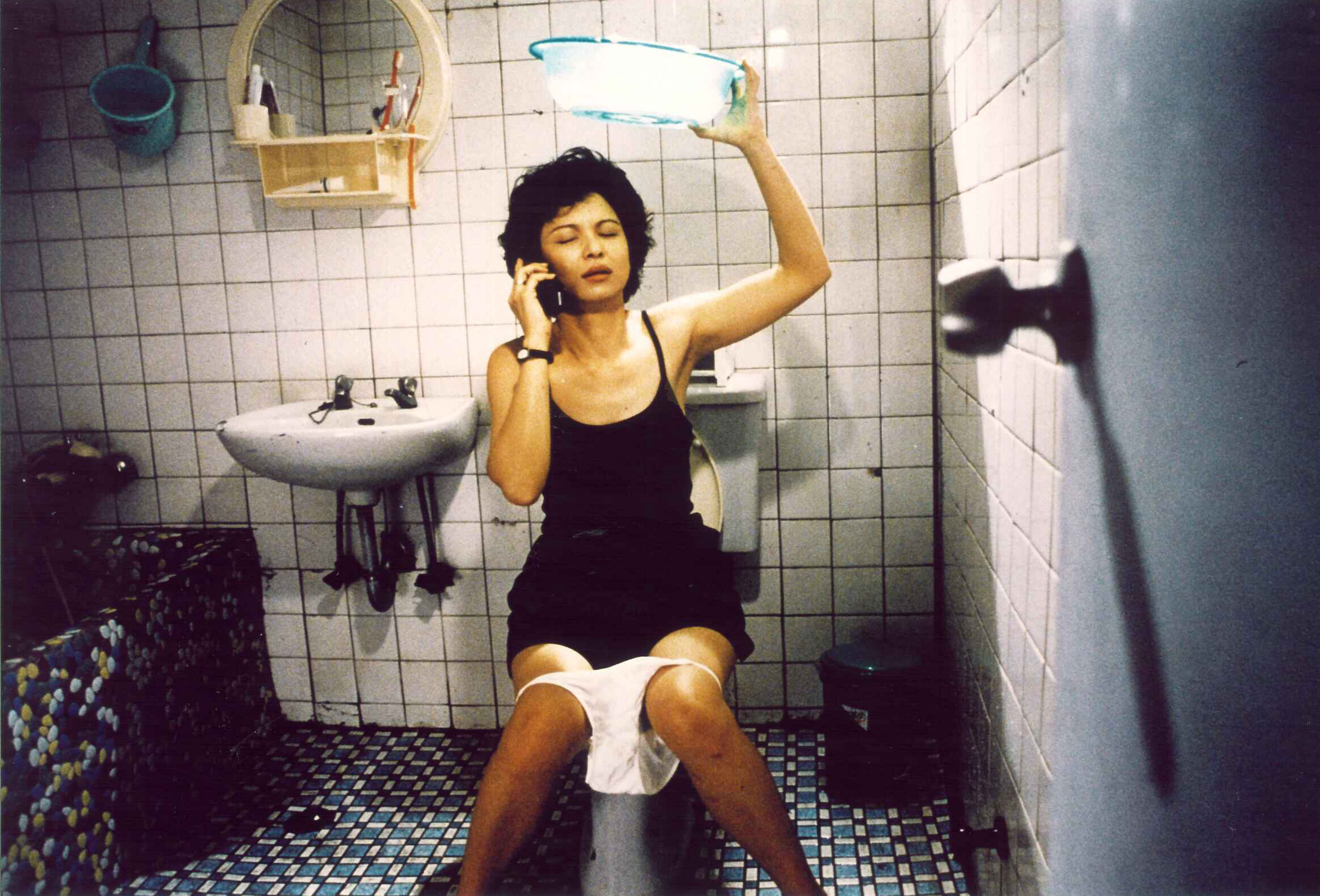
The following notes on The Hole were written by Josh Martin, the Cinematheque’s Project Assistant and Programmer. The Hole will screen at the Cinematheque on Friday, October 30 at 7 p.m. on a brand new 35mm print, courtesy of Big World Pictures. The screening takes place at 4070 Vilas Hall, 821 University Ave. Admission is free!
By Josh Martin
When it comes to contemporary slow cinema, an international mode of art film that adopts slowness as a virtue, prioritizing long takes, the tedious ordinary happenings of daily life, and little in the way of narrative momentum, few filmmakers loom as large as Taiwanese Malaysian director Tsai Ming-Liang, best known for his beloved 2003 paean to moviegoing, Goodbye, Dragon Inn. Tsai’s extraordinary slow films—static takes often linger for minutes at a time—feature no shortage of grim moments, especially in their conclusions. The tear-stained close-up that brings 1994’s Vive L’Amour to a close magnifies its subject’s emotional misery; the horrifically violent coda of The Wayward Cloud (2005), which moves Tsai’s characters to the Taiwanese adult film industry, goes to an even more disturbing place. Sometimes, bone-deep bleakness can nearly overwhelm Tsai’s work: it is difficult to imagine a film that sustains a rigorous mood of slow-moving, methodical despair as thoroughly or as effectively as Stray Dogs, his 2013 exploration of the lives of homeless men, women, and children in Taipei. Reading this description of Tsai’s work, one might find themselves sympathetic to writer Dan Kois’ famed 2011 New York Times screed against “cultural vegetables”—the idea that certain films, especially ones of the slow cinema variety, gain cultural prestige despite featuring next to no pleasurable qualities.
However, one could never accuse Tsai’s oeuvre of being one-note: his work is overflowing with unexpected pleasures. Despite the glacial long takes, forlorn characters, and thematic emphasis on alienation and loneliness, Tsai’s films are playful, darkly funny, and guided by an intertextual affection for all manner of cinema, peppered with allusions to Jacques Tati, Charlie Chaplin, and more. No film exemplifies the multifarious emotional resonance of Tsai’s body of work better than 1998’s genre-bending The Hole. The film begins with the wail of sirens, followed by voiceover that establishes an apocalyptic situation in this harrowing version of Taipei. At the turn of the millennium, a virus has suddenly struck—the government is uncertain of its origin and has established quarantine zones that are now being evacuated. As the credits roll, a news bulletin notes that, with just seven days until the clock strikes on the year 2000, water supplies will soon be cut off in the quarantine zones. A health administrator insists that those living there must leave immediately.
With his trademark sense of humor, Tsai cuts from these credits—which set a mood of urgency and terror—to a long take of a man sleeping on his couch in his underwear. In something of a nod to the simple scenarios of silent comedy, none of the characters in The Hole are ever named, but the man is played by Lee Kang-Sheng, Tsai’s longtime muse and the star of nearly all of his films. Lee’s slumber is disturbed by a plumber, who has come to check the apartment for a leak in the water line; Lee appears confounded and annoyed as the man putters around. Shortly after, we meet a woman, played by Yang Kuei-Mei, also a frequent Tsai collaborator, who lives in another apartment in the building. As she walks up to her abode while caught in a downpour, we see her carrying toilet paper. In addition, angry residents, frustrated by their government, have taken to throwing their trash outside the window, with vertical flashes of plummeting refuse briefly appearing on the screen. Her home is lined with towels that are collecting water from the upstairs leak: she drains them in buckets, keeping the water for later. She watches television, listening to talk of the situation. While doing her skincare routine and listening to the radio, which pivots wildly from news bulletins to ramen recipes, the ceiling begins to crumble, forming the shape of a small hole, with a cockroach scurrying out.
Without any warning, the film morphs into something entirely new. Tsai cuts to a version of the building’s elevator that seems more fantastical, adorned with lights and a woman clad in sparkling colors. Captured in an uninterrupted take, a woman sings Hong Kong artist Grace Chang’s “Oh Calypso,” dancing joyfully in unison with the song’s lyrics. The Hole is a comedy crafted in Tsai’s one-of-a-kind style, and it is a sci-fi movie depicting social collapse, but, most boldly, it is also a musical. Of course, it should come as no surprise that, in Tsai’s universe, the flights of fancy expressed in musical form exist, in part, to sharpen contrasts with the horrifically humorous drudgery of the characters’ day-to-day lives. Tsai cuts from the very same elevator back to the lift in the film’s less colorful reality, where a drunken Lee sits nearly passed out on the floor. He then stumbles back to his room, eventually retching into the hole that now connects him to his downstairs neighbor, who looks on aghast as vomit drips into her apartment. The beginning of a beautiful friendship, surely.
Though he directed a number of shorter projects in the late 80s and early 90s, Tsai’s breakout feature was 1992’s Rebels of the Neon God, which also marked his first collaboration with Lee. For the next two decades, Tsai blossomed as one of the most prolific and versatile artists in Taiwanese cinema, winning the Venice Film Festival’s Golden Lion for Vive L’Amour and Berlin’s Silver Bear for 1997’s The River. As the scholar Song Hwee Lim notes, The Hole was one of multiple Tsai projects produced by commission, with this film designed as part of La Sept-Arte’s “2000 as Seen by…” series. Song emphasizes the importance of French financing to Tsai’s career, not entirely unsurprising given the director’s cinephilic fondness for French New Wave titles. The Hole went on to become Tsai’s first film in competition at the Cannes Film Festival, where it took home the FIPRESCI prize; his follow-up project, What Time is it There? (2001), would solidify his status as a staple auteur at the French festival.
By marking contrasts between apocalyptic dread, quotidian misery, and cinematic fantasy, it is no surprise that The Hole received newfound attention during the peak of the COVID-19 pandemic. Writing for the Los Angeles Times in 2020, critic Justin Chang admits that the film could induce “spasms of recognition, many of them quite funny” for an audience also enduring lockdowns and pandemic anxiety. Though predicated on the development of a relationship between the two characters—as Chang describes it, the film coheres with Tsai’s “conviction that the human desire for connection can take the most wondrous forms”—The Hole nonetheless still builds to familiar outpours of raw emotion from characters unable to control their sadness any longer. There is no sign that the virus will be cured or the apocalyptic situation resolved. Instead, what mitigates the bleakness of The Hole is the suggestion that hard reality and delirious fantasia might finally merge, that the indulgence of a mutual escape into another realm might bring lasting comfort to a world on the brink.