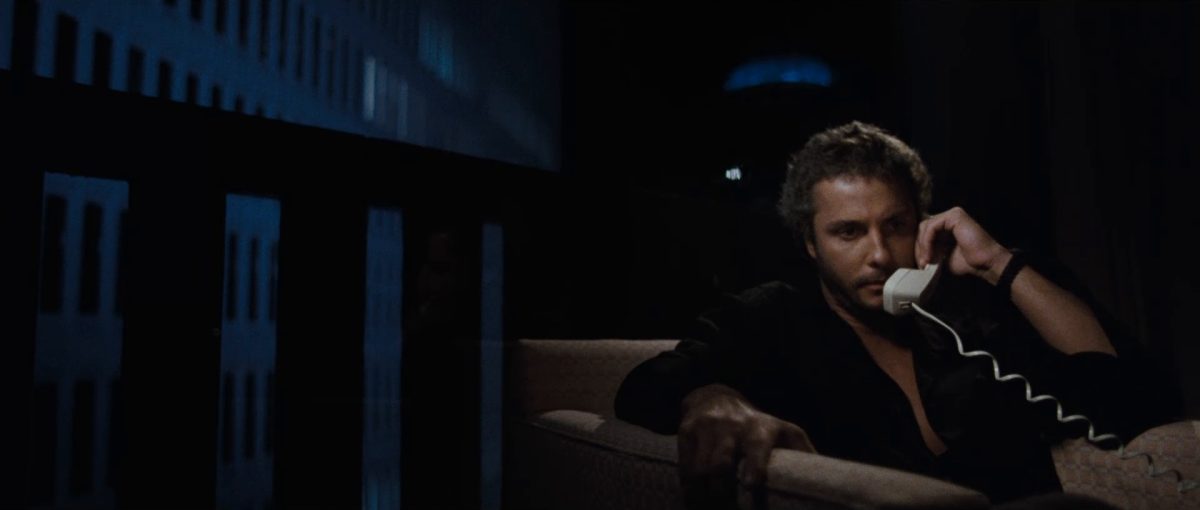
The following notes on Manhunter were written by Josh Martin, the Cinematheque’s project assistant and a PhD candidate in the Department of Communication Arts at UW-Madison. Michael Mann’s Manhunter: The Final Cut screens at the Cinematheque on Saturday, November 21, at 7 p.m. The venue is at 4070 Vilas Hall, 821 University Ave. Admission is free!
By Josh Martin
By the mid-1980s, through just two theatrical features and more extensive work in television and TV movies, the signature aesthetic and thematic concerns of writer/director Michael Mann were already close to solidified. With Thief, his 1981 debut starring James Caan, the story of a criminal with a code who treats his illegal trade like the diligent work of a master craftsman, the Mann ethos emerged in ruthlessly efficient microcosm, all captured in high style with backing from the synthy sounds of Tangerine Dream. Here was a filmmaker laser-focused on men, often violent and obsessive yet principled, a director capable of crafting pulse-pounding, electrifying drama while his thieves and gangsters remained cool-as-cucumbers. Despite what, in retrospect, can be understood as the birth of an essential authorial voice, Mann veered far off course for his sophomore epic The Keep (1983), a historical sci-fi drama set in Nazi Germany. Though Mann eventually disowned the film, The Keep inevitably achieved cult film maudit status for its idiosyncratic, studio-thwarted vision (and its accompanying lack of financial success).
In the aftermath of this failed excursion, Mann became a household name during a boom of hyper-stylish television in the 1980s with the crime series Miami Vice (1984-1989), for which he served as showrunner and executive producer. With expressionistic splashes of primary colors and the strategic use of popular songs (most notably, the smooth tones and drumbeat explosion of Phil Collins’ “In the Air Tonight” in the pilot episode), the series became a key touchstone of 1980s popular culture. While Mann’s star as a multi-media auteur was on the rise, so too was the profile of the Chicago-based actor William Petersen, who had a background role in Thief. Long before his own stint on television as the star of CSI: Crime Scene Investigation (2000-2015), Petersen first drew the attention of filmgoers as hard-charging, ultimately sociopathic cop Richard Chance in William Friedkin’s comeback vehicle To Live and Die in LA (1985), an acclaimed, sweat-and-grime-drenched thriller that drew no shortage of comparisons to Miami Vice. Portrayed by Petersen as a reckless adrenaline junkie in a world of modern-day cowboys and outlaws, Chance has the all the makings of a classic Mann antihero, only stripped of any inhibitions—or a sense of morality.
Petersen soon got the chance to serve as a proper Mann protagonist, reined-in, deliberate, and ruthlessly determined, in Manhunter (1986), the director’s third feature and his first (and only) film produced for the De Laurentiis Entertainment Group. Red Dragon (published in 1981), the inaugural volume of Thomas Harris’ book series focused on the cannibalistic killer Hannibal Lecter, while Mann’s adaptation follows Will Graham (Petersen), a skilled “manhunter” for the Federal Bureau of Investigation who has now settled into a quiet life in Florida with his wife (Kim Griest) and son. Graham was responsible for tracking down and capturing the erudite and terrifying Dr. Hannibal Lecktor (inexplicably misspelled here—and played by Brian Cox), a pursuit that brought him fame and ultimately took a severe toll. In Manhunter’s opening scene, viewers see an unknown victim from the perspective of a presumed killer, ominously filmed in her bedroom. Without seeing the stomach-churning violence that follows, Mann introduces us to Graham at his home, sat on a tree branch at a white sandy beach across from Jack Crawford (Dennis Farina). The head of the Behavioral Science Unit whom Graham served under, Jack has come with bad news: this killer, known colloquially as the “Tooth Fairy” for his tendency to leave bite marks on his victims, is on the loose. Worse, the FBI is on the clock—the Tooth Fairy kills in cycles in sync with the moon—and Jack needs Will back before he strikes again.
Viewers who have some familiarity with Manhunter will likely notice that the film, in its presently screened version, differs slightly from previous cuts. Like Wong Kar-Wai, George Lucas, and other notable filmmakers, Mann has an established tendency to revisit and revise his older work. As such, this new 4K restoration of Manhunter also presents the debut of what Mann has described as his “Final Cut.” Since the initial release of Manhunter, Mann has repeatedly tinkered with the film, settling now on a version that contains changes both macro and micro. In a June 2026 Q&A at the Academy Museum in Los Angeles, Mann identified dialogue tweaks and edits to scenes throughout, as well as an augmenting of the “sense of what [Graham] accomplished” in the film’s climax, which takes the form of a new final scene. In a move with ramifications for Manhunter’s visual aesthetic, Mann also noted that he and colorist Stefan Sonnenfeld adjusted the color temperature to produce something “contemporary to the palette of colors that we would have now.”
Though these many changes to the viewer’s experience of Manhunter are significant, the spirit of the film remains unaltered. Thomas Harris’ work would return to the screen many times following this screen debut, even ascending to Oscar-winning heights with Jonathan Demme’s chilling adaptation of The Silence of the Lambs (1991), but Mann’s own obsessions, fascinations, and visual signature unmistakably inform the material here. “What drew me to the story was its connection to the essence of evil,” Mann noted in a 1987 interview with Cinefantisque, “which emerges in the process of dehumanization that leads a human being with no exceptional past to become a killer capable of the most terrible atrocities.” In a recent article on The Final Cut in The Guardian, Mann reemphasized this sense of empathy and curiosity regarding these individuals, noting his correspondence with convicted murderer Dennis Wayne Wallace throughout his extensive research prior to production. Mann expressed a curiosity about how well-documented childhood trauma shaped Wallace: “I wanted to evoke that contradiction about killers. These people who commit heinous crimes who are at the same time victims themselves – how does one relate to that?”
The question of this ability to relate is a potent one, both for Manhunter specifically and Mann’s filmography writ large. Perhaps the most famous scene in Mann’s oeuvre—the coffee shop face-off between Robert De Niro’s Neil McCauley and Al Pacino’s Vincent Hanna in 1995’s Heat—simply allows two men from opposing sides of the law to understand their relationship to one another, to comprehend how similar obsessive tendencies and principles may have shaped their archetypal, almost cosmic rivalry. In the procedural context of Manhunter, the scholar Steven Rybin notes that the film focuses significantly on “the mental connection that Graham must draw between himself and the killer.” Indeed, Graham is shown to have a disturbing, almost supernatural ability to feel the desires inside the mind of a killer, a linkage that must be exploited and exorcized. While maintaining the humanity of hunter and hunted alike, Graham’s search, via Mann’s distinctive approach, morphs into something resembling a poetic, stylized clash between titanic figures of good and evil. Or, to use Graham’s own words from a key juncture late in the film: “Just you and me now, sport.”