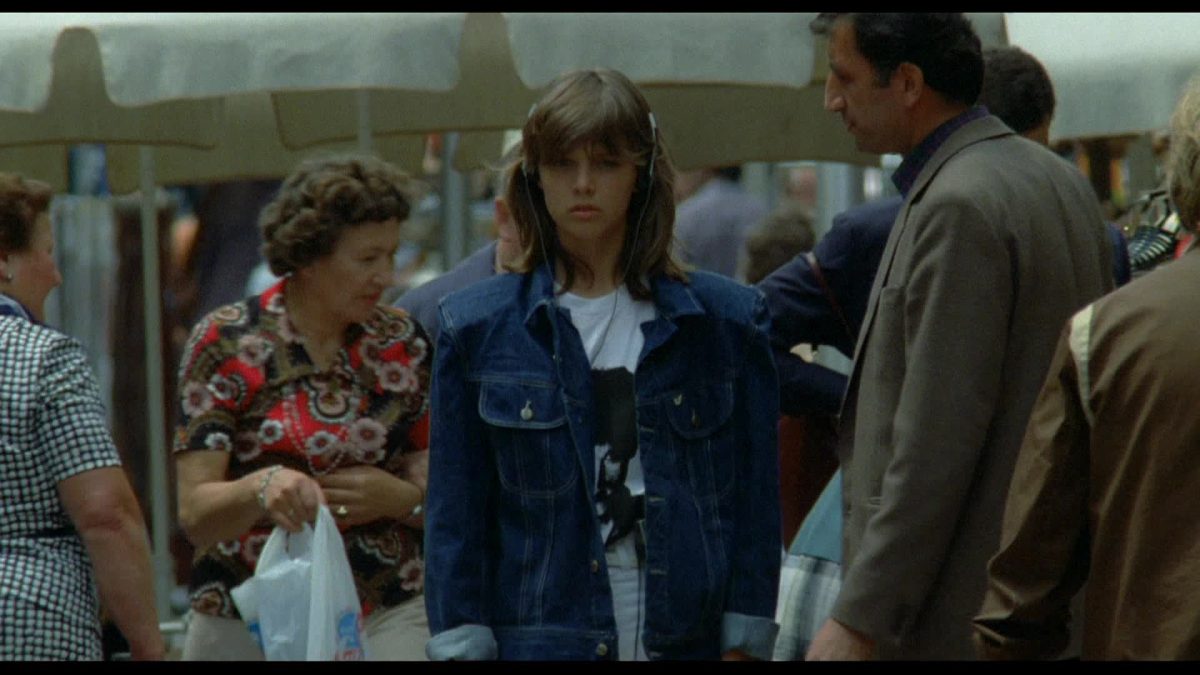
The following notes on Der Fan were written by Josh Martin, the Cinematheque’s project assistant and a PhD candidate in the Department of Communication Arts at UW-Madison. A new 4K DCP with Dolby Stereo sound will screen at the Cinematheque, Saturday, October 17, at 7 p.m. The venue is at 4070 Vilas Hall, 821 University Ave. Admission is free!
By Josh Martin
“You don’t know me,” admits Simone (Désirée Nosbusch) in her psychologically revealing voiceover narration early in Eckhart Schmidt’s Der Fan (1982), “but I’ve known you for two years now.” When we meet the young protagonist of this startling horror film, she is deep in the throes of a feverish obsession with R (played by Bodo Staiger, the frontman of Rheingold, the German pop group that supplies the film’s soundtrack), a popular musician with a synth-heavy sound and a stoic, mannequin-like stage persona. Each and every day, often wearing a T-shirt that bears his face, Simone waits for the mailman to arrive, hoping and praying that R has finally replied to one of her many fan letters. Like the eponymous Stan in rapper Eminem’s famed track about a one-sided fan relationship turned violently sour, Simone appears restless, paranoid, and delusional, convinced that nefarious forces are blocking her from her true love. Nearly religious in her devotion, she seems capable of just about anything in the pursuit of making her fantasies a reality.
Never officially released theatrically in the U.S., it is nonetheless unsurprising that a film as casually extreme and politically trenchant as Der Fan sustained a cult audience in the decades following its debut in Europe. Thanks to the efforts of Fun City Editions, the film’s unique terrors can at long last be seen—and heard—as the filmmakers originally intended, with a striking new 4K restoration featuring Dolby Stereo sound recovered from an optical track negative. Despite a protracted wait for the explosion of its inevitable carnage, Der Fan is never a movie that suggests a descent into madness. Rather, something is clearly unsettled with Simone from the very first frame, thus linking the viewer closely to the point of view of an entirely unreliable narrator. Much as Simone seems lost in the droning beat of R’s music, writer/director Schmidt commits so intensely to the viewer’s immersion in her headspace that we are helplessly entranced alongside her, coasting through the film on the wavelength of this hypnotic vibe. As critic Keva York notes in her essay on the film for Metrograph Journal, a dubbed version “did circulate via bootleg VHS” in the U.S. under the title Trance, a moniker snugly befitting the lulling tempo of its soundtrack.
Though some may initially bristle at the familiarity of the film’s configuration of a musician/fan relationship, Der Fan is astute and observant about the parasocial nature of our connections to celebrities, honest about the intimate, slippery relationship created between an artist and their audience. When Simone asserts that R’s voice sounds “different every time” for her despite its insistent monotony, anyone with a strong connection to an artist may even feel a pang of recognition in the meaning she has derived from this music. Yet her feelings are clouded by intense jealousy and possessiveness: few shots define the film quite like the image of Simone pressing her body into a poster of R, dreaming of sexual ecstasy with the star that remains out of reach.
Eventually, Simone takes matters into her own hands, traveling to Munich to find R ahead of his performance on a television show. Greeted by throngs of fans, R’s eye instead drifts to Simone, waiting sheepishly across the street. He invites her to come in for the show, taking an immediate liking to her. For Simone, it is a fairy tale vividly brought to life, her wildest dreams coming true all at once, such an astonishing whirlwind that one even ponders if what we are seeing is real. Yet as the wide-eyed Simone remains worshipful and awestruck, something about R proves unnerving. He is controlling and all-powerful, gleefully bossing around his doting entourage. More urgently, R is obviously preying on Simone as perhaps the latest in a long line of quick sexual encounters with fans; this is certainly not any kind of grand consummation of love. “Do you always treat them this badly?” asks a television presenter in a conversation with R, held at a distance from Simone. “That’s just how to do it,” R replies before beckoning Simone to come to him with the simple wave of a finger.
For all the ballyhoo around the specifics of its nightmarish narrative progression (which shall remain unspoiled here), Der Fan is ultimately much wiser about power and fantasy than its more outlandish shock tactics would suggest. Early in the film, R’s music plays over a photograph of a Nazi rally pasted on the wall of Simone’s room, with a sketch of the artist’s face eventually superimposed over the outstretched arms of the German masses. As the camera pans down the photograph, we eventually see that Simone has placed the photo of the rally directly next to her shrine for R, as if they are saluting their new Messianic leader. Such a potent linkage between fandom and demagoguery seemingly needs no further explication or belaboring. However, critic Jacqueline Castel notes in her recent essay on Der Fan, excerpted in Screen Slate ahead of its inclusion in Fun City’s forthcoming physical media release, that Schmidt’s political consideration—his probing of the question of whether “Hitler or the public who supported him” was more responsible for the horrors of Nazism—entirely went over the heads of many critics. The “alienated reviewers” in Germany, as Castel writes, saddled the film with poor initial notices, a minor travesty that nonetheless left room for a later reclamation.
Complicit though the German public may have been, Schmidt’s provocations do not prevent him from extending sympathy to his young heroine and her frightening fervor. Indeed, if Der Fan’s critique is obvious to the twenty-first century viewer without ever becoming foolishly didactic, what the film does repeatedly underline is the dismissive cruelty of every man that Simone encounters, giving her eventual turn to violence its own political charge. The mailmen sneer at her as she returns each day to check if a new letter has arrived, taking pleasure in her perpetual disappointment. In one brief scene, captured in a frightening frontal view, Simone’s father berates her for missing school, entirely uncaring and oblivious to her torment. Perhaps most harrowing of all, when Simone decides to hitchhike to Munich, a grotesque driver prods her for her thoughts on sex, eventually attempting to rape her. It is this accumulation of condescending, perverse, and violent experiences that makes Simone’s encounter with R seem so initially wonderful—and the film’s perspective shift so judiciously executed. Rather than further burrowing into Simone’s subjectivity, Schmidt allows us to see R for the vacuous manipulator that he is, unsavory qualities that remain oblivious to his young devotee.
Despite the obviousness of R’s disregard for Simone—and no matter our own uneasiness with Simone’s obsession—the film refuses to mock her for missing her idol’s machinations. Tears streaming down her face, Nosbusch’s portrait of Simone’s unleashed rage as she processes the truth of her unrequited love is deeply, palpably felt. Early in the film, Simone fantasizes about her own suicide, noting that, should she take her own life, she will bring along a letter to R as she jumps from a building, thus requiring him to notice her. “Then I’ll be a part of him,” she flatly observes, “And he a part of me.” In all its grisly, taboo-shattering detail, the conclusion of Der Fan takes this morbid urge to its logical endpoint, capturing the violent evolution of Simone’s instinctive desire for possession, a fixation that is not thwarted or cured so much as it is reborn anew.