The following notes on White Nights (Le Notti Bianche) were written by Matt Jackson, PhD student in the Department of Communication Arts at UW-Madison. A new 4K DCP of White Nights screens at the Cinematheque on Saturday, October 10, 7 p.m. The venue is at 4070 Vilas Hall, 821 University Ave. Admission is free.
By Matt Jackson
In conversations about postwar Italian cinema, few concepts loom as large as neorealism. This cinematic movement, heralded by films like Roberto Rossellini’s Rome, Open City (1945) and Vittorio de Sica’s Bicycle Thieves (1948), was quick to establish an aesthetic heritage which still finds echoes in twenty-first century Italian cinema. The well-cemented legacy of the movement is partially due to the fact that its core stylistic tenets—on-location shooting, the use of nonprofessional actors, and generally dismal, pessimistic stories of socioeconomic struggle—spoke not only to a preference for a particularly evocative “look,” but to a broader ethic of filmmaking that underscored the Seventh Art’s responsibility to tell “real” stories. Even in the more baroque or dramatic of neorealism’s inheritors, such as Fellini or Pasolini, there is an underlying emphasis on the textures of the real-world infecting and informing these plots of make-believe. As such, when White Nights (“Le notti bianche”) arrived in Italian cinemas in 1957, it was within the perhaps overbearing interpretive schema of neorealism that it was received. Though it did end the year by securing a prestigious Silver Lion award from the Venice Film Festival, general audience reactions at the time of its debut seem to have landed somewhere between miffed and underwhelmed with Visconti’s blatantly artificial film. Indeed, many read White Nights as a definitive statement that the filmmaker who had arguably kicked-off neorealism with 1943’s Ossessione was no longer capable of or interested in upholding its core values.
Yet despite the dingy, naturalistic sets that characterized his first several films, there was always a hint of the operatic in Visconti’s work: a preoccupation with performance, melodrama, and the fading glamor of a bygone Italian aristocracy. These motifs would reach their apex in his gilded 1963 historical epic The Leopard, but such tendencies were starting to rankle neorealism-purists all the same as early as 1954, when the director’s lavish costume drama Senso signaled a turn to decadent aesthetics and period piece escapism. Visconti’s financiers were none too happy with this turn either, as Senso solidified the filmmaker’s growing reputation for racking up lavish production expenses which were not proving justifiable by the standard of box office returns. According to many accounts (including Visconti’s own), this chastising about going over budget is why he decided (or perhaps, was “gently encouraged”) to scale down for his next film, which would be an adaptation of Dostoevsky’s short story about a lonely man befriending a lonely woman over the course of four meager nocturnal encounters. Perhaps we can even read a head-nod to his money men in Visconti’s description of White Nights as “a little story – grand in Dostoyevsky, but small in my film.”
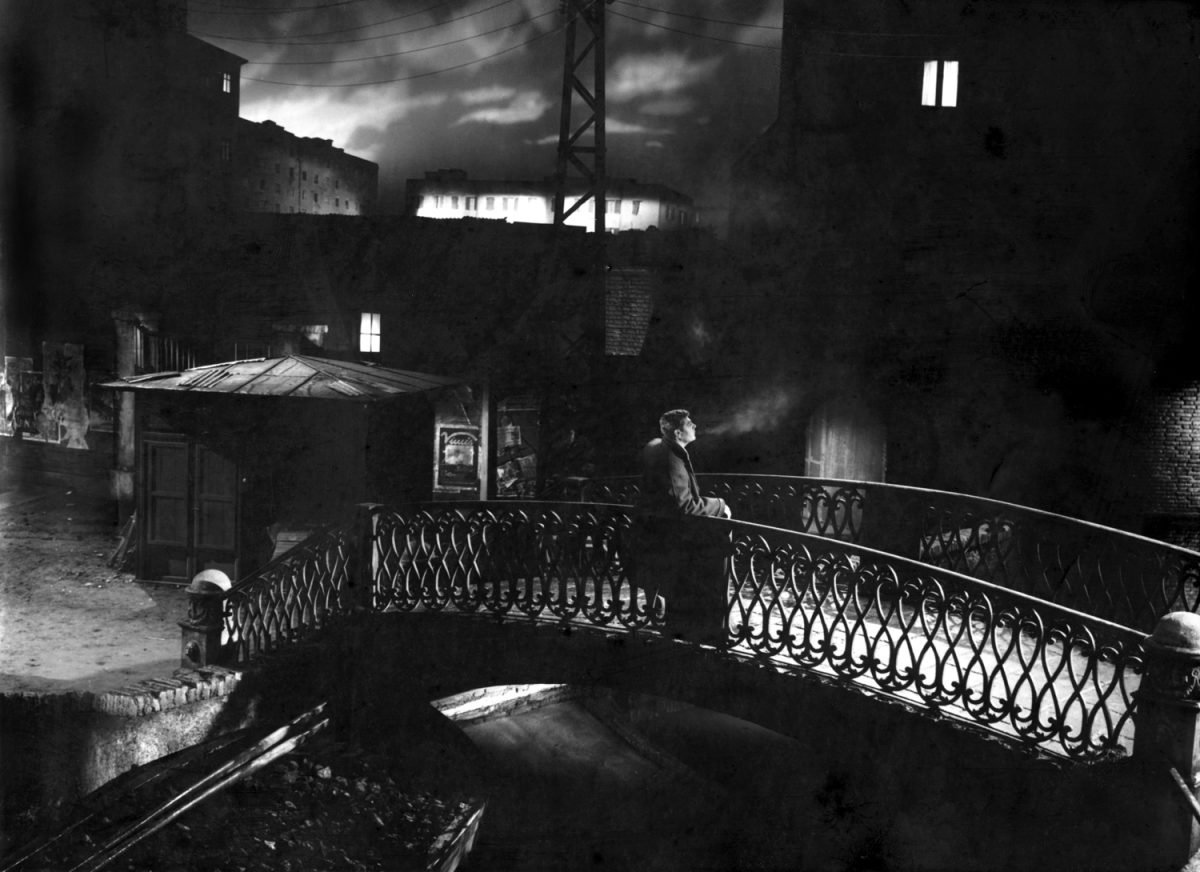
In a move that seemed reasonable to producers on paper, Visconti opted to shoot White Nights entirely on a soundstage in Rome’s famous Cinecittà studios rather than on location in St. Petersburg (where the original story is set) or in Livorno (where the action has been transposed for the film). It should be no surprise to contemporary viewers that White Nights’ set cost more than its producers bargained for—it may be the most expressive and impressive part of the film. Crafted as a conspicuously stagey facsimile of Livorno, the studio-world of Visconti’s film is an oneiric cityscape of bridges, canals, and neon signs flickering all-too-symmetrically above empty midnight streets. At times its rain-moistened gutters and expressionistic approach to lighting invite comparisons to film noir, as well as that genre’s French cousin, Poetic Realism. Indeed, several elements of the film—the visual obsession with the parallel brooding forces of wind and water, the stray pup that comes and goes as the main character’s sole companion—seem to have emerged right out of Marcel Carné’s Port of Shadows (1938), another movie about an itinerant loner that takes a decidedly “aestheticized” approach to depicting reality.
If the world of White Nights looks fake—or, at least, “dream-like”—it can hardly be considered a failed attempt at aping the realism of Visconti’s contemporaries. The film revels in the composed artificiality of its set: wide shots abound, and often, the two lovelorn leads who meet time and time again on the dramatic bridge at the center of the narrative are practically swallowed up by the lonesome expansiveness of their theatrical surroundings. This is a world where dreaming, or perhaps sleep-walking, forms the primary mode for being in the urban landscape, so it is only fitting that the two characters who center the film are idealists and romanticists, self-identified “dreamers” whose solitary wanderings and flights of bittersweet reverie make the world feel almost as if it was prefigured to fit the contours of their indulgent sorrows.
Mario, played by a pre-breakout Marcello Mastroianni, is a hopeless romantic whose lonely affliction comes from a boyish shyness, a lack of luck with women, and a feeling of dislocation at arriving in a new city. He is more than a bit pathetic, though Mastroianni is thankfully too charming to fully embody the more unsavory fervor of the narrator in Dostoyevsky’s original text. Meanwhile, Natalia, played by the highly-in-demand Austrian actress Maria Schnell, is lonely for much more extrinsic reasons: her crochety grandmother forbids her from leaving their home, and she is thus waiting for the return of the only man with whom fate has allowed her to fall in love under the circumstances of her imprisonment. Her predicament, including her ritualistic escape to a moonlit bridge every night in hopes of reuniting with her paramour, gives the movie an additional gloss of the tragic fairy tale with its locked-away princesses and gallant rescuers. This impression is not exactly deflated by the inclusion of Jean Marais as Natalia’s absent lover, an actor who was well-known at the time of the film’s release for having played the extravagantly regal Beast in Jean Cocteau’s 1946 adaptation of La Belle et la bête.
Though the rubric of neorealism seemed to dominate contemporary discourse around Visconti’s film, White Nights’ embrace of its own Romantic, pseudo-fantastical aesthetics and influences encourages viewers to reframe their experience around more melodramatic questions of sympathy and pity. Is Natalia a lovestruck damsel, or a tragic prisoner of draconic gender norms? Is Mario a kindred spirit for Natalia, or a quixotic and intrusive Casanova? On this question, critics have historically been split—though if you do some digging, you will find no shortage of oddly polemical reads of Natalia’s character. That viewers can’t seem to form a consensus on how well Mario and Natalia’s individual feelings of loneliness overlap is a testament to the power of a melodramatic approach in speaking to the complexity of sentiment, something that neorealism was not always equipped to handle in its dirt-and-dust approach to harsh truth. Rather than scrubbing a relief of life’s material harshness onto celluloid, White Nights looks to an alternate realism of longing: in a world populated exclusively by dreamers, who is to say what is sufficiently real?