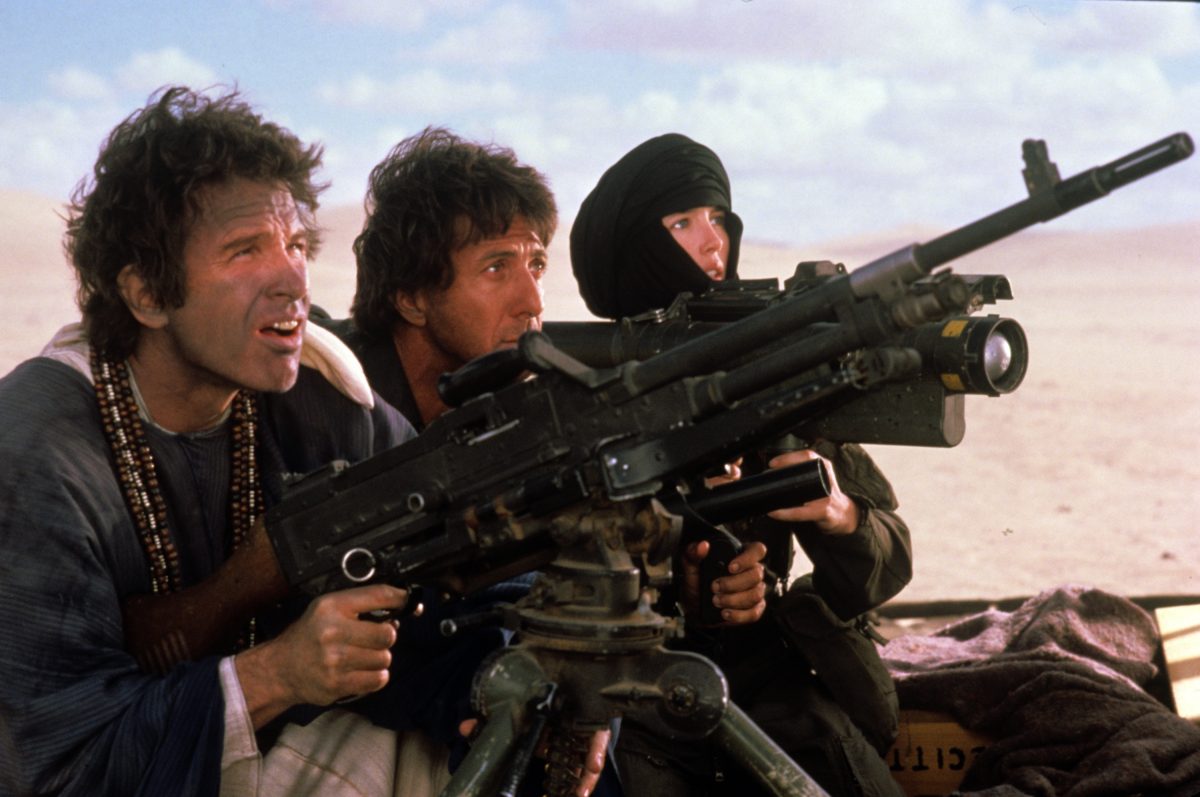
The following notes on Ishtar were written by Steph Chung, PhD student in the Department of Communication Arts at UW-Madison. Ishtar screens at the Cinematheque on Friday, October 9. Our venue is located at 4070 Vilas Hall, 821 University Avenue. Admission is free!
By Steph Chung
After months of negative press coverage, film critic Peter Biskind took to the pages of American Film magazine to try to set the record straight on the production of Elaine May’s Ishtar (1987). The most virulent rumors were those addressing the film’s budget, which had exploded from an original $33.5 million budget to a reported $55 million. For many critics, Ishtar seemed to be headed towards the same fate as “studio-killer” Heaven’s Gate (Cimino, 1980), whose original budget had quadrupled in size and prompted United Artists’ acquisition by MGM. Biskind addressed these rumors by making an oddly utilitarian comparison, suggesting that the film “cost about as much as a couple of F16s.” “And whereas two F16s create employment for about three hundred people over a year’s time, returning nothing on the investment, will eventually be outmoded or destroyed in battle, and bring pleasure to no one,” Biskind wrote, “Ishtar employed more than one thousand people (excluding extras) for varying periods of time over two years, may well bring sizable returns on its investment, will doubtless be around for years, and will probably entertain millions.” Despite Biskind’s best efforts to reframe the conversation, Ishtar crashed and burned, nonetheless. Critics described the film as “a lifeless, massive, lumbering exercise in failed comedy” (Chicago Sun-Times), “colossally dunderheaded” (Hollywood Reporter), and a “piddling… hangdog little comedy with not enough laughs” (The Washington Post). Ultimately losing Columbia $40 million, Ishtar became enshrined in Hollywood history as one of the industry’s most notorious box-office bombs.
Clouded by this box office failure, the story of Ishtar is often seen as a sad one. The film was initially meant to be an act of gratitude and friendship: indebted to Elaine May for her (often uncredited) work on his directorial features Heaven Can Wait (1978) and Reds (1981), Warren Beatty approached May with the intention of producing and starring in whatever project she had in mind. May set her sights on making a film loosely based on Bing Crosby and Bob Hope’s popular Road to… series, and Beatty rallied the support of Columbia’s head producer Guy McElwaine and star Dustin Hoffman (who May had also helped with uncredited writing contributions to Tootsie), despite their initial misgivings. Even before production had started, however, the press predicted the worst for Ishtar. May, Beatty, and Hoffman all had reputations for being temperamental, overwhelming presences on set, and the press assumed that their personalities would complicate production. The crew themselves had doubts: interviewed by Biskind, a production member recalled stories “months before [they] started shooting where people were willing to lay down substantial amounts of money that there would never be a first day of shooting, let alone a last day.”
Ishtar did begin production in Morocco in October 1985, but production was by no means smooth. May’s perfectionism and indecisiveness made her directing relentless, and the film crew chafed under what they considered to be unreasonable demands. Crew breaks were regularly delayed, and squabbles between May, Beatty, and cinematographer Vittorio Storaro held up production progress. May would shoot an average of 20 takes per shot and let the camera roll for long stretches of time (as one production colleague snidely commented, “Elaine May is a woman of many words… however, the word ‘cut’ does not happen to be among them.”). According to The Hollywood Reporter, May and the production crew ultimately shot no less than 650,000 feet of film, which equates to about 108 hours.
Ishtar’s success was further hampered by changes in management during its production. Dismayed with the runaway budget, CEO and president of Columbia Fay Vincent replaced the studio producer Guy McElwaine with British producer David Puttnam. This change in leadership spelled immediate trouble. Having produced successful films like Chariots of Fire (Hudson, 1981) and The Killing Fields (Joffé, 1984), Puttnam had been a vocal critic of exorbitant production spending in Hollywood. To make matters worse, Puttnam had personal beef with both Beatty and Hoffman: he remarked to press during the Oscar race between Chariots of Fire and Reds that Beatty ought to be “spanked” for his regular overspending on production, and he also described Hoffman as a “worrisome American pest” after their work on Agatha (Apted, 1979).
Upon joining Columbia, Puttnam publicly distanced himself from Ishtar in what Mike Nichols later described as “one of the only times a major studio committed suicide.” In a 1987 interview with New York Magazine just three months before Ishtar’s release, Puttnam told reporters: “It was agreed prior to my joining Columbia that I won’t involve myself in the release of this particular picture…. It’s all too common in this industry for incoming heads of studios to take the credit or blame for work negotiated by their predecessors. I don’t want to be guilty of this.” The public got the message: Ishtar was poisoned—radioactive, even—and Columbia had given up on the film. Beatty, of course, brushed off Puttnam’s slander, reportedly telling one Columbia executive, “Who gives a shit what Puttnam thinks? I certainly don’t. Just tell the asshole to keep paying the bills.” Furthermore, Beatty believed that Puttnam exacerbated the criticism dogging Ishtar from its inception by leaking negative information to the press.
Needless to say, Ishtar floundered in box offices after its release on May 15, 1987. Ishtar being a “bad movie” became a running joke in popular culture for years, to the point where Gary Larson made a dig at Ishtar in his The Far Side 1991 strip “Hell’s Video Store” (in which the shelves of a video store immersed in fire are filled only with copies of Ishtar). Funnily enough, in the complete collection for The Far Side, Larson confessed that he had not seen the film. “I only knew, or sensed, that it had entered the film industry lexicon as a major turkey,” Larson admitted, “Years later, I saw it on an airplane and was stunned at what was happening to me: I was actually being entertained…. There are so many cartoons for which I should probably write an apology, but this is the only one which compels me to do so.”
Larson wasn’t the only person who fell for the popular humiliation of Ishtar. Elaine May herself was aware of the discourse around her film: in an interview with Mike Nichols in 2006, she joked, “If all of the people who hate Ishtar had seen it, I would be a rich woman today.” Ishtar’s reputation precedes the film itself. And while this reputation has somewhat continued to dominate its presence in cultural memory, Ishtar continues to inspire new appreciation with contemporary audiences. Reflecting on Ishtar’s cultural legacy, Richard Brody’s vehement defense in The New Yorker comes to mind: perhaps Ishtar was a “wildly original work of genius that suffered the fate of many works of genius,” which is simply “being out of step with its time.”