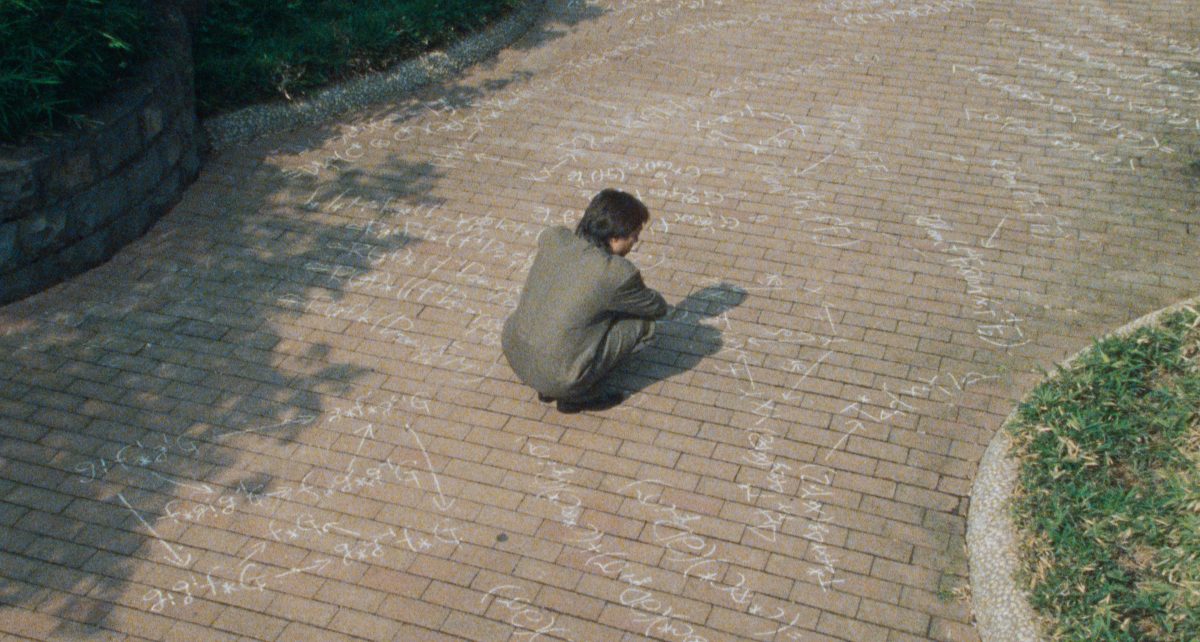
The following notes on Kiyoshi Kurosawa’s Serpent’s Path (1998) were written by Josh Martin, the Cinematheque’s project assistant and a PhD candidate in the Department of Communication Arts at UW-Madison. The 1998 version of Serpent’s Path screens at the Cinematheque on Saturday, September 5, 7 p.m., while Kurosawa’s 2024 version of Serpent’s Path has it’s Madison Premiere on Thursday, September 10. Both screenings begin at 7 p.m. at 4070 Vilas Halll, 821 University Avenue. Admission for both screenings is free!
By Josh Martin
Though consistently heralded for his prolific output over the last several decades, the late 1990s and early 2000s were a major breakout period – and an initial golden age – for Japanese filmmaker Kiyoshi Kurosawa. Established by his work in pinku (films focused on lurid sexual material) and V-Cinema (direct-to-video titles shot cheaply), Kurosawa expanded to an international critical and commercial audience shortly after the debut of his 1997 horror masterpiece Cure, which marked the director as one of contemporary Japanese cinema’s most important figures. The critic Jonathan Rosenbaum, writing of Cure, Serpent’s Path (1998), and its companion piece Eyes of the Spider (1998) upon an early Chicago retrospective for Kurosawa in 2001, makes note of this “belated international recognition” while simultaneously praising the director’s films as some of “the most inventive Japanese features [he had] seen in some time.” Newfound acclaim and reach also provided access to more resources: in a recent interview with The Film Stage, Kurosawa notes that Serpent’s Path was his “last film made in the V-Cinema format,” initiating the further expansion of his signature style seen in 1999’s Charisma (which played in Director’s Fortnight at the Cannes Film Festival) and 2001’s Pulse.
Written by Ringu (1998) screenwriter Hiroshi Takahashi, Serpent’s Path opens with two men, Miyashita (Teruyuki Kagawa) and Nijima (Shô Aikawa), driving down an empty city road as they discuss some vaguely ominous plan. At one point, Miyashita pulls out a camcorder, playing footage of a young girl; the next time we see him, he holds a gun in his hand, his visage overcome by a vacant expression. Soon, Nijima and Miyashita approach a house, where they proceed to abruptly kidnap a man named Ôtsuki (Yûrei Yanagi), who appears to be affiliated with the Yakuza. Taking him to a warehouse, the two men chain Ôtsuki to a wall, with Miyashita eventually wheeling out a television that plays the very same footage we saw in the car. Miyashita begins reading a report: “My daughter. Murdered. Miyashita Emi. Eight years old. The body was found in a field outside Hino, approximately a week after death.” As he continues, sinister musical notes entering the soundscape, Miyashita reads more about the terrible fate that befell his daughter, which includes genuinely stomach-churning descriptions of sexual abuse and torture.
Eventually, he accuses Ôtsuki of having killed his daughter: this is clearly only the beginning of a father’s bloody, torturous revenge on the man who wronged him. Yet for a viewer familiar with Kurosawa’s work, particularly his atmospheric supernatural horror films, it should come as no surprise that this is no simple tale of a thirst for vengeance quenched and satisfied. Even in the early goings, questions emerge. How exactly did Nijima, a math instructor, find himself mixed up in all of this? “What’s in this for you?” Miyashita asks as the conspiracy deepens. Might a flashback sequence that appears to depict Miyashita first meeting Nijima and his young star student have something to do with it? Is the truth of this grisly killing as simple as it first appears?
Rarely eschewing the brutality of its subject matter, Serpent’s Path is a film that faces head-on – and makes the audience complicit in – the nasty business that its characters initiate. During an early extended scene, Ôtsuki, chained to the wall, begs to use the bathroom, pleading that he is about to defecate himself. In a long take, Kurosawa’s camera holds on his cries, which go unacknowledged. Cutting to an extreme long shot, his camera tracks to find Miyashita, bundled in a blanket, quietly laughing at his victim’s pain. When Nijima returns to wash the filth off Ôtsuki with a pressure hose the next morning, Miyashita is again filled with uproarious glee. This plunge into depravity, both for the victims reduced to eating their meals off the mud-caked ground, and the men perpetrating this amoral violence, is viscerally repulsive and hard to shake, deliberately so. For his part, Miyashita behaves like a man possessed and hollowed out by what happened to his daughter, endlessly and robotically repeating the footage and police report to his captives.
However, what makes Serpent’s Path – and much of Kurosawa’s work writ large – so delightfully slippery is its delicate mixing of tones and moods. For viewers that encountered 2024’s digital world satire Cloud, Serpent’s Path ultimately serves as a notable antecedent for Kurosawa’s now-solidified brand of unexpected zaniness. In an interview with Kurosawa for InReview Online, critic Brandon Streussnig highlights the sneaky laughs found in the director’s work, asserting that “sitting in the absurdity of it all can lead to quite a bit of humor.” Kurosawa, for his part, describes it less as a calculated “balance” and more as a natural consequence of the filmmaking process. “Sometimes, after the film is made,” he claims, I realize that something’s funny and I’m surprised by that because it’s not intentional.”
Whether intentional or a happy accident, part of Serpent’s Path’s blackly comic streak comes from its snowball-like unfolding, the way that chains of events accumulate and turn preposterous (and preposterously violent). Nijima and Miyashita initially appear effective at pulling off their scheme, yet when Ôtsuki blames a different Yakuza, Hiyama (Shirô Shimomoto), for the death of Emi, our kidnappers prove far more hapless at making heads or tails of this expanded network of criminality. But even as Kurosawa doles out delirious, Looney Tunes-esque images of Nijima and Miyashita dragging a body bag down a golf course hillside, the film never loses sight of its existential gravity or its potent ambiguities. Far from a victim driven to madness by an isolated event of carnage, Miyashita himself is affiliated with the Yakuza, complicit in a system that inevitably produces unthinkable violence. By Serpent’s Path’s end, the film remains clouded by uncertainty, with Kurosawa and Takahashi refusing to absolve their characters – or the audience – of this moral murkiness.
Long underseen in comparison to his J-horror-adjacent landmarks, Serpent’s Path was recently restored and acquired for distribution by Janus Films in conjunction with Kurosawa’s 2024 featurette Chime. In an additional wrinkle, 1998’s Serpent’s Path returns to theaters on the heels of Kurosawa’s own recent remake of his earlier film, premiering in Madison next Thursday, September 10th, at the Cinematheque. In his aforementioned conversation with The Film Stage, Kurosawa acknowledges that “it was a very fun and precious experience” to be able to revisit and revise his own work. However, Kurosawa also notes that he feels a different type of connection to the remake, having co-written the film with the late journalist and critic Aurélien Ferenczi. “So, in some sense,” Kurosawa remarked, “I felt that the ’98 Serpent’s Path is, of course, my film, but at the same time, it feels like [Hiroshi Takahashi]’s film as well. And so in remaking the film, I felt that, ‘Oh, this might in fact be my film.’” Regardless of the contours of authorship at play, 1998’s Serpent’s Path remains an integral and distinctive chapter in Kurosawa’s oeuvre, an idiosyncratic revenge thriller that gazes upon a web of cruelty and offers no easy catharsis.