The following notes on Cry-Baby were written by Shannon Weidner, PhD candidate in the Department of Communication Arts at UW-Madison. A 35mm print of Cry-Baby will screen at the Cinematheque on Friday, September 25, 7 p.m. The Cinematheque’s regular venue is located at 4070 Vilas Hall, 821 University Ave. Admission is free!
By Shannon Weidner
Cry-Baby (1990), John Waters’ thirteenth feature film, opens with the upbeat croons of its titular song, the Honey Sisters’ “Cry Baby.” The saccharine and sunny doo-wop syllables could not be more at odds with the gloomy brick facade of Franklin High School, yet the harmonized cadence finds one or two kindred spirits in the theatrically contorted visages of high schoolers getting polio vaccines. Pulling back from the brave patients, the cartoonishly kinetic letters of the film’s title literally bounce into the frame suggesting that the bold, campy, and playful antics of the “Pope of Trash” are never far from the surface of this seemingly conventional teen comedy.
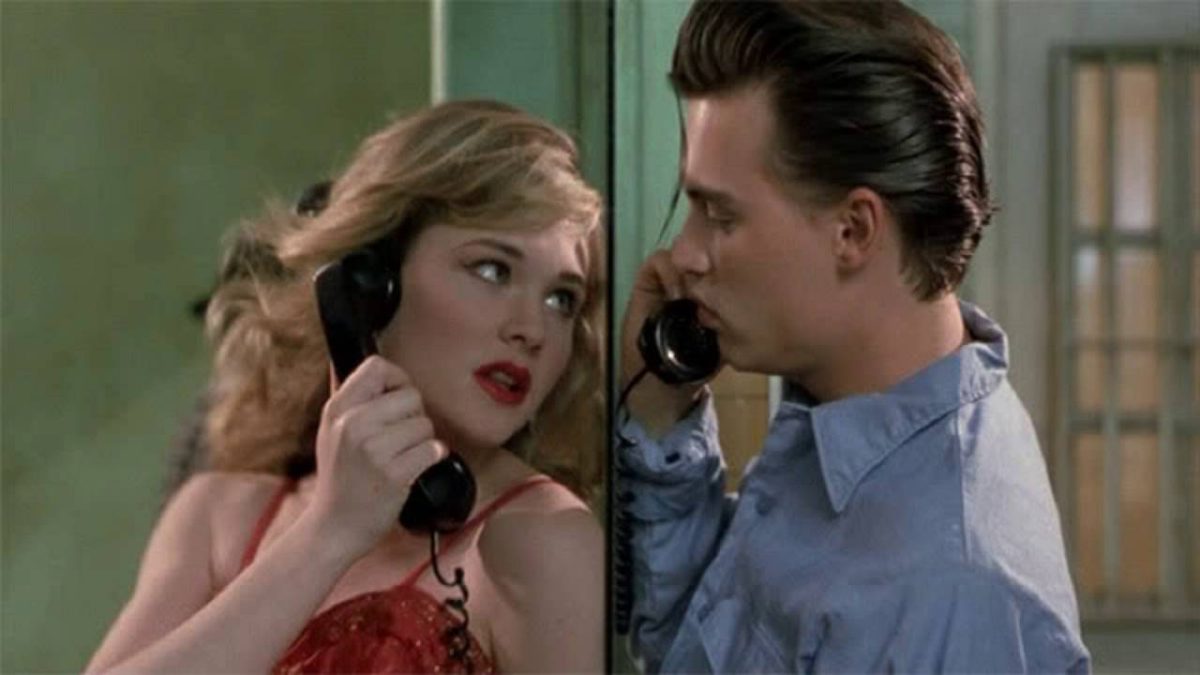
In line for vaccinations is the rest of the class of 1954, presented in equally goofy and raucous tableaux. Divided largely between the upper class “squares” and the working class “drapes,” the left line introduces us to popular “square” Allison (Amy Locane) and her beau, Baldwin (Stephen Mailer), as they breezily await the comically large polio needles. Simultaneously, visually striking “drape,” Mona “Hatchet-Face” Malnorowski (Kim McGuire) brandishes a switchblade on a group of harassers before locking lips with her lanky lover, Milton (Darren E. Burrows). Opposite Hatchet-Face, resident cool-girl Wanda Woodward works her carmine lips into a snarl at a nosy square before entrancing the male doctor administering her shot. Amidst these and other antics of the student body, all eyes turn to the center aisle as Wade “Cry-Baby” Walker (Johnny Depp) is strong-armed into the auditorium by a trio of burly student council representatives. Forced to the front at the same time, both Allison and Cry-Baby exchange shy glances before he sheds a single, gelatinous tear for the newly enamored protagonist.
Waters’ delightfully twisted tale of teenage romance was initially inspired by a local cold case: the grisly murder of a fourteen-year-old girl, Carolyn “Peaches” Wasilewski. The crime’s subsequent afterlife in Baltimore’s public memory provided the basis for Waters’ screenplay, as did Carolyn’s social identification as a “drapette,” a local term, according to Waters, used to refer to young people who wore loose, draped clothing. Such silhouettes, and the proclivities of those who wore them, were considered by the strait-laced, Eisenhower-era “squares” to be at odds with what Waters’ grandmother and Mrs. Vernon Williams (Polly Bergen) would refer to as the “four B’s:” beauty, brains, breeding, and bounty. Yearning to be a drape despite his parent’s distaste for the subculture, the director would return to his admiration of “the drapes” of his youth, along with the homoerotic, leather jacket-clad male models photographed by Bob Mizer, in developing and pitching the look and social complexities of Cry-Baby.
Fresh off the success of Hairspray (1988), the production of Cry-Baby presented a rare moment in Waters’ career in which his work became the subject of a studio bidding war. Ultimately backed by the pockets of Universal, Cry-Baby would become the director’s first major studio film and his most expensive to date, costing approximately $12 million—more than all of his previous projects combined. Filmed in Waters’ beloved Baltimore, production lasted fifty-nine days and was spread out over six locations in the greater Baltimore area, including Milford Mill Park and Swim Club, standing in for the Drapes’ home base, Turkey Point. The production, though largely well-remembered by cast members, was not without its problems. According to the film’s producer, Rachel Talalay, Waters’ catchphrase question during production — “What fresh hell is this?” — got much use thanks to the near-constant rain which besieged the shooting, among other difficulties. Casting trailers were often stuck in the mud, not unlike Babs Johnson’s trailer in Pink Flamingos (1972), while battles with the MPAA over getting the film to a contractually required PG-13 rating proved trying. Lastly, casting was not without its issues: actress Traci Lords, a former underage adult film star, allegedly used the film’s production as an opportunity to evade an ongoing FBI investigation on pornography charges, as noted in the film’s American Film Institute catalog listing.
Despite these challenges in production, Cry-Baby found strong success in its music and choreography. Relying on the combined expertise of music supervisors Becky Mancuso and Tim Sexton, composer Dave Alvin (of the Rockabilly group The Blasters), lip sync coach Ed Couppée, choreographer Lori Eastside, and with additional musical support from Waters himself, the film’s converging of 1950s R&B and pop worlds readily took shape. Mancuso and Sexton, experienced music supervisors at Imagine Entertainment, were hired to work on Cry-Baby particularly for Mancuso’s rich knowledge of 1950s pop and doo-wop hits, as well as her connections to artists and hitmakers of the era. These included legendary Blues and Rock and Roll Hall of Fame songwriter, Doc Pomus, who along with Alvin wrote the original song “King Cry Baby” for the film. Such songs were lip-synced by Johnny Depp and Amy Locane from the vocals of the credited singers, James Intveld and Rachel Sweet, respectively.
The film’s dance numbers required the precision and outside expertise of a professional who met Waters’ three loose criteria for a choreographer. The ideal candidate had to “have smoked cigarettes at least once in their life, been in jail, and had to be able to choreograph white people,” including the notoriously dance-averse Depp. According to a behind-the-scenes documentary, choreographer Lori Eastside satisfied all three requirements. During more intensive dance numbers like “Doin’ Time for Bein’ Young,” Eastside worked individually with background dancers, while also timing and rehearsing Depp’s cardboard box falls and water-hose spraying in the middle of the license plate factory floor, among other detailed dance moments.
Inspired by true crime, Waters’ adolescent memories, Mizer’s notable photography with the Athletic Model Guild, Elvis movies, the 1950s moral panic over juvenile delinquency, and set to a rich rock soundtrack, Cry-Baby’s spirited and gently unorthodox take on the conventional teen musical comedy has maintained a loyal coterie of fans since its 1990 release. Though criticized by some reviewers for lacking the same biting and brash subversiveness as the aptly named “Trash Trilogy,” Cry-Baby, like many of Waters’ films, has maintained a cult following in the years since its release, even getting its own stage musical treatment in 2008. While the director has since acknowledged “it isn’t that edgy a movie,” gratuitous sentimentality and playful edginess coexist in what remains one of the most accessible and wholly lively entry points into Waters’ transgressive oeuvre.