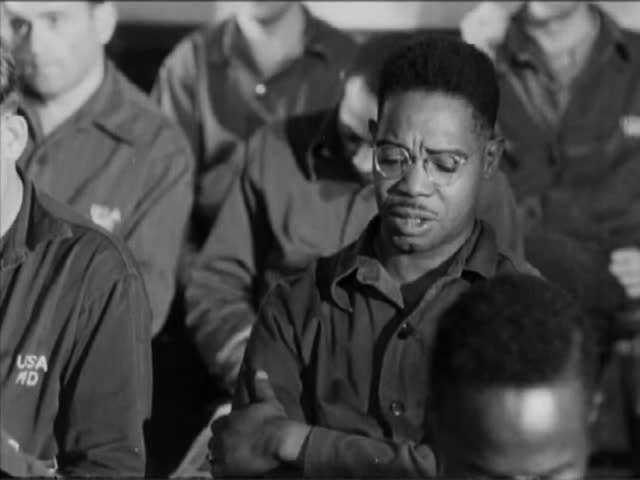
The following notes on John Huston’s Let There Be Light and Mark Robson’s Bright Victory were written by Garrett Strpko, PhD candidate in the Department of Communication Arts at UW-Madison. On Friday, November 6, Let There Be Light screens at the Cinematheque at 6 p.m., followed by a 35mm print of Bright Victory at 7:15 p.m. This program is presented in conjunction with the exhibition Craft/Work: A History of Occupational and Art Therapies, open in the Ebling Library Historical Reading Room from September 8 through December 17. Cinematheque screenings are at 4070 Vilas Hall, 821 University Avenue and admission to both screenings is free!
By Garrett Strpko
There is a still-persistent myth that after World War II, American culture, desperate to retain a sense of normalcy and preserve a ‘macho’ image of the American G.I., ignored or avoided discussions of trauma, war wounds, and the reintegration of servicemembers into peacetime society. In truth, however, as part of the popularization of Freudian psychoanalysis and the increased presence of the military in everyday American life, war trauma became a prominent topic in cultural discourse. A subtle anxiety made itself known among the American public on the eve of victory. Would the boys we sent ‘over there’ return their old selves? Would their training and experience in killing lead to an increase in violence here at home?
In response to these anxieties, the Army produced a series of three films on The Returning Soldier and the various forms he might come home in: one on the ‘average returnee,’ another on the physically wounded, and yet another on the category which, perhaps, most worried some: the psychologically wounded. This last film became John Huston’s Let There Be Light (1946), a movie of no small legend. Originally intended for (but soon kept from) commercial public distribution, the documentary follows a group of ‘neuropsychiatric’ servicemembers who are being treated for ‘combat fatigue’ or ‘battle neurosis.’ The condition is described by the film’s opening narration (provided by Huston’s father Walter) as one marked by “unceasing fear and apprehension, a sense of impending disaster, a feeling of hopelessness and utter isolation.” Often conflated with the modern psychological diagnosis of PTSD, cases of combat fatigue are marked by the presence of a distinct “breaking point” that has now landed these soldiers at Mason General Hospital.
Huston, fresh from filming combat documentaries in Alaska and Europe, worked with celebrated black-and-white cinematographer Stanley Cortez (1942’s The Magnificent Ambersons and 1955’s The Night of the Hunter) to film unstaged sequences of the soldiers receiving various kinds of therapeutic treatment. These include the soldiers relating their war traumas to psychiatrists, receiving experimental drug-based procedures (namely narcosynthesis, a hypnosis-based treatment involving pentothal, commonly known as ‘truth serum’), and group therapy where they discuss the issues facing their re-integration into civilian life. Huston’s bare, ‘fly-on-the-wall’ style of filming certain of these sequences, especially the soldiers’ harrowing recollections, fascinatingly presages the cinema verité/direct cinema movement of the 1960s, with Cortez’s lighting exemplifying the brilliant contrast that was his signature. The biblical connotations of the title play out through the seemingly miraculous transformation of these troubled men, many bearing worrying physical symptoms, back into contributing members of society. In a moment which echoes Jesus’ raising of Lazarus from the dead, a soldier with psychosomatic paralysis of his legs is given a single treatment of narcosynthesis and finds himself suddenly able to walk. Viewers should also notice that, despite the official policy of segregation in the military which persisted until after World War II, the hospital is desegregated, and the ward’s patients, both white and black, support and get to know each other in ways which rarely happened in other contexts.
Although many in the military were satisfied with the film in itself, its status as a piece for commercial distribution soon became controversial. Just as Huston was about to screen his own print at the Museum of Modern Art, military policemen arrived and confiscated the print on the grounds that the soldiers appearing in the film had not signed releases. Huston, ever the architect of his own mythos, contended that his film was actually removed from circulation to protect the military’s image, as if it showed something the powers-that-be did not want the public to see. A more charitable interpretation would be that the military perhaps was concerned about the ethical issues raised by commercial distribution of a film that shows these men at their most vulnerable (and, ultimately, without their express written consent) outside of more informed contexts.
Recent research by film scholar Noah Tsika has uncovered that far from being suppressed by the government, Let There Be Light enjoyed a fairly robust run in the nontheatrical 16mm market, where professional and civic groups interested in veterans, psychology, and war trauma were able to screen it all over the country upon request from the VA. It seems unlikely, then, that the film’s removal from commercial cinemas was because it challenged the government. After all, despite what Huston said, the movie hardly portrays the military in a poor light; it is Army doctors, nurses, and psychiatrists who are actively depicted as providing these men with thorough, miraculous treatment which allows them to return to civilian life unencumbered by trauma.
Documentary depictions of ‘real’ symptoms and treatment were nevertheless limited to nontheatrical markets. Commercial moviegoers instead gained an understanding of postwar military institutions of healing through Hollywood fiction films. One such film is Mark Robson’s Bright Victory (1951), which focuses not on neuropsychiatric patients, but soldiers who have lost their eyesight as a result of the war. Arthur Kennedy plays Larry, a soldier who is blinded by a German sniper in North Africa and sent to the states for rehabilitation to rejoin society with his disability. The film serves as a remarkable contrast to Let There Be Light. While we have a clear protagonist, there is a similar ensemble sensibility as we follow a group of patients as they navigate their treatment. It also thematizes the desegregation of military hospitals. Larry quickly becomes friends with a fellow southerner, Joe (James Edwards, who starred in the similarly themed Home of the Brave (1949), also directed by Robson). Although he harbors racist attitudes, he does not realize Joe is black. When he casually drops a racial slur in conversation, Joe and the rest of the motley crew are appalled, and Larry’s relationship with him sours. Cliché as it may be, Larry’s blindness, which he initially encountered as a curse, has opened him up to more accepting and thoughtful ways of being.
Ultimately, despite the reputation of Let There Be Light as the work of a brave auteur exposing the realities the military would rather be kept secret, Bright Victory offers a more open-ended view of the results of postwar medical treatment for soldiers. The former ends with the patients now returned to their healthy old selves, having done away with their tremors, stammers, and nightmares. They even play a baseball game to show off their recovery and suitability for their future lives. There is little suggestion that the trauma that was treated at Mason General will follow them the rest of their lives. Quite the opposite. For Larry, however, there are no such miracles. His journey is not to be cured of his blindness using cutting-edge procedures. It is to come to terms with his disability, to not only accept it but learn to thrive. When he returns home to Florida with the skills he’s learned, a local doctor attempts to tell him there “might still be hope,” and that “miracles happen.” Larry slams his fist on the table. He doesn’t believe in miracles. He doesn’t need to. The wounds will persist, but with the right community, he who has seen war can come to thrive in peace.