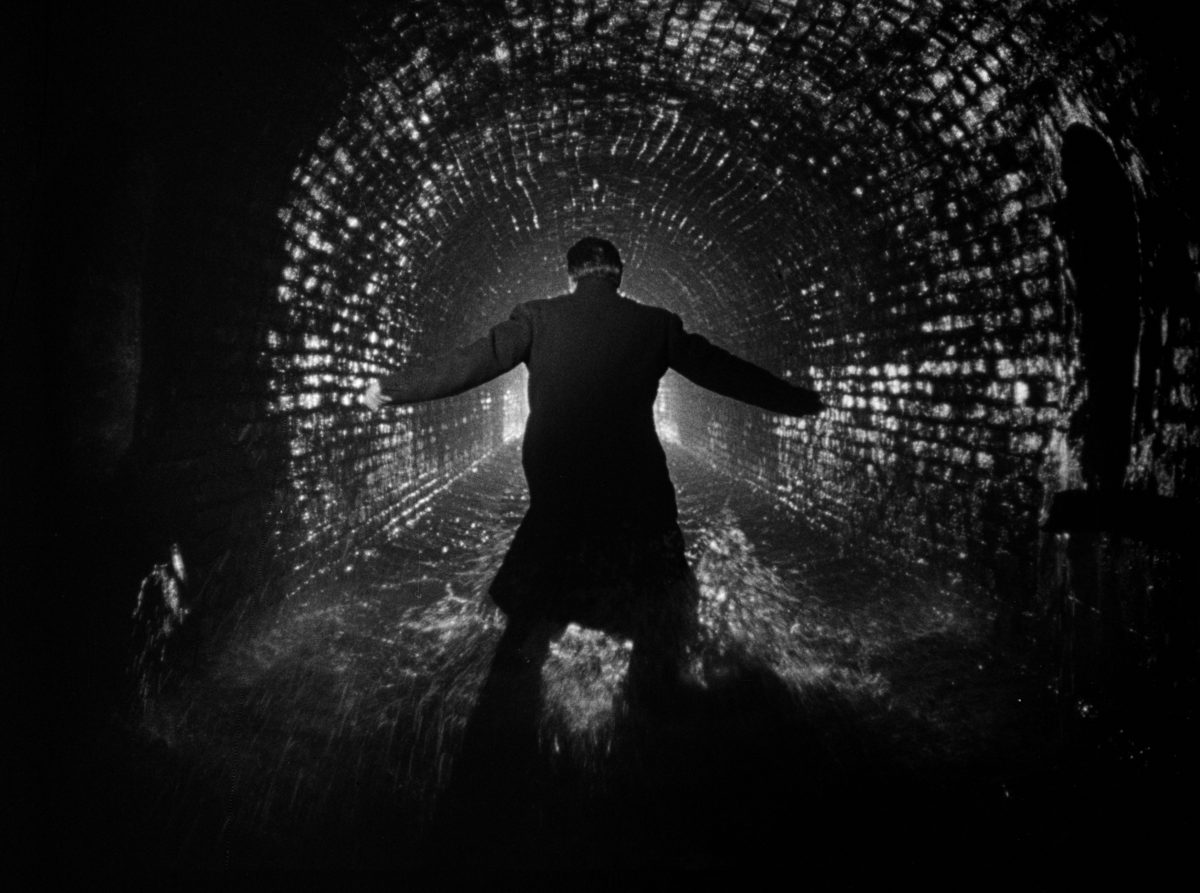
The following notes on The Third Man were written by Josh Martin, the Cinematheque’s project assistant and a PhD candidate in the Department of Communication Arts at UW–Madison. A recently struck 35mm print of The Third Man will screen at 7 p.m. on Saturday, September 26 in the Cinematheque’s regular venue, 4070 Vilas Hall, 821 University Ave.
By Josh Martin
In a film with no shortage of iconic moments, perhaps the most famous scene in Carol Reed’s landmark mystery The Third Man (1949) finds Holly Martins (Joseph Cotten) and Harry Lime (Orson Welles) meeting at a Ferris wheel. An American writer of “cheap novelettes,” mostly of the Western variety, Martins arrived in Vienna expecting to find work with Lime, only to discover that his old chum—initially presumed dead—is a conniving racketeer in the city’s black market, responsible for a scheme to dilute penicillin that has caught the attention of the police. As their paths finally converge in daylight at the Prater amusement park, Martins gets a chance to see his charismatic pal’s moral degradation up close. “Look down there,” Lime insists as they rotate in the sky above the city’s postwar rubble, the film then cutting to a high-angle, extreme long shot of the park, with several anonymous citizens milling about below. “Would you really feel any pity,” Harry asks, “if one of those… dots stopped moving forever? If I offered you 20,000 pounds for every dot that stopped, would you, really, old man, tell me to keep my money? Or would you calculate how many dots you could afford to spare? Free of income tax, old man—free of income tax.”
One of the greatest works of noir produced in the aftermath of World War II, The Third Man is a film that has been studied and praised for over 75 years, making it nearly impossible to reduce it to a single theme or idea. Yet at its core, Reed’s film is preoccupied with these matters of scale exemplified by Harry’s callous view from atop the Ferris wheel, disturbed by the way that life and death can start to feel meaningless and transactional at a time already clouded by violence of unfathomable, catastrophic proportions. What could one little dot possibly mean when untold millions perished in a devastating conflict initiated by the world’s most powerful men? When millions more died in concentration camps at the hands of a fascist regime? Harry’s musings are the observations of a man who has seen evil and decides he wants his cut of the action. “Nobody thinks in terms of human beings,” he claims to Holly, “Governments don’t, why should we? They talk about the people and the proletariat, I talk about the suckers and the mugs, it’s the same thing.”
While The Third Man is not explicitly a story about World War II or the Holocaust, the film’s production conditions—shot mostly on location in the streets of a Vienna still in ruins in late 1948—foreground the lasting effects of the devastation Europe felt throughout the 1930s and 40s. “I never knew the old Vienna before the war,” remarks Reed, as the film’s unseen narrator in his brief opening monologue, further reflecting that the “Strauss music, glamour, and easy charm” once associated with this old city are now long gone. In this Vienna, fragmented between several zones controlled by the victorious Allied forces, lawlessness now rules the day, much like the wild west in Martins’ novels. Replete with plentiful Dutch angles, turning each frame into a source of possible intrigue and danger, The Third Man presents a universe that has somehow spun off its axis, losing its visual and moral center. For all his cruelty, Harry Lime’s nihilism is merely a symptom of the destabilized time that our characters now find themselves in.
The Third Man was the second collaboration between director Reed, producer Alexander Korda, and acclaimed author-turned-screenwriter Graham Greene, who had successfully adapted his own short story for Reed’s The Fallen Idol in 1948, a film that ultimately earned both men Academy Award nominations. In a 1950 article written for the New York Times, Greene recounts that, for their follow-up effort, Korda wanted a story that would take place in occupied Vienna. For his part, Greene devised a hook for the film in the form of a single sentence: “I had paid my last farewell to Harry a week ago, when his coffin was lowered into the frozen February ground, so that it was with incredulity that I saw him pass by, without a sign of recognition, among the host of strangers in the Strand.” From this foundation, a logline that feels as much like the basis for a ghost story as it does a conspiracy thriller, Greene and Reed would go on to develop the film’s ultimate narrative together, with Hollywood tycoon David O. Selznick later joining Korda as a producer.
Considering Greene’s initial conceit—as well as the billing of wunderkind multi-hyphenate Orson Welles—it is not exactly giving the game away to note Lime’s eventual presence in the film. However, much of The Third Man consists of Martins’ search to understand the mysterious circumstances of Harry’s “death,” as well as the truth about whether his friend is the criminal he is made out to be by Major Calloway (Trevor Howard). Through the course of his detective work, Martins finds himself growing closer to Anna (Valli), Lime’s romantic partner, while also catching the attention of Lime’s colleagues, who are none too pleased to find the author poking around in their business. In a clever bit of reflexivity, Martins begins to treat the plot as the foundation for a new novel, much to the chagrin of Harry’s co-conspirators—and even Calloway. “This isn’t Santa Fe,” the Major scoffs, “I’m not a sheriff and you’re not a cowboy.”
Beyond its narrative intricacy, The Third Man endures in no small part due to the genius of its singular formal concoction, rarely directly emulated even as the film remains stylistically influential. Robert Krasker, who had previously worked with Reed on the James Mason thriller Odd Man Out, won an Oscar for his cinematography, with the film’s bevy of canted angles packing an even greater punch when paired with its high-contrast lighting, together bolstering the film’s ruinous, nocturnal atmosphere. Still, no formal flourish is as altogether remarkable as the score by Anton Karas, which would eventually become a best-selling musical record in the United Kingdom. Performed on the zither, the music, which begins in the opening credits and dominates the film’s soundscape, is profoundly unusual, almost alien in its playfulness yet nonetheless barely obscuring a more sinister anxiety. Put more succinctly, the music is “jaunty without joy,” as Roger Ebert describes it in his essay on the film. With Karas’ recordings guiding the action, the sense of sheer strangeness in The Third Man—the feeling that something is simply wrong—is magnified.
In his essay, Ebert likewise notes the film’s skepticism of Holly’s old-fashioned notions of heroism, “in the simplified good and evil of his Western novels.” Indeed, in that fateful conversation on the Ferris wheel, Harry pointedly tells Holly, “You and I aren’t heroes. The world doesn’t make any heroes outside of your stories.” As Lime is chased through the ruins from which his empire emerged during the film’s climax, Holly is dragged deep into the muck alongside him: playing the role of the noble cowboy comes at a cost. While the film refuses to ever placate Harry’s worldview, no triumph will come from vanquishing a single malevolent actor either. By The Third Man’s end, all that remains are lonely characters confronting the disturbing fallout of a rattled civilization with no heroes in sight, still violently fighting its way back from the brink of despair.