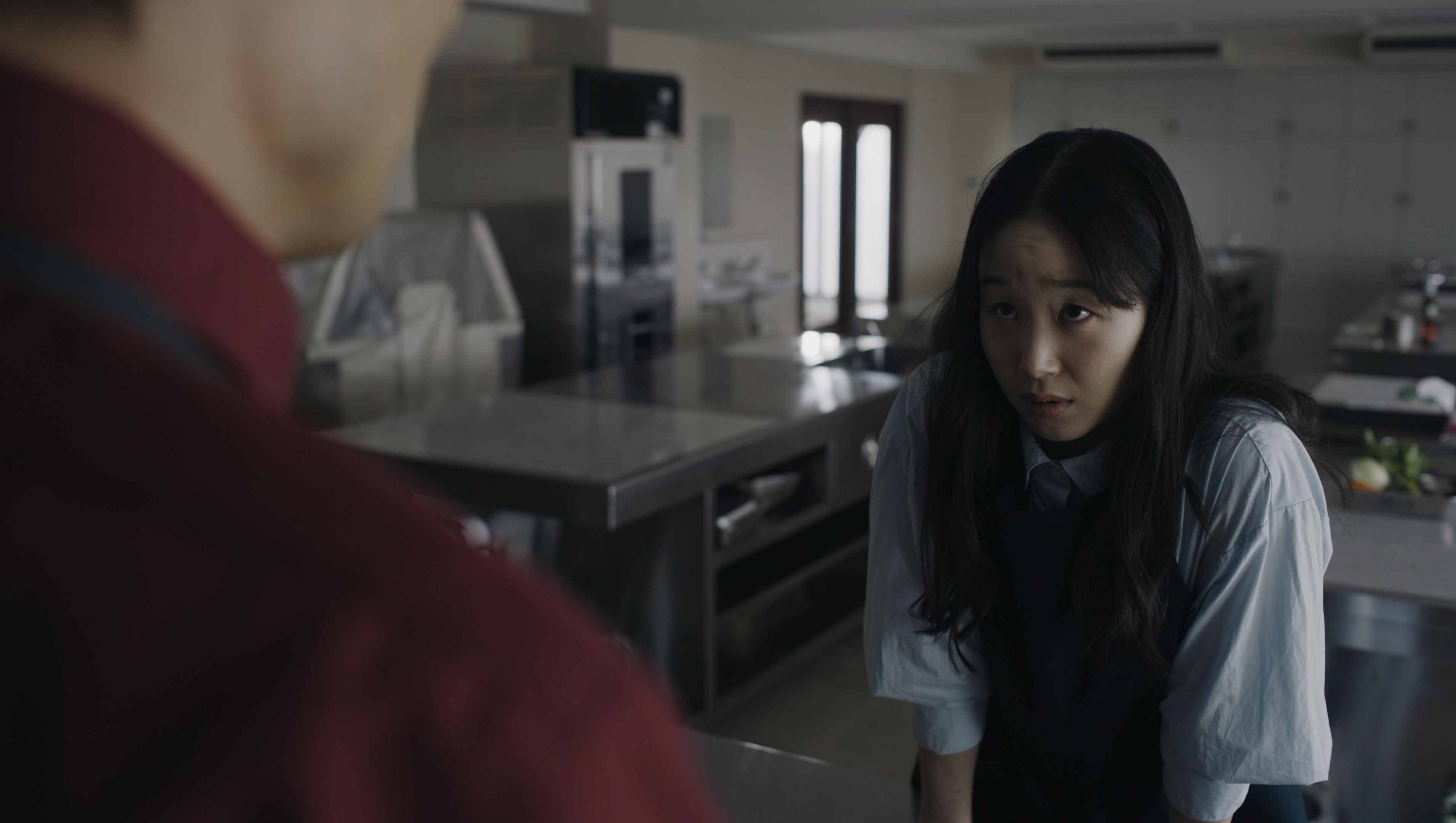
 The following notes on Chime were written by Josh Martin, the Cinematheque’s Bleak Week programmer and a PhD candidate in the Department of Communication Arts at UW – Madison. Kiyoshi Kurosawa’s Chime will screen at UW Cinematheque on Friday, June 26 at 7 p.m., followed by Kurosawa’s Cure, as part of our Bleak Week: Cinema of Despair series, presented in partnership with the American Cinematheque. Admission is free, and the UW Cinematheque is located at 4070 Vilas Hall, 821 University Ave.
By Josh Martin
With dozens of features to his name, Japanese director Kiyoshi Kurosawa has always been unusually prolific. Nonetheless, by debuting three films within the calendar year, 2024 marked an extraordinarily productive time for the filmmaker, one that saw a pronounced return to the themes, motifs, and disquieting atmospheres that powered his staggering run of success in the late 1990s and early 2000s. Still in search of broader distribution in the U.S., Serpent’s Path is a direct remake of Kurosawa’s 1998 revenge fable of the same name, this time a co-production between France and Japan with a multinational cast. The beneficiary of a splashy premiere at the 2024 Venice Film Festival, the comic thriller Cloud enjoyed a more successful stateside arthouse run in 2025, aided by a topical exploration of the dark side of online life, echoing the more overtly nightmarish engagement with turn-of-the-century Internet culture found in Kurosawa’s Pulse (2001).
Yet of Kurosawa’s 2024 films, Chime perhaps generated the most buzz—from those who were able to see it, that is. Chime began as an original short for Roadstead, a Japanese digital trading platform that entered the film production and distribution space in late 2022 (they also acquired the rights to Jean-Luc Godard’s final film, Scénarios). In a Screen International piece announcing the impending release of Chime, Roadstead is described as “a Web3-enabled platform, a decentralised form of the internet based on blockchain – the shared ledger systems used by cryptocurrencies such as Bitcoin.” As such, using this platform, viewers can purchase the film from Roadstead “but also sell it on or earn income by renting it out,” with “the rights fees… returned to the exhibitor from the takings.”
If you found the previous paragraph impossibly confusing, you are far from alone. Upon its initial release, cinephiles puzzled over how exactly to see the movie, confounded by the befuddling technological intricacies of crypto and NFTs (non-fungible tokens). Without using the Roadstead platform directly, there was no legal method to watching Kurosawa’s film—much less in a theater. Coinciding with this complex and unusual distribution situation, Chime was the recipient of significant critical enthusiasm. Writing for Film Comment, noted Kurosawa admirer Adam Nayman described the film as one of “deep, implacable horror,” impressive for how it “welcomes” a viewer’s own “interpretation” of its frightening events while offering little in the way of narrative stability. The Film Stage’s Rory O’Connor was similarly taken by the film, describing it as “the kind of fragmented nightmare you are grateful to wake up from but just as terrified to leave so unresolved.”
Perhaps bolstered by the success of Cloud and the rapturous response of critics, Chime is no longer locked behind a labyrinthine digital exchange: acquired by Janus Films for theatrical distribution in 2026, Kurosawa’s acclaimed featurette can now screen in cinemas around the U.S. For a film that plays with unnerving sounds and disturbing moods as effectively as Chime does, the theatrical experience proves most valuable. The film opens with a gray, monochrome cityscape, followed by a cut to a cavernous interior populated by the industrial noise of kitchen appliances. With Kurosawa’s fluid camera panning down and pushing into the space of a classroom, it is here that the film introduces Takuji Matsuoka (Mutsuo Yoshioka), a culinary instructor with ambitions of working as the head chef at a French restaurant. The classroom itself, which exists near a large intersection of railway tracks, is often rattled by the sounds and movements of rapidly passing trains, with streams of light slicing and fragmenting the space. Matsuoka’s lessons are attended by respectful, eager students, with the exception of one Ichiro Tashiro (Seiichi Kohinata). In an early shot, he stands apart from the group, an outsider staring ahead with blank eyes and a vacant look.
As the film progresses, Tashiro exudes an eerie sense of menace. “Can you hear it?” he asks Matsuoka, “That sound.” Yet no sound is audible—at least not to the viewer or Matsuoka at this time. Eventually, however, we do hear this sound. It does not carry the immediate terror that Tashiro describes: it is faint and mundane, like a doorbell that continues to vibrate, but it seems to have some effect on Matsuoka, who clearly senses its presence. “There’s a machine in my head,” Tashiro unnervingly states, “It’s there to control me. It responds to the chime.” Tashiro asserts that half of his brain has been “replaced,” that he is now evenly split between a rational mind and a more mechanical one, prone to actions of a more disturbed, irrational sort. When he picks up a kitchen knife, one senses that the irrational mind may be about to take over. To say more would risk giving away the plentiful surprises in store in Chime. But in their mutual recognition of this ominous chime, it is clear that, like Tashiro, some part of Matsuoka exists in the realm of the inexplicable and the irrational, beyond his own control. When an interviewer for a French bistro asks him why he contradicted himself in a previous conversation, Matsuoka pauses for a moment before remarking, “I don’t know what possessed me.”
What is astonishing about Chime is its concentrated exploration of the genres and subjects Kurosawa has explored throughout his career. Given the clear similarities in form and content, comparisons to Cure are inevitable—Nayman rightly describes it as a “spiritual sequel.” Kurosawa, for his part, invites the link: Mutsuoka’s purported possession is not far removed from the hypnotized victims in his 1997 landmark. In one of the film’s most astonishing scenes, Kurosawa depicts the messy aftermath of a vicious murder, an obvious allusion to Norman Bates’s meticulous cleansing of the evil deeds of “Mother” in Alfred Hitchcock’s Psycho (1960), another film about a man split between rationality and irrationality. Kurosawa, though, may be paying homage to himself as well as Hitchcock: as the blood-stained corpse lays visible in the center of the frame, the victim’s apron faintly forms the shape of a bloody X, the terrifying sign linked to the serial murders in Cure. Yet more than just a late-career return to art horror, Kurosawa’s status as a master of the family melodrama is also in play here, with shades of the director’s Tokyo Sonata (2008) emerging in the scenes focused on Matsuoka’s eerily placid home life, suggestively positing that something is festering in this icy domesticity.
As its critical boosters have noted, Chime is destined to leave one with more questions than answers, big and small. Why is Matsuoka’s wife feverishly leaving the dinner table to rummage through their recycling? Is all this horror stemming from some psychological impulse, a disaffection with the life of a teacher? The unknown proliferates in Chime, but what lingers is a sense of shared attunement between Matsuoka and the spectator, the ability to perceive these indecipherable sensations, encountering chilling sounds and uncanny images that produce some indescribable, terrifying effect on us. By Chime’s end, cinematic space has been entirely shattered and destabilized. Like Matsuoka, we are lost, left to accept our place in the realm of the irrational.