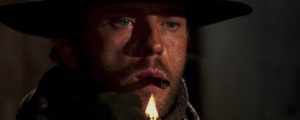
The following notes on The Great Silence were written by Garrett Strpko, PhD candidate in the Department of Communication Arts at UW – Madison. The Great Silence will screen at UW Cinematheque on Thursday, June 25 at 7 p.m. as part of our Bleak Week: Cinema of Despair series, presented in partnership with the American Cinematheque. Admission is free, and the UW Cinematheque is located at 4070 Vilas Hall, 821 University Ave.
By Garrett Strpko
Through the voice of Tinseltown agent Marvin Schwarz (played by Al Pacino) in Once Upon a Time in Hollywood (2019), Quentin Tarantino declared Sergio Corbucci the “second-best director of Spaghetti Westerns in the whole wide world,” after, of course, Sergio Leone. There can be little doubt that if the Italian filmmaker’s Django (1966) established such a reputation, The Great Silence (1968) cemented it.
Even among the many brutal Italian Westerns, The Great Silence is about as bleak as they come. The film trades the already-harsh scorched deserts familiar to the genre for rugged winter, with the Dolomites of northeastern Italy standing in rather convincingly for the snowy pine barrens of the Utah mountains. In this hellish blizzard-scape, the town of Snow Hill is ruled by the dubious ‘Justice of the Peace’ Henry Pollicut (Luigi Pistilli, a veteran of Italian Westerns), rather than the traditional forces of Law and Order. Having driven many into petty thievery to survive, the corrupt Pollicut uses the opportunity of the brutal winter to place bounties on the heads of the townspeople. These bounties are then collected by a ruthless gang of bounty killers led by Loco, played by the inimitable Klaus Kinski. Powerless to stop or avenge the killing, the desperate widow Pauline (Blaxploitation star Vonetta McGee, in her film debut) hires the eponymous mute hero Silence (Jean-Louis Trintignant) to help. Also arriving in Snow Hill is the slightly bumbling—but mostly competent—Gideon Burnett (Frank Wolff), a new sheriff who has been appointed by the Governor of Utah (Carlo D’Angelo) to regain control from the bounty killers.
While the arrival of a gunfighter would usually signal that things are looking up for the town of Snow Hill, the desolate winter atmosphere continues to permeate the situation with a sense of dread. The desert landscapes of your typical western may be harsh indeed, but the open expanse also signals freedom and opportunity. By contrast, the sea of pines continuously stretching up into the sky in the background of so many shots ensnares the characters, trapping them in the specter of death just as surely as Pollicut, Loco, and their gang have trapped the town of Snow Hill in their unstoppable string of murders. As much as the film’s title refers to its hero, the ‘great silence’ seems to also resonate with the bitter winds accompanying this atmosphere, the kind you hear after a hail of bullets—the sound of death. Indeed, Silence has earned his name not only because he is mute, but because, as Pauline says, “wherever he goes, the silence of death follows.”
The title role was the first and last of French actor Trintignant’s in an Italian Western. According to Corbucci, he was hired because he was presumed to speak English, a trait that was believed to increase American box office receipts. Trintignant did not. For this reason, Corbucci changed the character to be silent—quite literally. Combined with his vacant stare and pretty looks, Trintignant brings a softness to the usually rugged, sardonic heroes of the Italian Western. Unable to scare his opponents with a coolly delivered threat or to mutter a calloused remark after dispatching them, Silence projects a hardened, almost robotic exterior. As we learn, Silence is the victim of a childhood trauma which robbed him of his voice and, in so doing, transformed him into a silent avenger who cannot say no to someone in need. Compared to the theatrical meanness of Kinski’s Loco,
Trintignant conveys Silence with a minimalist but potent sense of deep pain and care beneath the mechanically ruthless surface. This robotic quality matches the unique weapon he carries: a new, German-made handgun that fires with each pull of the trigger, which he uses to shoot the thumbs off of his attackers, rendering them helpless to operate their old-style revolvers against him.
While Silence might engage in acts of spectacular violence in a manner similar to the typical anti-heroes of Italian Westerns, the softness behind those eyes betrays a strong sense of morality. Though the request for his aid does initially come with the offer of money, it is not long until he abandons the price in favor of doing what’s right. Yet it is also this deep moral sensibility which threatens Silence and his task. Like all great moral gunfighters, he can only draw once his opponent has. Loco, cool-headed as he is psychopathic, knows this, and refuses to draw first, testing Silence’s ethical boundaries and, eventually, setting him up for failure.
A moralistic crusader attempting to rescue poor, ordinary people from a corrupt and violent governmental institution imbues the film’s bleakness with discrete political overtones. In an interview with Film magazine not long after the film was released, Corbucci, aligned with the Italian political left, made the provocative proclamation that The Great Silence was dedicated to Che Guevara, Martin Luther King, Jr., and Robert F. Kennedy, three political figures who were assassinated for their respective causes during the film’s production. From Corbucci’s perspective, these very different leaders were each larger-than-life individuals, who, like Silence, dedicated themselves to justice for the needy above their personal desires or troubles—a dedication that nonetheless came at great cost, and not just to themselves. For the stoic hero of Corbucci’s grim Western, there is a similarly significant cost to his principles. The great silence must come for us all—even, it would seem, for Death himself.