The following notes on Le Bonheur were written by Pate Duncan, PhD student in the Department of Communication Arts at UW – Madison. Agnès Varda’s Le Bonheur will screen at UW Cinematheque on Sunday, June 28 at 5 p.m., as part of our Bleak Week: Cinema of Despair series, presented in partnership with the American Cinematheque. Admission is free, and the UW Cinematheque is located at 4070 Vilas Hall, 821 University Ave.
By Pate Duncan
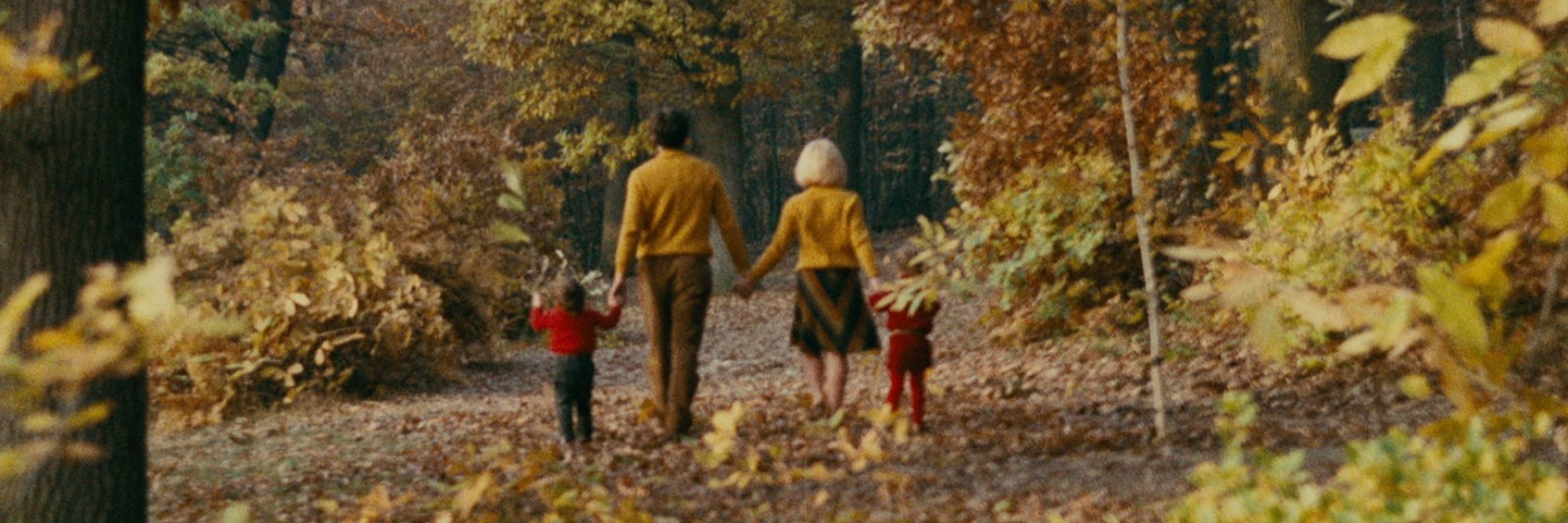
Agnès Varda has described her third feature film, 1965’s Le Bonheur (Happiness) as “a summer peach, with its perfect colors, and inside, there is a worm.” Varda, pithy as ever, presents a vivid image to describe this film’s overripe cynicism as well as its natural splendor: Varda wanted to spend more time outdoors while filming, so she wrote multiple picnics into the film. Boasting a soundtrack of Mozart, lush outdoor landscapes, and strikingly patterned stylistic flourishes on sumptuous Eastmancolor stock, Le Bonheur is a deceptively thorny work of nouvelle vague feminist politics and critique.
Le Bonheur follows the Chevalier family—François (Jean-Claude Drouot), his wife Thérèse (Jean-Claude’s actual wife, Claire), and their two young children (played by Jean-Claude and Claire’s actual children)—over the course of the patriarch’s budding affair with Émilie (Marie-France Boyer), a local postwoman. François treats this situation fairly lightly, viewing his affair with Émilie as purely a supplement to his wonderful home life with Thérèse and the kids. François’s optimism seems naive on the whole, and the film’s shocking finale casts some doubt on the possibility of his having it all. As the film unfolds, Varda’s style alternates between painterly landscape sequences and startlingly modernist games of form that contribute to a pervasive, bitter ironizing of François’ attitude.
Varda’s approach here was bold and controversial: why would a woman director in an historically male-dominated space have a protagonist like François? While the film received both Berlin’s Silver Bear award and the prestigious Prix Louis-Delluc, critics at the time were baffled by the film and often inattentive to its modernist form and ironic tone. Rebecca DeRoo summarizes this reception, saying that “Because Varda entered clichés of domesticity in order to challenge them, Le Bonheur has been dismissed as a product of the feminine culture it questioned.”
The film may also benefit from some contextualization of the role of women in films in and around the French New Wave: with some exceptions, the films of Jean-Luc Godard, François Truffaut, Éric Rohmer, Claude Chabrol, and other major figures in 1960s French cinema would often present the women in their films as inscrutable objects of romantic and sexual interest to the main lead. Films like Truffaut’s Jules and Jim (1962) or Godard’s Contempt (1963) tease out much of their dramatic conflict through the figure of a fickle, unreasonable, irrational central woman as a foil to her more straightforward male counterpart. Inasmuch as Varda’s film critiques the role of women in 1960s France, it also seems to be a more covert parody of the male characters in New Wave films: François’s naive optimism and superficiality seems to be a funhouse mirror of the attitudes of these male protagonists.
Varda will instead displace the modernist and existentialist inscrutability that so intrigued New Wave filmmakers elsewhere in the film. Rather than reducing it to an essentialized feminine psychology, Varda will embody it in her style more so than in her narrative, a process she called cinécriture (film-writing). The film features a variety of bizarre formal quirks, developing intrinsic norms that suggest a lapidary design and clockwork ordering only to shatter that patterning in disorienting ways. Varda will manipulate editing rhythms to staccato flashes, end sequences with fades to blocks of color that may or may not be extended into clothing and objects (before and after the fade), and vary the naturalistic landscape shots with frontal planimetric views, often situating nested frames of text or screens within the film frame itself. Varda, always eloquent about her own work, described a similar formal strategy in her film Vagabond (1985): “I enjoyed setting up a little enigma for which only I knew the secret.”
While this kind of patterning for its own sake is in part what gives the film its searing ironic distance from its central protagonist, Varda’s deliberate breaking of her own patterns seems to take us far from symbolism at every turn. Here, Varda’s playfulness is fully evident: in drawing our attention to the worm in this peach, Varda has distracted us from the fruit’s inedible pit, her arbitrary formal play that refuses to be reduced to narrative, theme, or tone, chasing after what the French literary theorist Roland Barthes described as an “exemption from meaning.” By doing so, Varda roughens her form to denaturalize both the plenitude of the film’s outdoor locales and the performances of gender at the film’s center. In the context of France still under the sway of structuralism, Varda’s questioning of the “natural” linkage of the terms “nature” and “woman” was a radical move.
This approach is in part what aligns Varda’s work with both her peers in the New Wave and with a slightly older generation of daring French filmmakers, Robert Bresson and Jacques Tati. While contemporary reception of the late Varda as the “grandmother” of the French New Wave rightly emphasizes Varda’s unwavering feminist politics, infectious humanist spirit, and playful self-presentation in her documentary work, popular approaches to Varda today often overlook Varda the high modernist. Varda scholar Kelley Conway notes how Varda took a gap year to hole up in a Parisian apartment reading modernist literature while later taking a strong interest in the history of painting, Bertolt Brecht’s modernist theatre, and photography, the latter becoming Varda’s initial home as an artist. In her early years as a filmmaker, Varda was enmeshed in a bustling cultural market of fellow film artists, aligned with the “Left Bank” group of New Wave filmmakers (Alain Resnais and Chris Marker, especially) while also chummy with the “Cahiers group” of filmmakers like Jean-Luc Godard, for whom Varda maintained deep creative admiration even as their personal relationship was rocky. While Varda has historically underplayed the extent of her cinephilia prior to making her first film, she was clearly a diligent student and master practitioner of the high modernist aesthetic programs that enriched midcentury French art, literature, and film.
Perhaps the most important of these connections, though, was that of Varda with her fellow filmmaker and husband, Jacques Demy. Known for his candy-colored musicals The Umbrellas of Cherbourg (1964) and The Young Girls of Rochefort (1967), Demy was the central figure in Varda’s life and late-career art. Varda and Demy remained together up through the late seventies when Demy— who, like Varda, was bisexual—separated from Varda for several years. They would reunite in the late 1980s when Demy was dying from complications from AIDS, and much of Varda’s career after her husband’s death was devoted to filmic memorials of his life and to the restoration and appreciation of Demy’s films.
It is tempting to retroactively read something of Varda’s nonnormative relationship with Demy onto the film’s somewhat pessimistic view of an open marriage. To give into such a temptation, though, seems as dangerous as the central temptation that the film dramatizes. Both Varda the feminist and Varda the modernist ask us to suspend our quest for allegory in Le Bonheur. Instead, our task as viewers is to enlarge our tolerance for ambiguity in both the cinema and in those whom we love most. That and, of course, to have more picnics.