The following notes on Carrie were written by Sarah Mae Fleming, PhD candidate in the Department of Communication Arts at UW-Madison. Carrie screens Saturday, October 31, 7 p.m. at the Cinematheque, 4070 Vilas Hall, 821 University Avenue. A 35mm print from the Wisconsin Center for Film and Theater Research will be screened. Admission is free! Happy Halloween!
By Sarah Mae Fleming
“I never got to like Carrie White,” author Stephen King admitted in his memoir On Writing, more than twenty-five years after Carrie, his 1974 debut novel, was published. Viewers of Brian De Palma’s 1976 adaptation have consistently expressed different feelings on the matter. Recent reviews for Carrie on the popular social media platform Letterboxd range from practical (“she did what she had to do”) to absolutist, with one poster arguing that Carrie“has done nothing wrong, ever, in her life.” The site’s most popular review for the film is also the pithiest, with the author writing simply: “Good for her.” Fifty years on, Carrie White is still hard to pin down. She is the film’s victim, the film’s monster, and for some, even its heroine.
In King’s novel, Carrie is a “frog among swans.” In fact, within the first 13 pages of the novel, Carrie is unflatteringly compared to an animal no less than eight times. She is a cruel, ugly girl, who grins madly as she destroys all those in her path with her newfound supernatural capabilities. In De Palma’s film, however, Carrie, performed spectacularly by Sissy Spacek, transforms into a complex object of desire, revulsion, and pity. Carrie tells the story of the eponymous high schooler, an unpopular girl who begins to develop telekinetic powers while living under the control of her religious fanatic mother, Margaret (Piper Laurie). Carrie’s rebellion against Margaret’s control coincides with the moment she thinks she is finally being let into ordinary teenage life. As such, the narrative culminates at the film’s infamous prom sequence, in which Carrie’s powers finally reach their full potential.
Encouraged by her husband, art director Jack Fisk (renowned for his collaborations with De Palma and Terrence Malick, among others), Spacek auditioned for the lead part. In a 1979 profile in Rolling Stone, Spacek explained that to embody the outcast nature of the character, she arrived at the audition with her hair slicked back with Vaseline, clad in an old sailor dress from grade school. Fisk recalls that De Palma’s initial original choice for the role portrayed Carrie “as someone you could hate. You could understand why everyone made fun of her. You didn’t really care about her much yourself.” On the other hand, Spacek performed the character with a hefty dose of empathy. As Fisk, perhaps a little biased, put it: “You could almost fall in love with Carrie White when she played her, and it made the film twice as effective.”
To feel some of Carrie’s isolation herself, Spacek kept apart from the rest of the cast for most of the production. The climax at the prom was one of the last sequences filmed, and only then did Spacek start to mix with everyone else, just as Carrie was finally letting her classmates in on screen. Every production detail of the prom sells the idea that this night might go well for her. For the big prom scene, Fisk had decorated the gym with inexpensive materials that high schoolers would reasonably have access to (crepe paper, tin foil, and cardboard), while still creating a dreamy, almost otherworldly, atmosphere. Costume designer Rosanna Norton made Carrie’s dress a simple 1930s-style bias cut, so it looked like something Carrie could have sewn herself, while the other girls wore fussy, ruffled prom dresses bought cheaply from a nearby bridal shop that was going out of business. Norton also changed the dress from its original red to pink, in order for Carrie’s pivotal moment to make a stark visual impact.
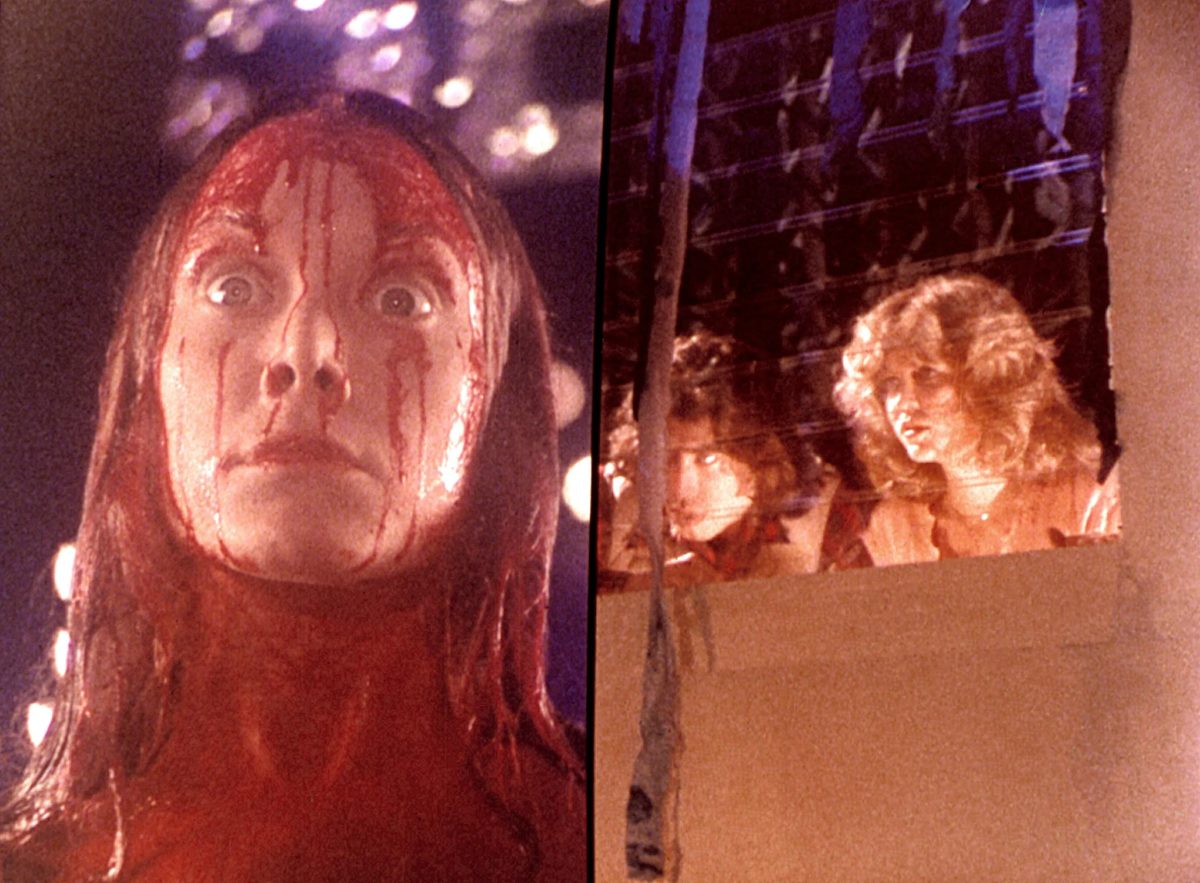
De Palma saved his most demanding camerawork for the prom, using it to bring us close to Carrie’s happiness, her downfall, and her revenge. The crew built a custom circular track for Carrie and Tommy’s (William Katt) dance—a delirious moment of pure bliss. The dolly circled opposite to the dancers while the lights above spun a third way, while De Palma continuously yelled “Faster!” Camera operator Joel King and cinematographer Mario Tosi both remember the crew collapsing in vertigo when the take ended. The acclaimed 2-minute crane shot, which, according to screenwriter Lawrence D. Cohen, contains the entire film in microcosm, took a full day of shooting to accomplish. In one graceful shot, a remarkable amount of narrative information is communicated to the audience. With essentially no dialogue, the long take shows the viewer the rigged prom king and queen vote, the conspirators in place, innocent Sue Snell (Amy Irving) slipping in backstage, and the bucket of blood waiting overhead. By the time Carrie is crowned, we know exactly what’s coming, but she doesn’t. After the blood falls, De Palma famously splits the screen, showing us Carrie on one side and the destruction she causes on the other, taking on the perspective of victim and monster simultaneously.
No one in Carrie, good or bad, fits neatly into a prescribed character type. Sue is the closest thing to a final girl: she means well, and she survives. But her good deed, asking her boyfriend Tommy to take Carrie to the prom, is what puts Carrie on that stage. Miss Collins (Betty Buckley), the gym teacher, is the one adult on Carrie’s side, but her attempt to lead Carrie into the sanctioned femininity embraced by her peers ultimately fails. Neither of them can save her. Cohen’s script initially had Carrie spare Collins by merely throwing her against a wall, but De Palma decided at the last minute to have a falling backboard nearly cut her in half. Like Hitchcock killing off Marion Crane in Psycho, that action takes away the character the audience might have leaned on. There is little doubt that Nancy Allen’s Chris is a straightforwardly vile character, but even the monstrous Margaret’s deeply unsettling worldview seems to be somewhat vindicated, as her daughter is indeed made to look a fool when she attempts to join her peers in secular life.
In the decades since the release of De Palma’s film, numerous filmmakers have returned to King’s original story and offered a fresh spin, with Mike Flanagan’s new series for Amazon Prime the latest attempt to bring Carrie back. In a story full of monsters, each adaptation still must ask: is Carrie one? In King’s novel, Carrie chooses her violence; in De Palma’s film, she loses control of it. But no matter the origin of this violence, once we start to count the bodies in the gymnasium, it becomes a little harder to say, “Good for her.” Yet despite the grisly evidence of Carrie’s revenge, one senses that this strong sympathy for Carrie does not entirely diminish for viewers. Indeed, the power of De Palma’s film rests in its remarkable ability to foster identification with our protagonist’s anguished pain—even as the blood-stained walls around her burn.