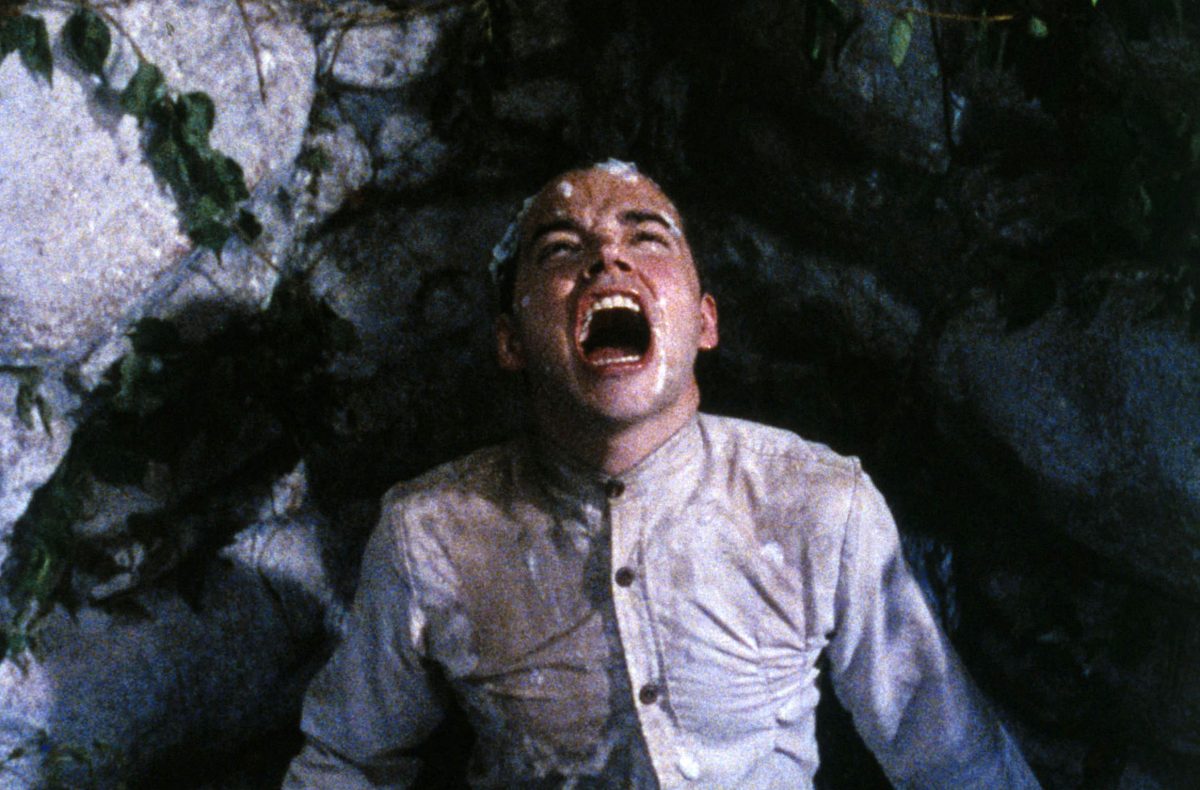
The following notes on Todd Haynes’s Poison were written by Pate Duncan, PhD candidate in the Department of Communication Arts at UW-Madison. A 35mm print of Poison, from the Zeitgeist Collection at the Wisconsin Center for Film and Theater Research, will screen at the Chazen Museum of Art on Sunday, September 27, 2 p.m. Admission is free and the Chazen is located at 750 University Ave.
By Pate Duncan
Well before his star-studded projects like 2015’s Carol or 2023’s May December, director Todd Haynes emerged with his feature film debut Poison (1991), an anthology of three distinct narratives and film aesthetics braided together. An early entry into the cycle of films now canonized as New Queer Cinema, Haynes’ audacious approach would prove characteristic of the transgressive, formally innovative period of queer indies to follow. “Horror” opens the film by aping B-movie aesthetics and introducing a tale about a dangerously overreaching scientist, “Hero” is a documentary pastiche about a young boy who kills his father and flies away, and “Homo” is a love letter to the queer underworlds vividly depicted in the writings of Jean Genet, centering on criminal and carceral environments that prove to be curious grounds for intense male obsessions. This early entry in Haynes’ career—nabbing the prestigious Grand Jury Prize at the Sundance Film Festival—would prove indicative of his unpredictable formal gambits and usher in the career of one of queer cinema’s greatest living auteurs.
At this point in the late 1980s and early 1990s, American independent cinema’s boom united new cultural markets of exhibition in film festivals with greater interest in low-to-mid-budget works that pushed aesthetic and political boundaries, with films like Jim Jarmusch’s Stranger Than Paradise (1984) and Steven Soderbergh’s sex, lies, and videotape (1989) standing out as influential landmarks of the era. At the same time, the queer cultural production that had blossomed in the post-Stonewall period—including the rise of gay “porno chic” auteurs like Wakefield Poole, Fred Halsted, and Tim Kincaid—grappled with the mass death and political firestorms of the North American AIDS crisis, leading queer activists and artists to create increasingly politicized and aesthetically striking works of queer cinema. Filmmakers and video artists like Gus Van Sant, Gregg Araki, Cheryl Dunye, Derek Jarman, Bruce LaBruce, Isaac Julien, Sally Potter, Terence Davies, John Greyson, Tom Kalin, Todd Verow, and Marlon Riggs held up the prominent North American and British delegation of this wave, though other European auteurs like Ulrike Ottinger and Pedro Almodóvar would also make important work in this same period. Encouraged by critics like B. Ruby Rich and the diverse reception contexts of both queer and independent film festivals, the milieu of the New Queer Cinema gave rise to a fertile cultural market for politically and aesthetically urgent queer cinema. It is in this context in which Haynes’ genre-crossing anthology film came into being.
Haynes came to filmmaking from his time studying semiotics at Brown University, and this academic pedigree would serve him well as a means of defamiliarizing against the low-cultural camp and kitsch forms that recur throughout his works. Poison comes on the heels of Haynes’ earlier unauthorized biopic Superstar: The Karen Carpenter Story (1987), a film made through stop-motion animation of Barbie dolls. Though feted as a cult classic now, its lack of authorization and use of licensed music has made the film still largely viewed only through bootleg dissemination. Despite its controversy, the film inaugurated Haynes’ career-spanning fascination with music as subject matter for his films, evident in his 1998 film Velvet Goldmine and its fusion of glam rock with Oscar Wilde’s queer dandyism, 2007’s I’m Not There and its bizarre approach to multiple actors cast as Bob Dylan, or his recent documentary The Velvet Underground (2021) and its loving imitation of 1960s avant-garde strategies.
While Poison is deprived some of this musicality, it lacks none of the referentiality that will run across Haynes’ entire career, linking him to his immediate predecessors and current peers in queer cinema. Central in this respect is the work of French writer Jean Genet, a figure achieving the gay equivalent of sainthood for his literary works like Our Lady of the Flowers (1943) and The Thief’s Journal (1949) and his influential short film Un chant d’amour (1950). Genet has remained something of a perennial influence for the queer artists to come after him: Our Lady would provide the stage name for John Waters muse and drag performer Divine, while queer cinema’s enfant terrible Rainer Werner Fassbinder would adapt Genet’s Querelle as his final film in 1982. Poison incorporates direct quotations from Genet’s work alongside some of its central thematic preoccupations, especially those regarding equations of criminality and violence with queer intimacy and a kind of Nietzschean transvaluation of sacred and profane elements. These elements color the “Homo” section as it traces its nonlinear narrative from schoolyard bullying to prison yard cruising.
Such citational maneuvers are not intended as an object of mere aesthete curiosity, however. Poison, like its siblings-in-arms in the New Queer Cinema canon, mobilizes this form towards a politicized representation of queer sexuality amidst the homophobia of the AIDS crisis. This comes about most explicitly in the film’s “Horror” sequence, which calls back to 1950s monster movies and their penchant for allegory during the Red Scare. Updating this strategy for the era of the AIDS epidemic in North America, Haynes concocts a mad scientist whose isolation of the sex drive in hormonal form unleashes an epidemic of sexuality, violence, and grotesque leper-like sores. Undercutting his kitsch somewhat by likewise pulling from higher-art sources, the delicious high-contrast black-and-white cinematography here recalls both the inky-black body horror of David Lynch’s Eraserhead (1977) and the claustrophobic corridors of Roman Polanski’s “apartment trilogy,” especially Repulsion (1965). Audiences expecting an on-the-nose allegory and positive representations of queer characters will be somewhat disappointed, though, as Haynes’ equivocation of sexuality and violence in this sequence bristles against somewhat more normative identity political activism of the time. In doing so, Haynes aligns his representations closer to both the earlier Genet and his New Queer Cinema peers, especially in the pessimistic queer couples who careen through Gregg Araki’s apocalyptic films of the same period.
The final section, “Hero,” is perhaps the one most indicative of Haynes’ delicacy in handling tone, making the words “kitsch” or “camp” feel far too blunt of instruments to describe what’s at work here. Featuring rough-and-ready 16mm color photography, voiceover narration, talking heads, and glaringly artificial dramatizations of events through rear projection and composite photography, Haynes establishes a clear favoring of the aesthetic than a kind of transparent reportage of reality. In focusing on the sleazy tabloid crime of a child killing his father, Haynes constructs a sympathetic image in how the film uses its talking heads against their purported subjects, avowing a kind of relativity of truth characteristic of 1990s postmodern culture and its political affiliates. The curious admixture of sympathy and awe that he develops here will be extended in the tonal ambiguities of Safe (1995), the Douglas Sirk pastiche of Far From Heaven (2002), and in May December’s hotdog-eating, lisping, dead-serious camp. More than the debuts of most auteurs of his time, Haynes’ Poison is a fully formed masterwork, providing a debut that presages an illustrious career in miniature while also immediately claiming a space in what would become the canon of New Queer Cinema.