The following notes on John Ford’s Young Mr. Lincoln were written by Garrett Strpko, PhD candidate in the Department of Communication Arts at UW–Madison. On Friday, April 24, the Cinematheque will present a 35mm print of Young Mr. Lincoln from the Chicago Film Society Collection at the University of Chicago Film Studies Center. The screening begins at 7 p.m. at 4070 Vilas Hall, 821 University Ave. Admission is free. Copies of Lea Jacobs’ book John Ford at Work will be on sale for $25 before and after the screening.
By Garret Strpko
John Ford’s Young Mr. Lincoln (1939) is perhaps one of the most ‘teachable’ films ever made. It encapsulates at once the style and themes typical of Ford as well as the broader political and aesthetic dimensions of classical Hollywood filmmaking. In academic film studies, it is best known as the subject of a groundbreaking analysis by the editors of the French cinema journal Cahiers du Cinema in 1970. This analysis was produced during a time of great sociopolitical shifts not only at the magazine, but in French society and the world abroad. Turning from the traditional stylistic, formal, and narrative criticism which had largely characterized the journal’s output to that point, the editors now attempted to consider cinema through a Marxist lens. They specifically sought to understand film as a political, ideological art form, one which reflected in concrete terms the political discourses of its time and place. As one of their inaugural films for explicating the goals and method of such studies in classical Hollywood cinema, they chose Young Mr. Lincoln.
It is easy to see why the critics were so enamored by approaching the film from this angle. Without giving a precise judgement on the ‘ideology’ of the picture, it becomes clear when watching just how remarkably it negotiates the contentious political discourses of its time to depict one of American history’s simultaneously most celebrated and most controversial figures. At stake in Young Mr. Lincoln is a production context which sought to organize the wandering, tangential facts of history into a unified story that American audiences—North and South—could appreciate.
The first of such decisions lies in the film’s truncating and rearranging the episodes of Lincoln’s life around which it centers. The movie is essentially a courtroom drama, depicting a fictionalized incident from Lincoln’s career as a lawyer in which he successfully defended one of his clients against great odds by referencing a farmer’s almanac. Despite what Young Mr. Lincoln would have you believe, however, this incident did not quite occur in Lincoln’s youth, but in fact mere months before he would ascend to the presidency.
Lincoln would first run for the state legislature while living in New Salem, Illinois in 1834. A year later, after a three-year courtship with the woman commonly understood to be his true love, Ann Rutledge dies in New Salem. In 1837, two years after Rutledge’s death, Lincoln was admitted to the bar, taking up a practice in Springfield. He would go on to marry Mary Todd, who had moved to Springfield to live with her sister Elizabeth and brother-in-law Ninian Edwards, five years later in 1842. It would not be until 1858 that Lincoln defended William “Duff” Armstrong on a murder charge, discrediting an eyewitness using evidence drawn from a Farmer’s Almanac, leading to his acquittal. That same year, Lincoln runs for the US Senate, a Republican against the incumbent, Stephen Douglas, a powerful Democrat from Illinois (in office 1847-1861). During the election, the two men conduct seven influential debates. Most importantly, Douglas favored and Lincoln opposed the extension of slavery to the new territories of the West. Lincoln loses the election, but the debates make his reputation nationally. The rise of Lincoln’s reputation leads to his 1860 run for the Presidency, in which he faces Douglas and wins, precipitating the Civil War.
Young Mr. Lincoln condenses all the listed events up to the 1858 Lincoln-Douglas debates, a span of nearly 25 years, into what appears to be only a handful of years. Nevertheless, one could argue the film depends on a general (though certainly not specific) knowledge of Lincoln’s life for several of its emotional and narrative lynchpins. Stephen A. Douglas appears as a character (played by Milburn Stone), chiefly functioning as a rival to the affections of Lincoln’s eventual spouse Mary Todd (Marjorie Weaver), who pines after Honest Abe. This romantic conflict stands in for the heated debates between the two politicians which would take place in 1858, which cemented Lincoln’s reputation in the nation. Indeed, Lincoln’s character feels almost haunted by a great, stormy future whose passing only the audience has full knowledge of.
Relatedly, one also observes (as the editors of Cahiers did) the film’s penchant for depicting Lincoln more as the Great Unifier rather than the Great Emancipator. Ford and screenwriter Lamar Trotti emphasize Lincoln’s Southern heritage. As he rides along meekly on his donkey (remind you of anyone?), he plays “Dixie” on a jaw harp. Later on, he voices his opposition to slavery, but not on strictly moral grounds. Rather, he notes that because of the influx of enslaved peoples into Kentucky, “white folks had a hard time makin’ a living.” Such baffling folksy remarks demonstrate the film’s commitment to making Lincoln a figure who could be celebrated even by white Southern audiences.
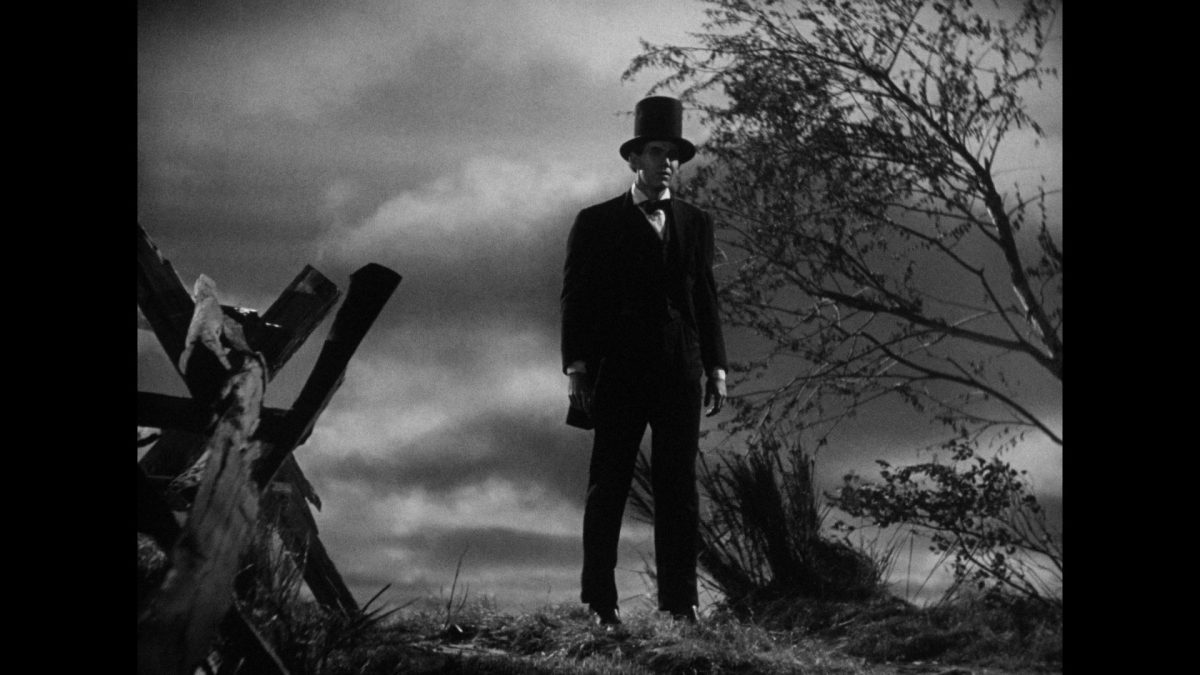
The charm we see in this strange mythic vision of Abraham Lincoln is provided largely by Henry Fonda’s understated, moving performance. With the addition of a prosthetic nose designed to make him look even more like the 16th president, Fonda strides about with lanky humility. His whole presence often exudes a calm comfort inhabiting the unassuming Lincoln, especially as he makes his way around the courtroom and appeals, with his downhome demeanor, to the jury. At times, too, Fonda rises to the masculine strength of the typical John Ford hero, such as in a sequence where he wins a rail-splitting contest—or another that sees him stand his ground against a would-be lynch mob. Fonda’s ability to balance a vision of Lincoln who is at once humble, calm, and even occasionally awkward while also bitingly witty, forthright, and sturdy is one of the film’s many accomplishments.
Though Young Mr. Lincoln portrays a somewhat historically and politically tangled vision of the youth of one of history’s greatest figures, this ultimately ends up serving the film rather than detracting from it. Amidst a rocky sea of such contested ideas, one finds a compelling vision of a simple person whose greatest achievements lie destined ahead of him, a remarkable piece of black-and-white cinematography, and a showcase of exciting performances (besides Fonda, look for Donald Meek as a dandy-ish prosecutor and Lincoln’s legal opponent, as well as Ward Bond as a smarmy criminal who becomes a key witness for the prosecution). In sum, Young Mr. Lincoln remains one of the most fascinating of Ford’s chronicles of American mythic history.