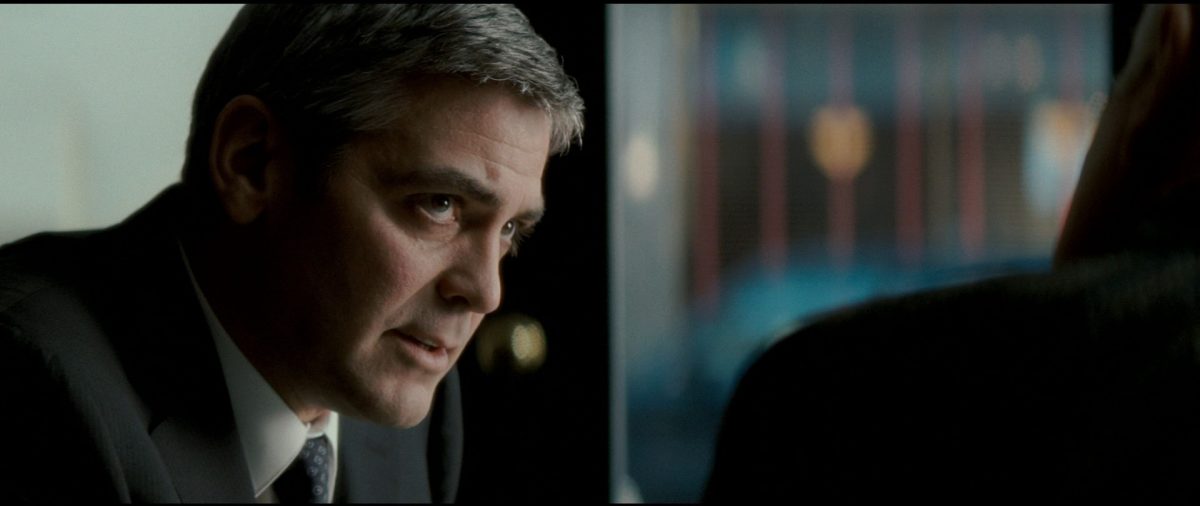
The following notes on Michael Clayton were co-written by Mattie Jacobs and Sarah Mae Fleming, PhD candidates in the Department of Communication Arts at UW – Madison. A 35mm print of Michael Clayton, from the collections of the Wisconsin Center for Film and Theater ResearchM, will screen at the Chazen Museum of Art on Sunday, April 26 at 2 p.m., part of our Sunday Cinematheque at the Chazen series. Admission is free and the Chazen is located at 750 University Ave.
By Mattie Jacobs and Sarah Mae Fleming
“Your options here are going to get smaller very quickly.”
A particular kind of American moral rot seemed to be on the minds of audiences in 2007. Alongside Paul Thomas Anderson’s There Will Be Blood and the Coen Brothers’ No Country for Old Men, Tony Gilroy’s Michael Clayton filled out the majority of the Best Picture nominees at the 2008 Academy Awards. While There Will Be Blood traces that rot to the extractive frontier of the Southern California oil boom, and No Country depicts that decay as an encroaching force overwhelming the vast plains of the American Southwest in the Reagan era, the evil at the center of Michael Clayton has an HR department. An updated legal thriller echoing classic Sidney Lumet films, Michael Clayton’s titular lawyer, a fixer at a very expensive law firm, is played by George Clooney. The story is told mainly in an extended flashback, as Clayton balances the stress of his profession, a large debt owed from a failed restaurant, demands from his son to connect over his fantasy book Realm+Conquest, and most pressingly, the manic episode in Milwaukee consuming his friend and ally at the firm, Arthur Edens (Tom Wilkinson).
This episode results from Arthur’s burgeoning moral compass, magnetically pulled by sixteen-year-old Anna (Merrit Weaver), who lost both of her parents to cancer caused by a weed killer produced by U-North. Clayton’s firm was in the process of defending U-North from a multi-million class action lawsuit as Arthur derailed the deposition, acting as the catalyst for Clayton’s involvement with the corporation and their general counsel, Karen Crowder (Tilda Swinton). In her review of the film, Manohla Dargis describes Karen as “Lady Macbeth in pumps and discreet pearls,” underscoring the film’s fusion of classical tragic archetypes with the sleek and corporate textures of millennium filmmaking. Indeed, Karen is wicked yet banal. Dressed in nondescript luxury, Karen practices smiling, speaking, and the motions necessary to come across as a human in the world, despite her willingness to destroy any living being in her path.
While Michael Clayton was his debut as a director, demons in tailored suits are a recurring concern for Gilroy, who says that he got the idea for Michael Clayton when he was doing research for the supernatural legal thriller The Devil’s Advocate (1997), which he co-wrote with Jonathan Lemkin. In that Keanu Reeves vehicle, the hellish corporate reality is made literal, with Al Pacino as the devil leading a white-shoe New York law firm. The question for Gilroy often seems to be: where does the rot reside? And once you see yourself rotting, how long can you keep looking away? Arthur, at the end of his tirade during the deposition, laments: “I had been coated in this patina of shit for the best part of my life. The scent of it and the stain of it, will in all likelihood take the rest of my life to undo.” Gilroy comes back to structures we see in Clayton repeatedly: the machinations of the corporate or government machine that seems beholden to no one and the men who both keep it running and throw a wrench in the gears. In a similar vein, Gilroy wrote the adapted screenplays for all three Jason Bourne films—The Bourne Identity (2002), The Bourne Supremacy (2004), and The Bourne Ultimatum (2007)—describing how secret units within larger organizations can push far beyond their legal and moral mandate to “get the job done.”
There’s no courtroom in Michael Clayton: here, the law is exercised in shareholder meetings, depositions, and corporate headquarters. However, the law is also practiced within living rooms late at night, through personal phone calls at secret poker games, and occasionally, in deserted alleys, while Arthur grips a bag of sixteen baguettes. Decisions are made based on favors, handshakes, and implicit promises decoded in hushed conversations. Yet these promises are easily broken once the legal machine moves again, stranding Clayton broke and unmoored, with the law firm for sale and his role as a fixer left outside the legible corporate structure.
The critical legacy of Michael Clayton seems to live in the reappraisal of the skill and power of its screenplay, named twentieth best of the century (so far) by The Writer’s Guild of America’s internal polling. The film forthrightly takes up the cultural concerns of 2007, including the complexity of the corporate public relations story up against a grassroots movement, the “lean-in” dynamics of the precariously anxious Karen, and the realities of how the “law occurs outside the courtroom.” Roxana Hadadi’s 2020 reconsideration of the film for RogerEbert.com points out how these topics thematically resonated across the next decade and a half. Hadadi notes that “At a time when human lives are regularly diminished for corporate gains, the ferocious anger of Michael Clayton—the power of one person taking a stand—feels like a miracle.”
Still, the film has an uneasy tension between moral crusade and corporate reality. The righteous crusader in the story is not the titular Clayton; instead, it is his boss, Arthur. And Arthur is mad. While Edens is situated as having come to a sudden enlightenment about his role as the primary legal mind defending—for over a decade—an Agribusiness covering up a massive environmental health scandal, this revelation comes in the midst of a manic episode. The revelation is real, the business is rotten, but Arthur’s near-divinely inspired conversion is a difficult frame on which to hang a moral message about the power of one man. Michael Clayton’s righteous anger, by contrast, is coupled with his existence as a man already comfortable in quasi-legal territory. If you hire a thief to rob a thief, you hire a lawyer to expose a lawyer.