The following notes on Stagecoach were written by Nick Sansone, PhD student in the Department of Communication Arts at UW – Madison. Stagecoach will screen in the Cinematheque’s “John Ford at Work” series at 7 p.m. on Friday, April 17, followed by a special discussion on the movie’s production by John Ford at Work author and Cinematheque co-founder, Professor Lea Jacobs. The screening takes place at the Cinematheque’s regular venue, 4070 Vilas Hall, 821 University Ave. Admission is free! Copies of John Ford at Work book will be available for the discounted price of $25.
By Nick Sansone
By the year 1939, John Ford had already been a working director in Hollywood for more than two decades, directing more than sixty silent films and successfully making the transition to sound, ultimately winning his first Best Director Oscar for 1935’s The Informer. And while Ford worked in a great variety of genres throughout these first two decades of his career, one of the genres he became most associated with during the silent era—the Western—had declined in popularity to such a point that Westerns were virtually not being made at all in Hollywood outside of the low-budget “Poverty Row” studios. As such, it was not until almost a decade after the transition to sound that Ford even attempted to return to the Western genre. This return to the genre was specifically prompted by Ernest Haycox’s short story “The Stage to Lordsburg,” which had been published in Collier’s magazine in 1937 and soon formed the basis for Stagecoach.
Ford purchased the film rights to Haycox’s story soon after it was first published in Collier’s and hired his longtime collaborator Dudley Nichols to write the screenplay. While Nichols had written screenplays for many of Ford’s sound films throughout the 1930s, the period at the end of the decade during which Nichols wrote Stagecoach was a particularly pivotal moment in Nichols’ public and professional life. In the years preceding Stagecoach, Nichols had become very visible within Hollywood as one of the founding members of the Screen Writers Guild and a fierce advocate for the union and organized labor in general. He even went so far as to refuse his Screenwriting Oscar for The Informer due to his commitment to strengthening the union in relation to the studios. At the same time, he was also very vocal and active in various social causes of the time, speaking out against Hitler’s actions in Nazi Germany and founding a committee to aid the Republican faction in the Spanish Civil War, all around the time that he was collaborating with Ford on Stagecoach.
As Charles J. Maland discusses in his writings on Nichols and his contributions to Stagecoach, the characters of Doc Boone (an Oscar-winning performance by Thomas Mitchell) and the banker Gatewood (Berton Churchill) were not part of Haycox’s “Stage to Lordsburg” story. Instead, these characters were invented for the film by Nichols, in a way that Maland argues “transformed Ernest Haycox’s short story into a Popular Front Western, one that drew on contemporary concerns and conflicts to energize the narrative from the point of view of a Popular Front liberal.” Specifically, Nichols used the characters of Gatewood, a greedy banker representing an archetypal capitalist villain, as well as Doc Boone, the drunk doctor who represents the lowly, marginalized Americans of the Depression era, to help make the classic Western narrative relevant and vital for contemporary times. Through the ways in which they interact with the other characters in the film who share their social classes—and more precisely how Doc and his lower-class compatriots (most significantly Claire Trevor’s Dallas, a prostitute literally ostracized by her town’s “Law and Order League,” and John Wayne’s Ringo, an escaped prisoner) form a sense of mutual support that Gatewood and the other upper-class passengers are exempt from—the screenplay for Stagecoach ultimately became one about class solidarity in the face of overwhelming chaos from the outside world.
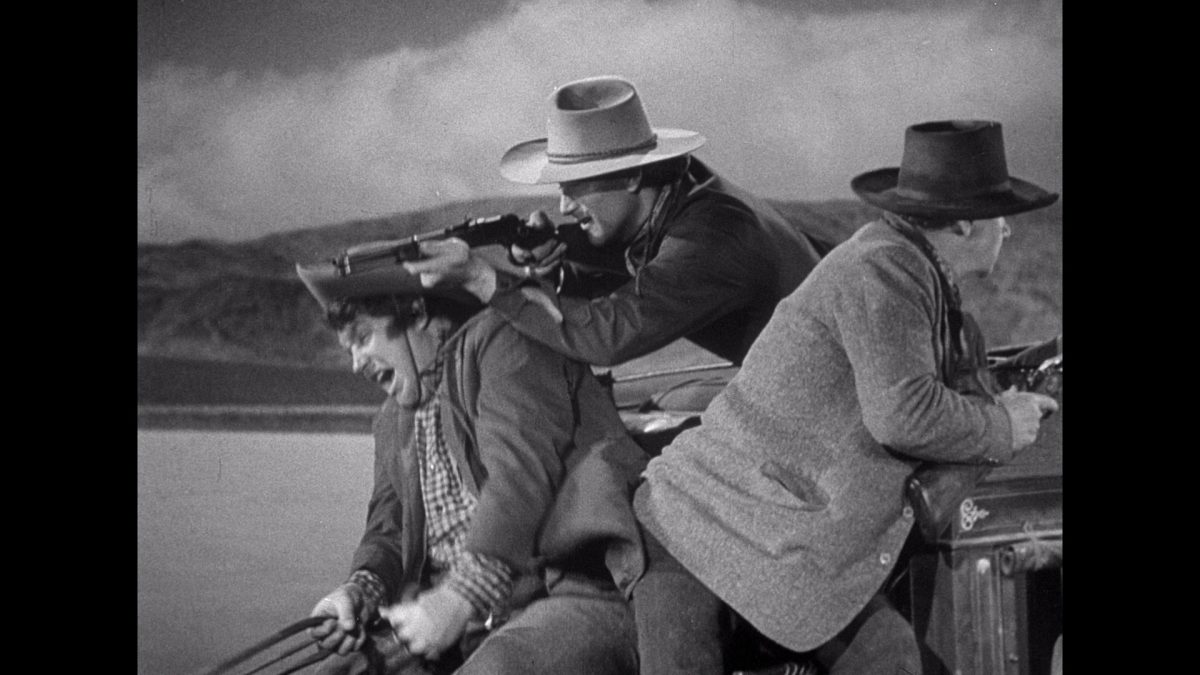
However, Nichols’ screenplay also functions as a quintessential example of the classical Hollywood narrative structure. Arriving in 1939, widely celebrated as the peak of the Hollywood’s Golden Age, Stagecoach presents, via an ensemble Western narrative where the characters are traveling, nearly a summation of the tight narrative structure that had defined that era of filmmaking. Starting with the archetypal characters all boarding the stagecoach by chance and establishing the central conflict of traveling through dangerous Apache territory (featuring the now-famous zoom-in introduction to John Wayne’s Ringo when the other stagecoach passengers first encounter him), the film continues through the various conflicts that arise between the passengers, ultimately culminating with a long chase scene that has influenced countless other chase scenes in Westerns and action films. Although the film’s stereotypical, antagonistic treatment of the Native American characters certainly marks it squarely within its time, its mastery of narrative structure and the classical Hollywood form within the Western genre has indeed allowed it to endure even in the vast oeuvre of Ford and Wayne’s collaborations.
Of course, in addition to Ford’s battle to even get Stagecoach made at a time when Westerns had greatly fallen out of favor, he also fought with the film’s eventual producer Walter Wanger regarding the casting of John Wayne, who was not a major star at the time, in one of the leading roles. Wanger wanted established star Gary Cooper, but Ford was so insistent on Wayne’s casting that they made a deal in which Claire Trevor received top billing over him. Ultimately, the film proved to be a tremendous success, turning a profit of almost $300,000 at the box office, receiving seven Academy Award nominations, and turning Wayne into an A-list actor almost instantly. While Ford would continue to rotate between a variety of different genres, Stagecoach reintroduced him to mainstream audiences as one of the Western genre’s best storytellers, setting the stage for him to eventually make My Darling Clementine (1946), The Searchers (1956), and The Man Who Shot Liberty Valance (1962) among others.
Stagecoach ultimately proved to be enormously influential almost immediately after it was released: Orson Welles, in preparation for making Citizen Kane (1941), claimed to have rewatched Stagecoach repeatedly, studying it as a textbook of filmmaking. Contemporary filmmakers Steven Spielberg and Quentin Tarantino, both of whom have repeatedly cited John Ford overall as a filmmaking hero (with Spielberg even depicting Ford as a character at the end of 2022’s The Fabelmans), have paid explicit homages to Stagecoach in films such as Raiders of the Lost Ark (1981) and The Hateful Eight (2015). Stagecoach itself was remade in color in 1966 as a neo-Western starring Ann-Margret and Bing Crosby, although it was not nearly the critical and commercial success the original was. Among its many imitators and loving homages, as long as Westerns and action films continue to be made, Stagecoach will continue to be viewed as perhaps the definitive source text from the classical Hollywood era.