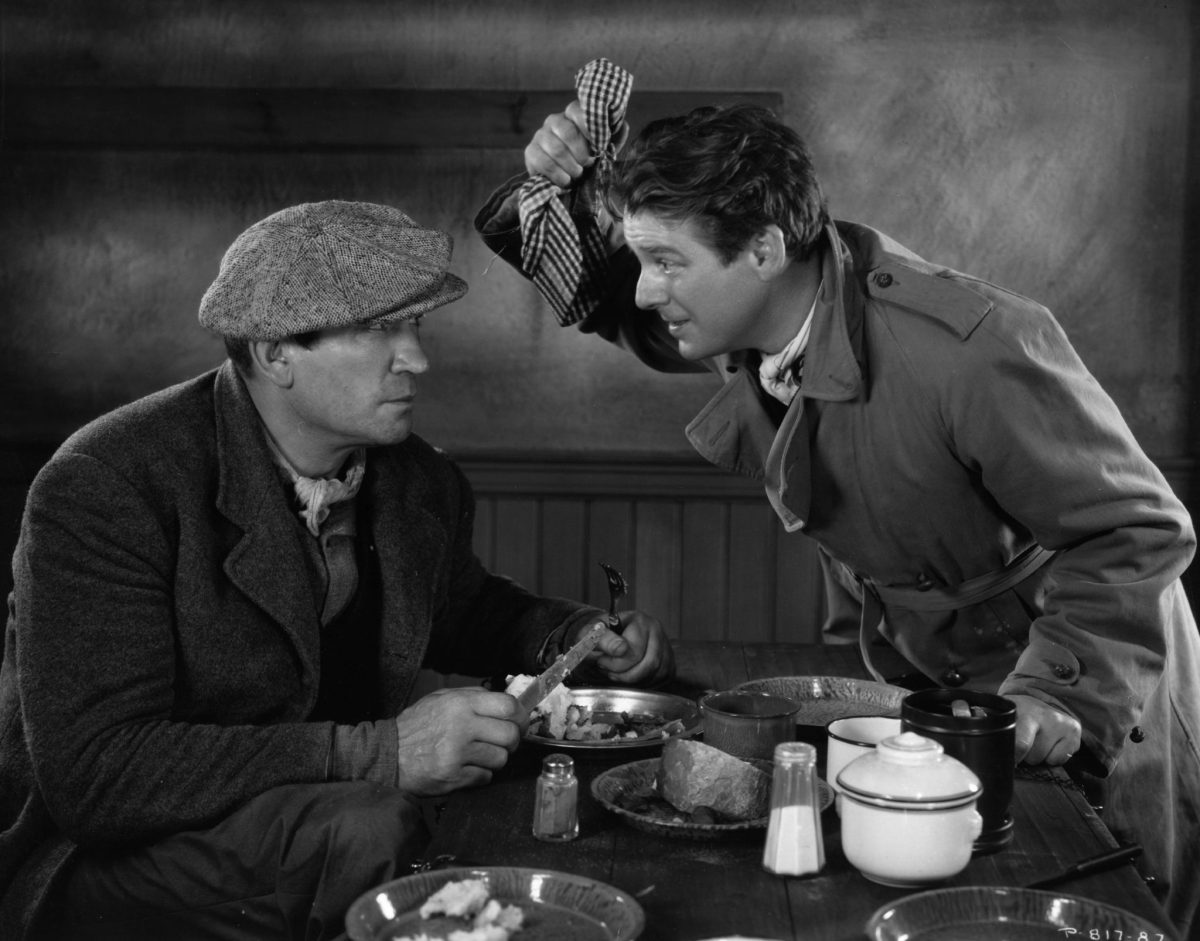
The following notes on John Ford’s The Informer were written by Mattie Jacobs, PhD candidate in the Department of Communication Arts at UW – Madison. A 35mm print of The Informer, courtesy UCLA Film & Television Archive, will be shown on Friday, March 13, 7 p.m., at 4070 Vilas Hall, 821 University Ave., the Cinematheque’s regular venue. The screening is the second in our “John Ford at Work” series and will be preceded by an introduction from John Ford at Work author Lea Jacobs.
By Mattie Jacobs
In his review for the New York Times, Andre Sennwald noted that John Ford’s The Informer (1935) is both a “striking psychological study of a gutter Judas and a rawly impressive picture of the Dublin underworld during the Black and Tan terror.” The picture is set in Dublin in 1922 against the backdrop of the Irish rebellion against British authority, leading to the creation of the Irish Free State. Victor McLaglen stars as Gypo Nolan, a former IRA (Irish Republican Army) soldier who betrays his best friend Frankie McPhillip (Wallace Ford) to the authorities for a £20 reward, aiming to obtain just enough money for passage to America for his girl Katie Fox (Margot Grahame) and himself. “Twenty pounds, and the world is ours,” she says.
Though he is, as described in a Variety review, “a huge ox of a peasant,” Gypo is more complicated than he might appear, quietly soft at heart and not particularly good at the real violence required of a revolutionary. He has been kicked out of the brotherhood of the IRA for not following orders to kill a Black and Tan who has killed a fellow IRA man. His Judas-like betrayal seems somehow part of his own bad fate, a decision made in spite after Katie’s taunting him for his poverty and inability to support them to get out of Ireland. He proceeds in fascinated horror at his own actions, seemingly not believing what he’s done even after he does it, a fool subject to his own blundering responses to circumstances outside his control.
The story was adapted by Dudley Nichols from the 1925 Liam O’Flaherty novel of the same name. The novel, however, is set in 1922-1923, the Irish Civil war raging and Gypo a member of an international “organization” of revolutionaries. The novel is much more pessimistic in its treatment both of revolution and of Irish politics, the “green on green” violence tearing the Free State apart after independence. The themes of communism and the multiple prostitute characters in the novel had to be excised for the screen, with characters further changed to be suited to Hollywood taste. Lea Jacobs notes that a reviewer at RKO suggested that “there’s not a single character in O’Flaherty’s book capable of arousing any element of admiration or sympathy.” In contrast, Ford’s Gypo can lay claim to both in equal measure, along with pity.
Adapting O’Flaherty’s work to the screen proved to be tricky, in part because of questions regarding how to handle the political background. That same reviewer expected an adaptation of the book to be highly offensive to any Irish or Irish-American sympathetic to the Sinn Fein movement and the Irish Free state. The setting of the “strife-torn” Dublin of 1922 allowed Nichols and Ford to avoid the Irish Civil War that would come the year after and to instead look back, almost romantically, at the dreams of revolution. The IRA of The Informer is more of a brotherhood than a radical terrorist group, a background social reality and structuring force—for Gypo especially. Gypo is clearly an IRA member—contemporary reviews refer to him as such—but the film never uses those words. In the first adaptation of the novel, a British 1929 part-talkie of the same name directed by Arthur Robinson, they are referred to simply as an organization. The setting of 1922 allowed a story with a clearer IRA, supported by the entire population with less concern about what would come the next year.
The Black and Tans are handled more directly. They were a group of nearly 10,000 paramilitary British recruits, from former criminals to World War Veterans, enlisted by the British government to aid the Royal Irish Constabulary and put down the IRA rebellion. They were known for their extreme cruelty to IRA soldiers and Irish citizens alike, often not trying to distinguish between the two. The film is clear on the level of hatred between the group and the Irish population: Black and Tan soldiers harass a street singer who then snubs their payment in return, and they prove to be Frankie’s eventual end after Gypo’s betrayal. For The Plough and the Stars (1937), Ford claimed to have cast former Black and Tan soldiers to add to the authenticity, “[i]t adds to the sincerity because in the mass demonstration scenes they remember their own experiences and have real tears in their eyes.”
By softening the IRA themes, shifting the focus to Gypo’s subjectivity, and reconfiguring Katie from a prostitute to a desperate woman forced into a bad situation, the film was successfully produced for the screen, allowing critics to focus on the complexity of McLaglen’s portrayal and the movie’s achievements in foggy, beautiful lighting. These changes, however, didn’t help some censors. The film’s background of Irish politics and terror proved a much stickier subject geographically closer to its setting. Those scenes of the Black and Tan Terror, so effective in their cruelty, were removed by British censors, along with any even veiled mention of the Irish Republican Army and most of violence. In sum, these censors made 129 cuts from the film. While it’s not surprising that British censors took issue with the depiction of recent history, Irish censors were barely warmer to the film. The film was rejected by the board, a censor calling it “a sordid and brutal libel” with concern that “the issue of a certificate by the censorship board could be used as an advertisement of the Free State’s approval of the truth of the picture.” The truth of the revolution and its evolution into the civil war and the split country were difficult to juggle for the still young government, though the film was finally released without cuts after an appeals board overturned the decision.
During Gypo’s first meeting with Katie, as he throws a man soliciting her into the street, she points out his own internal strife, his high principles and inability to meet them. “Saint Gypo!” Katie exclaims after he insults her for being a streetwalker, “you’re no better than any other man!” And Gypo proves this true, capable of friendship and betrayal, both generous yet judgmental, cruel and innocent. As their fight ends, she shouts back to him, “go along with your fine principals, I can’t afford them!” Through these lines, The Informer points both toward the Civil War to come and the desperate position of the Irish public in the face of British occupation and cruelty, desperate for a way out.