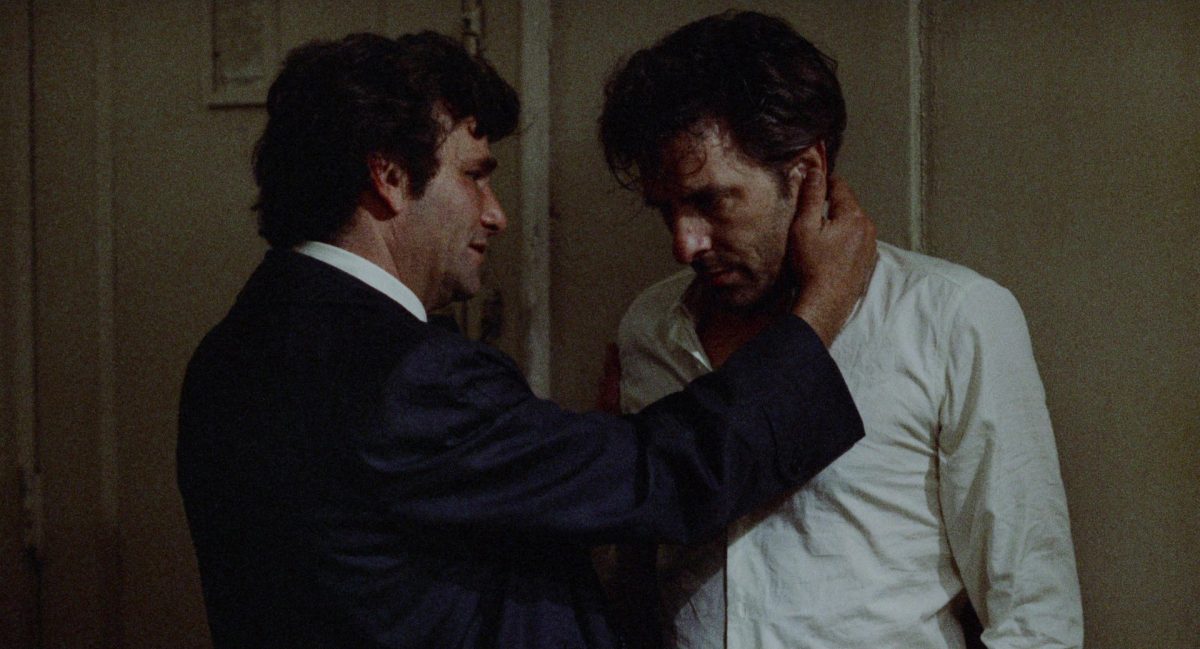
The following notes on Elaine May’s Mikey and Nicky were written by Mattie Jacobs, PhD candidate in the Department of Communication Arts at UW-Madison. A recently restored DCP of Mikey and Nicky will screen at the Cinematheque on Friday, October 2 at 7 p.m. The location is 4070 Vilas Hall, 821 University Ave. and the showtime is 7 p.m.
By Mattie Jacobs
In 1970, six years before Mikey and Nicky’s initial release, Elaine May asked Peter Falk to meet John Cassavetes and sell him on co-starring with Falk as the title characters, but Cassavetes didn’t need any convincing. “You think I care about if it will be successful?” Cassavetes asked Falk, “Are you going to be in it? Did she write it? Is she going to direct it? What else do I have to know?”
In many ways, Mikey and Nicky was developed in one Hollywood era and released into another. While Hollywood has almost always claimed to be in crisis, the early 1970s probably hold the best claim for a make-or-break moment for the business. 1971 saw the all-time low for American weekly movie theater attendance, the low point in a slide lasting two decades, and studio heads were searching for what could engage audiences again. For the next few years, the solution was edgier or teenage-targeted successes, like George Lucas’ American Graffiti (1973), as well as artistic films that would appeal to the counter-cultural adults of the late 1960s, like Francis Coppola’s The Conversation (1974). But by 1975, demographic changes meant that film audiences started to skew younger, and the sudden success of Jaws and the blockbuster format turned studios back into money-making machines reliant on a wholly different formula. An edgy, performance driven, art-house oriented movie for sophisticated adults like Mikey and Nicky was inherently in a difficult financial position.
This would have been true even if the production of May’s third feature film was free of problems; it was, unfortunately, anything but a breeze. May first secured funding at United Artists before it fell through. Later, a second producer, Palomar Pictures, and the distributor, Twentieth-Century Fox, each backed out as the film went over budget in the planning stage, even with May’s guarantees that she would make up the difference. Based on the critical and limited financial success of her debut, 1971’s A New Leaf, Paramount gave May the green light to direct the script she wrote for the film, though at a budget of only $1.8 million. Todd Berliner’s recent account of this film’s production, Hollywood Renegade: Mikey and Nicky and the Making of a Masterpiece, suggests that May’s fame as a 1960s comedy icon (noted for her popular partnership with fellow director Mike Nichols) and her new status as a female director/writer/star had been regarded by Paramount as assets for marketing of A New Leaf. Though that production had been near-disastrous, Berliner notes that “the studio boasted to the press ‘with self-congratulatory glee at its good fortune that a woman has assumed such a triple-threat role’ for the first time [in] a Hollywood production.” Mikey and Nicky would then be funded and produced from a script that May had been writing for twenty years, with Falk and Cassavetes already cast in the titular roles. This time, Paramount believed they had covered their bases in financing the film, providing clauses in the director’s agreement that May pay anything that went over budget from her salary and giving themselves the right to take control of the film altogether if she went more than 15% over.
The film’s final $4.3 million budget was 140% over. May spent 110 days shooting only at night, letting the camera roll on Falk and Cassavetes ad-libbing, going in and out of character, exploring actual Philadelphia locations, as well as Los Angeles-as-Philly. The only consistency between the two actors was “not sticking to the script,” says cinematographer Victor J. Kemper, “they ad-libbed everywhere, all the time.” The characters developed through the actors’ understanding of the complexities of their relationship to one another. While Mikey and Nicky are both gangsters—or “illegitimate entrepreneurs,” in May’s words—they’re neither classic film mafiosi nor low-level street thugs. Falk attempted to describe how the audience might respond to these anti-heroes: “I don’t know how they’re going to react to a gangster who is not very effective in his job.”
The setup is simple: Cassavetes’s Nicky is hiding because there is a contract out for him after stealing from his boss, so he calls his childhood friend Mikey (Falk) to help him get out of Philadelphia. We follow them through the night. In the hands of these actors, the gangsters become full-fledged characters; Falk’s Mikey is reachable, almost understandable, Cassavetes’ Nicky is a charming, paranoid, inaccessible solipsist. Falk shrewdly summarized the latter character’s ethos: “The trouble with Nicky is that he can’t sustain any kind of loyalty to anyone. I don’t think he’d take your whole wallet, but he’d reach in there and take eight dollars. And then he’d convince you he really needed it.” The two talk and argue around town, sometimes fighting, careening from the bar to Nicky’s girlfriend’s apartment to the cemetery to see his mother’s grave, where they rehash their past fights. Every take was ten minutes, each full 35mm reel running beginning to end, capturing everything that either actor could bring to the story. What was captured was 1.5 million feet of two of the most incredible performances of two of the most difficult characters ever created.
Two and a half years after the film was supposed to be delivered, Paramount head Barry Diller demanded to see the movie. May suggested that he come by at 4 p.m. to see the finished cut, but Diller rescheduled and arrived at 10 a.m. instead. They proceeded to project the first—finished—reel of the film, but from the second reel onwards, the film was silent: no dialogue, sound, or sound effects. To give an idea of what she would have finished in the next six hours, May acted out the dialogue, hummed the music, and improvised sound effects on the spot, the movie alternating sound and May-improv for ten more reels. While Diller, against all odds, liked the movie, Paramount still decided to axe her final cut privilege and take the reels away from her, eventually dumping a messy studio-cut release into theaters and moving on. It took ten years—with May and Falk finally purchasing back the rights—to see this finished, tightened version of the film, a final vision of two impossible men and their frenzied and fearful relationship to each other.