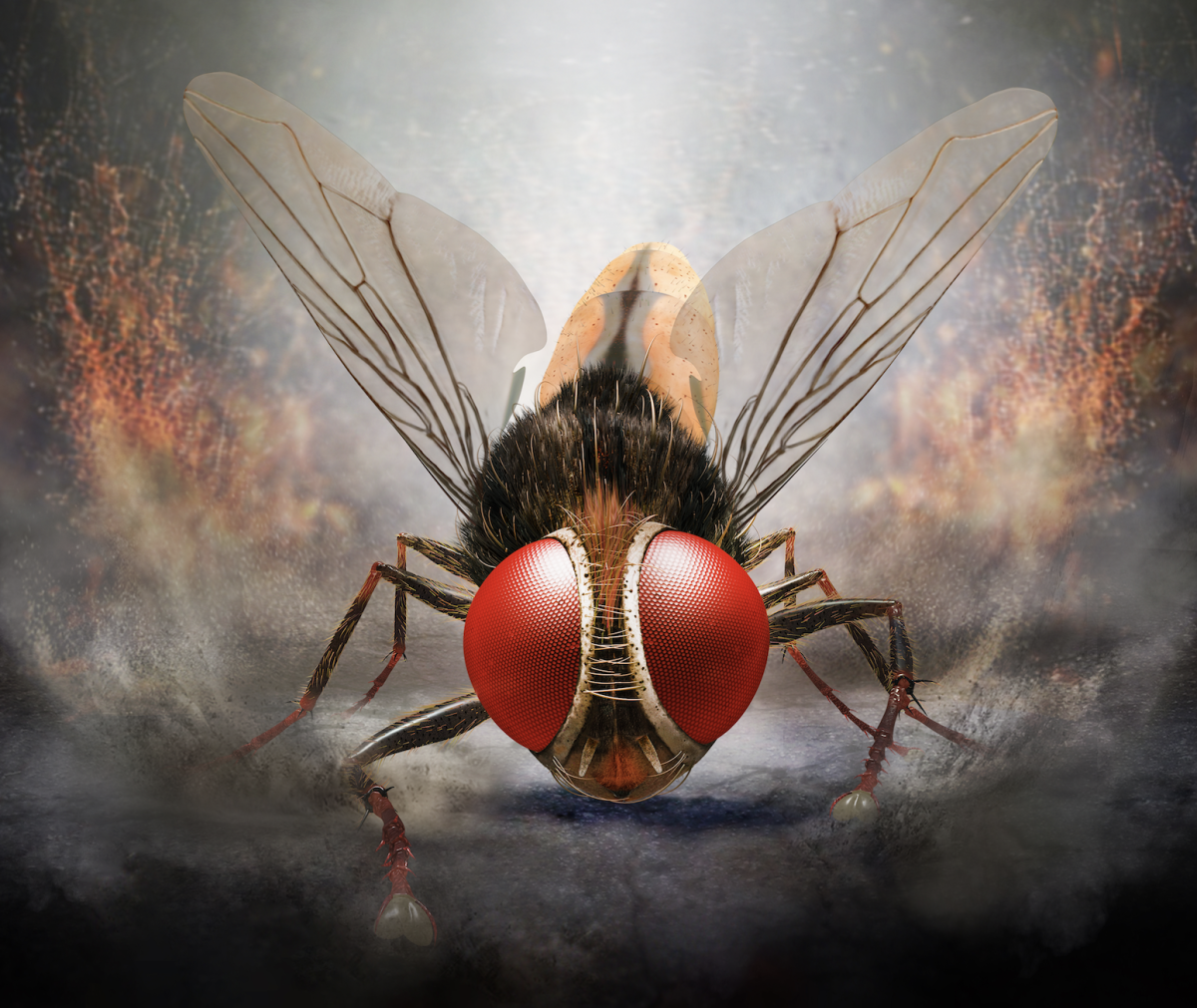
The following notes on S.S. Rajamouli’s Eega were written by Kris Salazar BA ’18, graduate of the Department of Communication Arts at UW-Madison. A screening of Eega kicks off the Cinematheque’s series “Rajamouli: Myth, Spectacle, Cinema” on Friday, November 13 at 7 p.m. The Cinematheque is at 4070 Vilas Hall, 821 University Ave. Admission is free!
By Kris Salazar
There is not a more prolific name in the modern-day Telugu Film Industry (TFI) and Pan-Indian cinema than director S.S. Rajamouli. Prior to Eega (2012), Rajamouli’s accolades included several critical and commercial successes throughout the 2000s, which came from directing incredibly varied films featuring major stars, from the Nithiin-led sports drama Sye (2004) to the action-drama Chatrapathi (2005) with Prabhas to the mythological romantic comedy Yamadonga (2007), starring Jr. NTR. Across this range of films, Rajamouli always treats his stories and characters, heroes and villains alike, with such high importance and articulation. This is why, when it comes to Eega, a film whose main character is a non-verbal CGI eega (fly) seeking revenge, the preposterousness of the idea itself is swatted away by the power of its characterizations and its universal farce comedy.
The idea of Eega came from the imagination of Rajamouli’s father and frequent collaborator, Vijayendra Prasad, during the 1990s, and had been a story Rajamouli himself was interested in making since his earliest films. It did not crystallize into a full-fledged screenplay until after the completion of his eighth film, Maryada Ramanna (2010), an adaptation of the Buster Keaton silent comedy film, Our Hospitality (1923), based on the Hatfield and McCoy feud. With newfound experience working in this mode of comedy, it appeared to be a logical progression to finally develop this housefly story after finishing Maryada.
The silent film antics in Maryada Ramanna are fully brought out by the gifted comedic timing and talent of the actor Sunil, who, during this stage of his career, tended to appear in South Indian supporting “comedy track” roles in hero-led films. In Maryada, he was now the unorthodox lead of a story about love, violence, drama – with a talking bike serving as the main comedy track. The 2010 film thus perfectly lays the foundation for Eega, pushing the universality of comedy so that, even without knowing the language or the region, you could watch without subtitles and laugh throughout the film’s length. In Eega, Rajamouli uses many silent film characteristics, particularly the exaggeration of the title character’s legs, wings, and body, along with sounds and prop interactions, to showcase the fly’s inner struggle. This conflict principally concerns the memories of his past as a human named Nani, played by Telugu star Nani, the love he still has for Samantha’s Bindu, and the eagerness to enact revenge on the one who squashed his life.
Rajamouli’s savviness as a director allows Eega to bypass many issues that might cause apprehension in a fly protagonist. He does this by grounding the story in a subject that is easily understood. Above all else, the focus of the story is a fantasy revenge film that we have seen in Hollywood movies like Ghost (Zucker, 1990) or The Crow (Proyas, 1994). The additional crux here is the added narrative of an Indian reincarnation story that has been previously featured in Hindi cinema, such as Karan Arjun (Roshan, 1995) and Om Shanti Om (Farah Khan, 2007). However, these past stories usually have the protagonist reincarnate back into the human form, usually played by the same actor – and in the cases listed above, both die and return as megastar Shah Rukh Khan.
The oddity of the housefly brings more attention to how this poor being will enact revenge on the human who took his previous life. Herein lies the comedy, the drama, and the suspense. Of course, a CGI housefly protagonist is only as good as the antagonist who can react to the farcical situations this eega puts him in. Sudeep, an actor known for his heroic roles in the neighboring Karnataka’s Kannada Film industry, truly brings the film to life with his villainous character, also named Sudeep. With every swat, spray, and attack he attempts on the fly, he has to react to every tormented blow the fly schemes up in return. Sudeep carries such flair and timing in his interactions with this animated fly that he pulls us in and makes us all cheer and fear for the fly as the revenge penetrates deeper and deeper into Sudeep’s deteriorating psyche.
Bringing a villain from a different film industry is not a distinct Rajamouli-ism: it is common amongst many films across all film regions to cast another region’s actors. However, he uses the strength of each actor from their respective industry. Instead of just casting them for the sake of their regional fans’ ticket purchasing power upon release, Rajamouli homes in on their ability for intensity and giving oneself to the despicable depths of each against-type role. Rajamouli’s cinematic rogues’ gallery crosses all industries, from Vikramarkadu (2006)’s Vineet Kumar, who at the time was mostly starring in Hindi films, to casting Malayali actor Prithviraj Sukumaran in his next film, 2027’s Varanasi. Rajamouli has been quoted by the protagonist of his next film, Mahesh Babu, stating that Rajamouli “loves [his] villains even more [than his heroes].”
It makes sense for Rajamouli to be so particular when building these worlds and opening them up to audiences so they can be easily understood, no matter what language they are dubbed or subtitled in. Rajamouli is far from the origin of Pan-Indian cinema, as there are other directors, like Mani Ratnam and Shankar, who have similarly participated in industry mixing and dubbing in the Tamil Industry. Yet Rajamouli has ushered in a new age in the TFI by incorporating actors from other industries as well as releasing films with dubs in multiple languages simultaneously during release: Eega, its Telugu title, is also known as Eecha (Malayalam title for Fly), and Naan Ee (Tamil title for ‘I am Fly’ as well as a double meaning to the protagonist and main actor’s name Nani). These three were released in July of 2012, while the Hindi dub, Makkhi, was released later that year. At the time, Rajamouli was unique amongst other directors due to his specific style of comedy and the prominent role given to a CG fly. He modernized the concept to the point that, after the success of the two Baahubali films’ simultaneous dubs during the filming, it is now common for films to have several language versions available in theaters for people to prioritize their viewing experience based on the language they are most familiar with.
By virtue of its unique, genre-bending vision, Eega remains a special cinematic touchstone that can be seen as a gateway to not only the exciting world of Rajamouli’s cinema, but also to South Indian cinema at large. Through the many actors and different production team members that can be traced back to other regional industries from this film, this wonderful, courageous fly (eega, ee, makkhi, eecha) can serve as a guiding light to the next film you decide to experience.