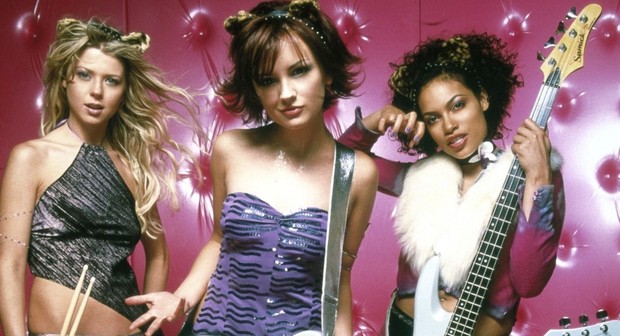
The following notes on Josie and the Pussycats were written by Dr. Paxton Haven, visiting assistant professor in the Department of Communication Arts at UW-Madison. A 35mm print of Josie will screen on Saturday, November 7, 7 p.m. at 4070 Vilas Hall, 821 University Ave. Admission is free!
By Paxton Haven
Karl Marx and Friedrich Engels likely would be horrified to discover that their critique of the culture industry finds perhaps its purest cinematic expression in 2001’s Josie and the Pussycats, a pop-punk musical adaptation of an Archie comic. Fresh off their success with A Very Brady Sequel (1996), the writer-director duo of Harry Elfont and Deborah Kaplan were initially hesitant to do another adaptation. Yet the idea of turning these beloved comic book characters into a rock musical proved to be all too enticing. “We had grown up in the era of rock and ‘authenticity.’ Everything that was happening in pop music at the time seemed so manufactured. It felt very plastic,” Elfont told The Fader in an extensive oral history of the film published in 2017, “So we thought, maybe we set it in that world and kind of satirize what’s going on right now.” The result is a 98-minute indictment of music industry corporatization, featuring an ensemble cast of 90s and early 2000s favorites. Alan Cumming and Parker Posey are particular standouts, gleefully chewing the scenery as MegaRecord’s unscrupulous A&R executive and cartoonishly evil CEO. Their performances are rivaled only by those of the film’s brazenly homoerotic boy band, Du Jour, played by Breckin Meyer, Seth Green, Donald Faison, and Alex Martin.
For the titular Josie and the Pussycats, Elfont and Kaplan looked to pop’s upper echelon when casting the project. Beyoncé, Lisa “Left Eye” Lopes, and Aaliyah all auditioned to play Val, while Maggie Gyllenhaal and Zooey Deschanel went out for Josie. Rachel Leigh Cook, hot off She’s All That (Iscove, 1999), eventually landed the role of Josie, alongside Tara Reid of American Pie (Weitz, 1999) fame as Melody the drummer and Rosario Dawson as the bassist, Val. With the team assembled, Josie and the Pussycats trained at a musical boot camp during pre-production to look as legitimate as possible when playing their instruments. Rachel Leigh Cook reflected on her experience: “Sweet and Lowdown, that movie where Sean Penn plays a jazz musician, had just come out, and he was under a ton of fire for not being able to play accurately. I think that got into Deb and Harry’s heads a little […] I remember thinking, I could fake this pretty damn well. As hard as it was, I’m really glad that they did make us knuckle down and really learn how to play the songs.” The film’s eight original songs, however, don’t feature vocals by Cook; instead, Kay Hanley of the alt-rock group Letters to Cleo sings lead.
This movie magic did the trick: the soundtrack charted at number 16 on the Billboard 200 and reached gold status. The album was executive produced by self-proclaimed Archie comic fan Kenneth “Babyface” Edmonds and Fountains of Wayne singer Adam Schlesinger. The album features lyrics and melodies from a ragtag group of 90s rock musicians: Adam Duritz of Counting Crows, Jellyfish’s Jason Falkner, that dog.’s Anna Waronker, and Gigolo Aunts’ David Gibbs. Particularly key was the involvement of The Go-Go’s Jane Wiedlin, inspired by her experience as a member of one of the relatively few all-female bands to emerge from the late-1970s punk scene (though she reportedly found collaborating with many other writers quite frustrating). Elfont and Kaplan were heavily involved in the album’s writing and production, aiming to replicate what they heard on the radio: an emergent pop-punk sound. “Other than the sheer pop music that was going on, there was a power punk thing happening with Green Day and Blink-182—that power trio,” Kaplan said, “We wanted that sound but from an all-female band. They could have been a pop band, but part of our choice was to say that rock seemed to be disappearing, so for us it was like, let’s make it about a rock band that’s trying to be turned into something else.” The soundtrack captured this sound so well that it prompted newcomers Fall Out Boy to reach out to Babyface after watching the film, resulting in the pop-punk classic “Thnks fr th mmrs” from the band’s 2007 album, Infinity on High.
Every frame of the film is packed with brand iconography, an unmistakably on-the-nose visual gag that reinforces the film’s broader critique of consumerism. The joke, however, works on two levels: none of the brands featured actually paid for product placement. Upon the film’s release, critics were quick to cry foul, accusing Elfont and Kaplan of hypocrisy while missing the sly metacommentary at play. Ultimately, the film’s collision of familiar teen movie conventions and dark music industry satire proved an uneasy fit for critics and audiences alike. While this dissonance is a hallmark of the film’s cult status today, it did not translate into ticket sales. The film made $14.9 million at the box office, a crumb of its reported $39 million budget. Elfont recalls knowing something was off while shooting: “There was a certain point during the production where we looked at the dailies and I had that moment of panic like, Oh, fuck. We’re making a cult movie. I can see what’s happening. I had a flash of what we had on our hands, and that, by nature, it wasn’t gonna be embraced by a lot of people immediately.” The film ended up putting Elfont and Kaplan in the dreaded industry limbo colloquially known as “Director Jail,” relegating their careers to TV movies and web series.
Still, Josie and the Pussycats’ impact outlives the naysayers and its status as a box office bomb. In fact, singer-songwriter Mitski cites the film as particularly influential: “I studied the way they performed. The little gestures and facial expressions they do in those music videos, how they would rock out. I’d be like, Oh that’s how you do it! That’s how you rock out! That’s how you perform, that’s how you hold a guitar.” And she was not the only young girl this movie inspired. In that same 2017 oral history, Kaplan meditated on the film’s lasting impact on a whole generation of female musicians: “Now I hear people say, ‘I saw that movie when I was a girl, and it made me realize I could pick up a guitar, I could be in a band, I could play music,’ and that feels really good; in a way, almost better than, ‘The movie was so well-reviewed, and made a ton of money.’ Not that it wouldn’t have been great to make a ton of money and get great reviews and not be put into director jail. But it’s nice at least that it had some permanence. It makes people happy. The people who love this movie love it with such a passion.”