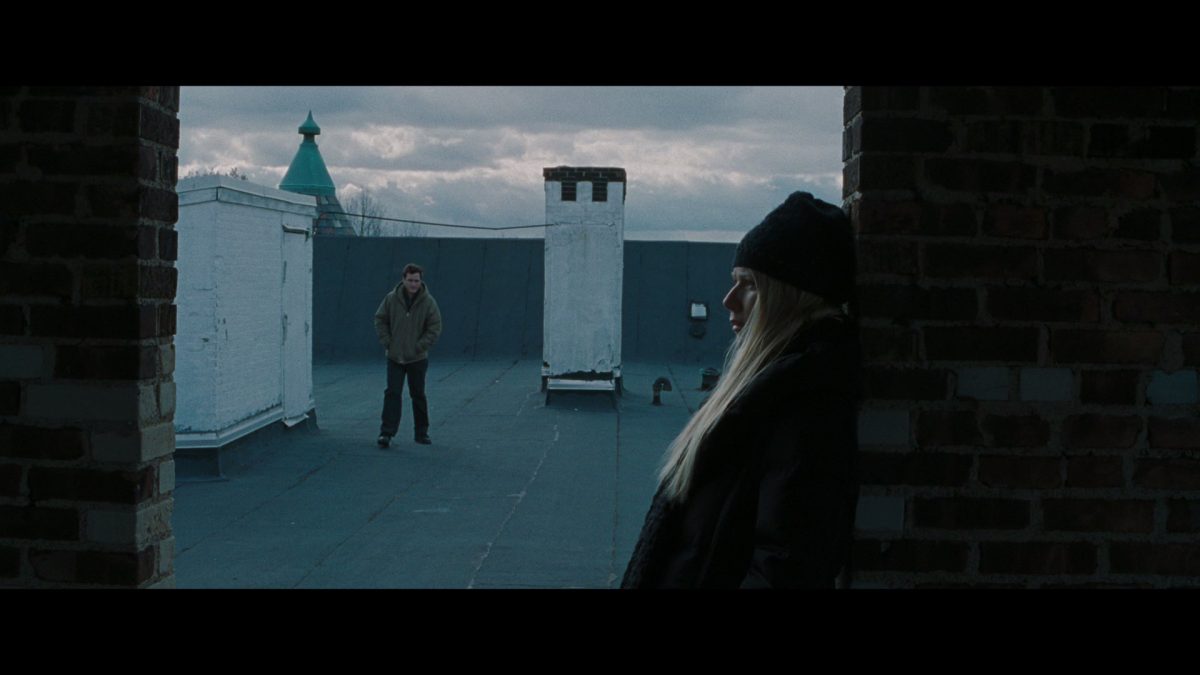
The following notes on Two Lovers were written by Nick Sansone, PhD candidate in the Department of Communication Arts at UW-Madison. Two Lovers will screen Saturday, October 3 on 35mm film, the second screening in our “Three White Nights” series. The venue is 4070 Vilas Hall, 821 University Ave and the showtime is 8 p.m., following a 6 p.m. showing of Bresson’s Four Nights of a Dreamer. Admission for both screenings is free!
By Nick Sansone
Just a few years before he released his fourth feature film Two Lovers (2008), writer/director James Gray married producer Alexandra Dickson and visited a genetic counselor with her after she became pregnant. During this visit, he learned a story about a couple who had also visited this counselor and discovered that they both carried the gene for Tay-Sachs disease, meaning that any child they had would die soon after birth, tragic news that soon resulted in the demise of this relationship. At the same time that he heard this story, Gray found himself re-reading Fyodor Dostoevsky’s “White Nights,” a story which had already been adapted to film multiple times by directors such as Luchino Visconti and Robert Bresson. Despite these daunting predecessors, Gray nonetheless saw an opportunity to reinterpret the story in a contemporary American context. Dostoevsky’s story, the sad tale from the counselor’s office, and an amusing challenge he received from Gwyneth Paltrow to “write a movie without guns” (after 1994’s Little Odessa, 2000’s The Yards, and 2007’s We Own the Night, his loose trilogy of New York crime films) each formed the foundation for what would become Two Lovers, Gray’s deliberate, complex portrayal of unrequited love and desire. Well received upon release, Two Lovers helped to solidify his status as a critical darling and frequent European festival presence who has never quite achieved commensurate recognition from mainstream American audiences.
Indeed, this disconnect between Gray’s acclaimed status in Europe compared to America—in spite of his stories being deeply rooted in American settings and ideas, specifically as it pertains to the various boroughs of New York City—can be at least partially explained by Gray’s own affection for international cinema and the particular methods by which these vaunted international auteurs throughout film history have approached authenticity and emotion in storytelling. When discussing the films he made the crew watch in preparation for making Two Lovers, Gray mentioned Alfred Hitchcock’s Vertigo (1958) but noted that he mainly showed them “lots of Fellini from the 1950s” and “stuck primarily to foreign cinema, because most American films have treated love as fodder for comedy.” For Gray, “the goal was to make something moving and austere and simple, emotional but never sentimental.” Adding to the European feel of Gray’s approach to the film is the intentional decision to set the film in the Brighton Beach neighborhood of Brooklyn. While Brighton Beach the setting of many films from Gene Saks’ Neil Simon adaptation Brighton Beach Memoirs (1986) to Sean Baker’s Anora (2024), as well as Gray’s first feature Little Odessa (1994), its predominantly Russian-Jewish population—and distinct lack of the gentrification that had taken hold of other parts of Brooklyn—made it stand out from the hipster milieu that other Brooklyn-set independent films of the 2000s were rooted in.
Additionally, the film’s tone, described by A.O. Scott in his contemporary review as “earnest and anguished,” is one that reflected a general trend amongst both American and international films in the mid-to-late 2000s. Two Lovers was one of three films to receive awards attention in 2008 that could be accurately described as anguished romantic dramas. The other two, The Reader and Revolutionary Road, were both Kate Winslet vehicles carefully positioned for multiple Oscar nominations, with Winslet taking home the Best Actress trophy for the former film. In contrast, Two Lovers stood out as a much more nuanced depiction of romantic longing and anguish that had a much more European sensibility than even The Reader, a film set in Europe. But despite Two Lovers’ critical acclaim out of the Cannes Film Festival, where it competed for the Palme d’Or, it struggled to find a distributor, ultimately being released by Magnolia Pictures (a subsidiary of 2939 Entertainment, the company that financed most of the production) in only 148 theaters. It likewise failed to garner a single Oscar nomination and only grossed $3.1 million domestically. However, true to the disconnect between Gray’s reception in the U.S. versus internationally, Two Lovers grossed $13.2 million total from non-U.S. markets, accounting for 80% of its worldwide total.
At the time of Two Lovers’ release in 2008, a global financial crisis was underway, and America and the world were reckoning with the consequences of Bush-era politics. Just a year earlier, several acclaimed films like Paul Thomas Anderson’s There Will Be Blood, the Coen Brothers’ No Country for Old Men, and Tony Gilroy’s Michael Clayton grappled with America’s follies in the twentieth and early twenty-first centuries, while international films like Cristian Mungiu’s 4 Months, 3 Weeks, and 2 Days and Ari Folman’s Waltz with Bashir adopted anguished tones through vastly different formal methods to tell deeply political stories. In this context, Gray’s depiction of New Yorkers longing for human connection might seem quaint, but the film nevertheless reflects the anxieties of its time. The 2000s New York setting does not lean into the post-9/11 atmosphere as explicitly as Spike Lee’s 25th Hour (2002) or Kenneth Lonergan’s Margaret (2011), but it lingers in the background and in the troubled natures of our central characters, Leonard (Joaquin Phoenix) and Michelle (Gwenyth Paltrow). Likewise, the film’s roots in melodrama reflect the heightened emotions that many in the city were feeling throughout the 2000s.
Following the release of Two Lovers, Gray continued to make several movies distinctly rooted in New York City, including 2013’s The Immigrant, 2022’s Armageddon Time, and the forthcoming Paper Tiger (2026). Each of these films, like Two Lovers, have competed for the Palme d’Or at the Cannes Film Festival and have been warmly received by the international film press. While The Immigrant and Armageddon Time failed to generate much interest in the U.S., either in terms of box office or awards, Paper Tiger may face a different reception stateside when it is given a wide release later this fall. Whatever the differences in his reputation on both sides of the Atlantic, Gray has consistently remained an American filmmaker who tells distinctly American stories with a very European sensibility, and his filmography is ripe for reexamination. For Two Lovers in particular, a film that uses the conventions of the romantic melodrama to reflect the specific anxieties of its time and place, such a rediscovery pays handsome dividends.