The following notes on Messiah of Evil were written by Josh Martin, the Cinematheque’s Bleak Week programmer and a PhD candidate in the Department of Communication Arts at UW – Madison. Messiah of Evil will screen at UW Cinematheque on Saturday, June 27 at 7 p.m., on a 35mm print courtesy of the American Genre Film Archive, as part of our Bleak Week: Cinema of Despair series, presented in partnership with the American Cinematheque. Admission is free, and the UW Cinematheque is located at 4070 Vilas Hall, 821 University Ave.
By Josh Martin
Before the opening credits roll on Willard Huyck and Gloria Katz’s Messiah of Evil (1974), the film captures a man (played by none other than The Warriors director Walter Hill) on the run in the dead of night. Sprinting as fast as he can, we know nothing about who he is or what he might be running from. Eventually, he collapses in front of a gate, which opens to reveal a young girl, spooky but friendly. She silently permits the man to enter through this gate, where he washes his face with a sprinkler before falling in a heap once more in her backyard. The girl approaches the man on the ground, eventually placing the back of her hand against his forehead. The man kisses her hand and holds it tight. Without warning, the girl raises a straight razor with her other hand, swiftly bringing it down to slash the man’s throat before he even has a chance to scream. Punctuated with a freeze frame, the screen turns blood red in tandem with the reveal of the film’s title card.
It is hard to imagine a more fitting welcome to Messiah of Evil than this jarring and unceremonious murder: here is a world where the vibes are bad from the get-go. “They say that nightmares are dreams perverted,” ruminates our protagonist Arletty (Marianna Hill), captured in an out-of-focus long shot at the end of a hallway. Arletty is seemingly confined to an asylum, now reflecting in voiceover on the peculiar horrors she experienced while searching for her missing father (Royal Dano). Arletty’s search brought her to the cursed California town of Point Dune, a coastal community possessed by a folkloric figure—with a tinge of Charles Manson’s cultish powers of influence—known as The Dark Stranger. Arriving to proliferate his murderous religion in the era of the Donner party, The Stranger prophesized his eventual return to “a world tired and disillusioned… looking back to old gods and dark ways.” Now, a century later, Point Dune’s citizens are flesh-starved vessels of death caught under the stranger’s spell, teardrops of blood rolling down their cheeks.
The magic of Messiah of Evil lies in this pervasive sense of a dream logic perverted and warped, calming and alluring until it is suddenly, viciously violent, a terrifying waking nightmare molded into the shape of a familiar genre picture. This magic was not evident to everyone upon the film’s release: the Los Angeles Times film critic Kevin Thomas lambasted Messiah of Evil as “sleep-inducing,” saddled with a “hopelessly vague and illogical” narrative and a “lethally slow pace.” Naturally, these accusations of slowness and a taste for the illogical—or even the suggestion of a soporific quality, with the viewer finding themselves on the verge of slumber—can look more like features than bugs depending on your vantage point, a subjectivity reinforced by the film’s growing popularity since its initial release in 1974.
Messiah of Evil was written, produced, and directed by Willard Huyck and Gloria Katz (though she was uncredited in the latter category upon the film’s release), a husband-wife duo who emerged from the vibrant Southern California film school scene in the late 1960s. As Huyck recounts in a 2019 interview with the Projection Booth Podcast, included on Messiah of Evil’s restored Blu-Ray release, he was a student at USC (later dropping out to work for Roger Corman’s AIP) and Katz studied across town at UCLA. When a producer gave them the opportunity to direct their own film—with the stipulation that it had to be a horror movie—Huyck and Katz wrote Messiah of Evil in three days and made the project on the cheap, employing friends and family and shooting the film mainly in the local San Fernando Valley.
If you recognize Huyck and Katz’s names, you may be wondering: is this offbeat, under-the-radar chiller really the handiwork of the same couple who co-wrote Howard the Duck (1986)? Though Messiah of Evil has grown in stature, Huyck and Katz are still best known for their collaborations with fellow SoCal luminaries George Lucas and Steven Spielberg, penning the former’s breakout American Graffiti (1973) and the latter’s blockbuster sequel Indiana Jones and the Temple of Doom (1984), with some uncredited edits on the script for Star Wars (1977) in between. Taken at face value, the joyride of Graffiti and the roller-coaster ride of Temple of Doom share next to no affinities with the bad trip that is Messiah. Of course, as Huyck notes, Messiah of Evil was a genre picture by industrial necessity, albeit one that drew on his own affection for H.P. Lovecraft’s cosmic horror. As such, though it would be easy to bracket the project off from the Huyck/Katz oeuvre, it still maintains something of their personal touch. If one is keen to adopt an auteurist lens, shades of Graffiti’s nostalgic Americana can be found in the off-kilter, chillingly evacuated small-town iconography peppered throughout Messiah. Graffiti was the pleasurable dream of an America gone by; here then is the nightmare, Americana perverted. Notably, as the critic Bill Ackerman discusses in his essay on Messiah, the influence of American artists Edward Hopper and Edward Ruscha can be felt in many frames, with Huyck and Katz “[adopting] a pop art-inspired approach” that extends to Jack Fisk’s elaborate, unusual production design.
Thus, Messiah of Evil offers a unique flavor of horror compared to its immediate predecessors of the era. In the aforementioned podcast interview, Huyck is quick to note that, despite frequent comparisons, he had not seen Herk Harvey’s Carnival of Souls (1962) or George A. Romero’s Night of the Living Dead (1968) at the time of production, instead taking inspiration from the atmospheric 1930s horror films directed by Edgar G. Ulmer and James Whale. While marketing shenanigans did not dispel this comparison—the film was re-released as Return of the Living Dead, per the AFI Catalog, sparking litigation—Huyck is right to place Messiah in dialogue with an earlier era of terror. In fact, considering Arletty’s voiceover and the somnambulistic mood, foregrounding a locale with an ominous supernatural history, the oblique, sensuous minimalism of Jacques Tourneur’s I Walked with a Zombie (1943) is perhaps Messiah’s most significant intertext.
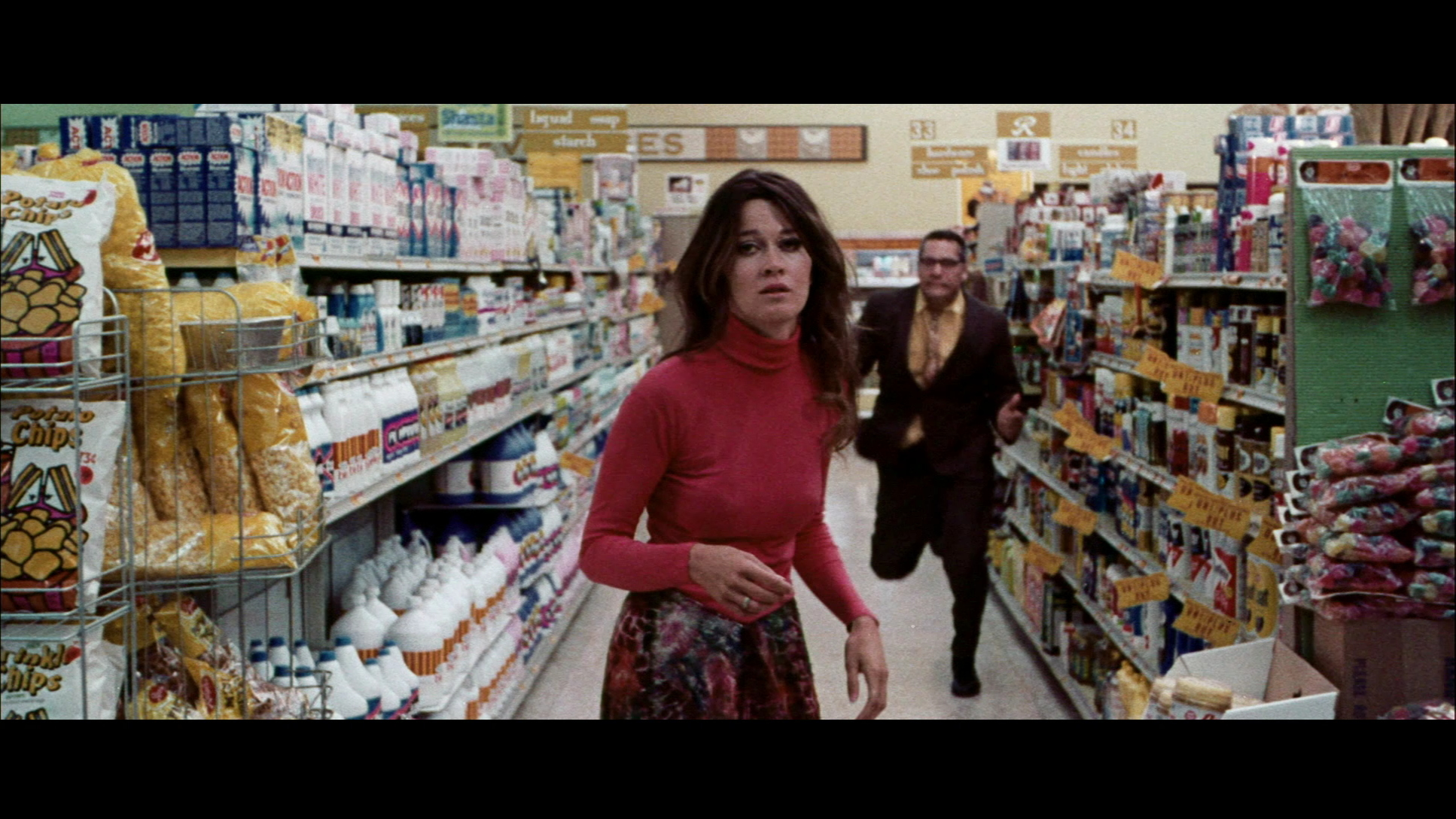
Though Messiah of Evil remains in the realm of ambient uneasiness, the film also features plenty of spectacular setpieces, staging chilling nocturnal encounters with Point Dune’s undead in a desolate grocery store and a picture palace. In the case of the latter, the theater’s programming playfully foreshadows our characters’ fate: “KISS TOMORROW GOODBYE” is listed on the marquee in bright, bold letters, the undead slowly filling in this empty theater to zero in on their human prey. Despite these thrills, Messiah of Evil arrives at a place of profound existential discomfort by its conclusion, with a haunted Arletty insisting that the evil of Point Dune will soon encroach upon the world at large. “In order to live, they will take you one by one,” she exclaims, “and no one will hear you scream.” We are reminded again of the man from the opening scene, running from death, desperate to escape his fate, only to be slaughtered before even the faintest sound of protest can exit his lips. There is no escape: kiss tomorrow goodbye, indeed.