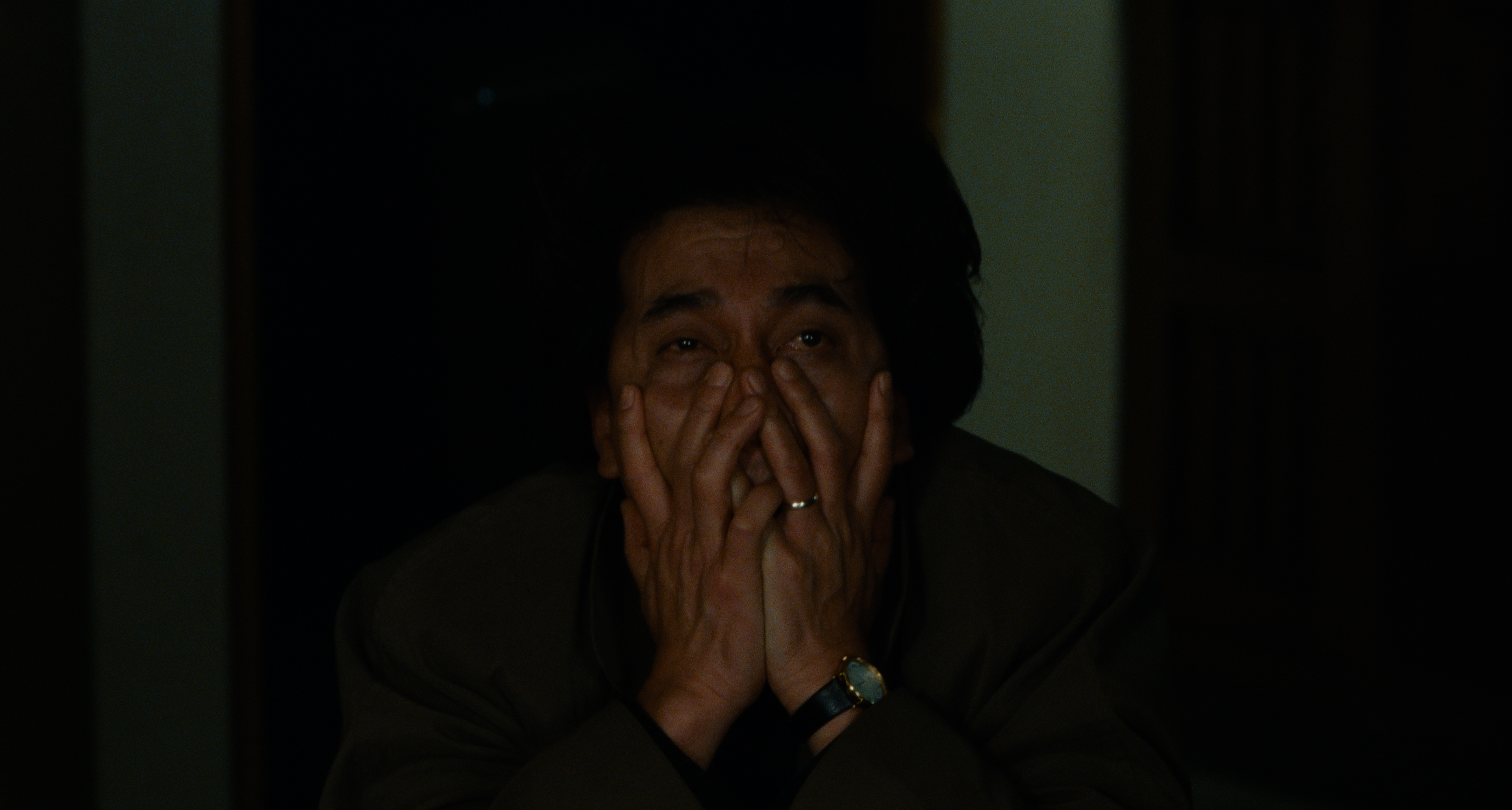
 The following notes on Cure were written by Sarah Mae Fleming, PhD candidate in the Department of Communication Arts at UW – Madison. Kiyoshi Kurosawa’s Cure will screen at UW Cinematheque on Friday, June 26 at 8 p.m., preceded by Kurosawa’s Chime at 7 p.m., as part of our Bleak Week: Cinema of Despair series, presented in partnership with the American Cinematheque. Admission is free, and the UW Cinematheque is located at 4070 Vilas Hall, 821 University Ave.
By Sarah Mae Fleming
“I found myself in the film business. But not because I had a particular story to tell. Fundamentally, what interests me is the nature of film itself.” – Kiyoshi Kurosawa
Kiyoshi Kurosawa has said that the seed of 1997’s Cure came from his television set. While watching the news, Kurosawa came across a familiar report. Authorities had just arrested a murderer, and the coverage followed a script that has since become cliché: the neighbors, incredulous, claimed that the arrested man was so normal, so nice. He was the kind of person you’d never suspect. Many of us might file this under the banality of evil and move on, yet Kurosawa was struck. What if the neighbors were telling the truth? What if the man really was ordinary, and something outside him—some trigger, some suggestion—reached in and turned him into a killer?
The film that resulted from this inquiry is famously difficult to slot into a single genre. It opens like many a police procedural: a troubled detective, Kenichi Takabe (Kōji Yakusho), investigates a string of murders in which each victim has had an “X” carved into their bodies, each killing committed by a different ordinary person with no memory of why they carried out such a horrific act. The premise promises enough supernatural suggestion to be folded into the J-horror wave it helped inaugurate, in the company of later films like Ringu (Hideo Nakata, 1998) or Kurosawa’s own Pulse (2001). It borrows, too, from the violent American procedurals of the nineties, such as The Silence of the Lambs (Demme, 1991) or Seven (Fincher, 1995). But Cure ultimately moves in a direction all its own.
This friction between what it resembles and what it is accounts for much of its unsettling power. Kurosawa stretches scenes out using distant shot scales and long shot duration, creating extended sequences of quietness and remoteness. Viewers witness people performing the dull tasks of quotidian life, a wife absently switching on a clothes dryer, or fluorescent light pooling on sickly off-white walls. Quickly, this calm is punctured with brutal violence. There is little boundary to mark the crossing from the ordinary into the savagery. That sort of seamlessness is both what makes the film difficult to sort into one category, as well as what imbues Cure with its unshakeable dread.
The integration of heightened violence with the dullness of modern life might seem to be a marked aesthetic decision, but it has humbler origins. By the mid-1990s Kurosawa was a veteran of V-cinema, Japan’s straight-to-video market, where he directed a flurry of low-budget yakuza pictures and, earlier on, some erotic “pink” films. In this mode, Kurosawa was used to working quickly and cheaply to produce several titles a year. While developing some shoestring gangster films for the studio Daiei, he handed them a synopsis for Cure. They liked it enough to produce it with a healthier budget and plans for a theatrical release. Despite this, Kurosawa brought his V-cinema instincts—and much of his V-cinema crew, including cinematographer Tokushô Kikumura—along with him.
What carried over to Cure wasn’t only the personnel but also the economy and method of shooting V-cinema. Cure was shot on film, which meant there was no money or time to waste. Kurosawa knew that he and his crew didn’t have the luxury to cover a scene several ways, to wait for the perfect light, or the right weather. Whatever the environmental conditions, Kurosawa decided that he would embrace it and shoot: if the day was overcast, they shot in the overcast; if the sun was out, they used it. Murders unfold in broad daylight, drained of suspense and menace while scenes devoid of violence arrive under low, storm-heavy skies. One of the film’s most forbidding moments came out of similar constraints. Kurosawa had wanted to use a lighter in the scene, but the location wouldn’t permit fire or smoke, so he improvised with water instead, letting a glass spill and the liquid spread slowly across tile. The image wasn’t planned, but it became one of the eeriest in the film.
Kurosawa’s refusal to impose order goes deeper than the weather. It suggests a fundamental skepticism about the self. The murders in Cure have no motive because motive assumes a coherent person who can be found, interrogated, and blamed, and Kurosawa isn’t fully convinced about the concept of stable identity. In a 2003 archival interview with the director, he expresses his doubts about whether the entire notion of identity is real. He contends that we are one self at work and another at home, changing by small degrees all the time, yet insisting throughout that some single “I” holds it together. Kunihiko Mamiya (Masato Hagiwara), the amnesiac drifter who seems to hypnotize strangers into performing violent acts, emphasizes this doubt. His recurring question to everyone he meets (“Who are you?”) appears to be a sincere inquiry the film doesn’t intend to answer. And Takabe, the detective who needs the world to make sense, hollows out under his life’s unrelenting pressure—until the final scene, when he finally sits and eats. Now calm, his torment is gone because it has migrated outward, into everyone around him.
It is here that critic Chris Fujiwara locates the film’s grim thesis in his essay “Cure: Erasure.” The social problem of the killings is never solved within the story. Instead, Fujiwara argues, it is “solved on the formal level, as the erasure of society from the film.” The cure, in other words, is subtraction of motive, of coherence, and of the self that might have been held culpable. What lingers after the credits is Kurosawa’s original question, the one he took from the evening news. Maybe the nice neighbor really was nice, and also a murderer. Maybe “nice” and “murderer” could never be housed in a single, stable self to begin with.