The following notes on Miracle Mile were written by Josh Martin, the Cinematheque’s Bleak Week programmer and a PhD candidate in the Department of Communication Arts. A 35mm print of Miracle Mile will screen at the UW Cinematheque on Wednesday, June 24 at 7 p.m., part of our Bleak Week: Cinema of Despair series, presented in partnership with the American Cinematheque. Admission is free and the UW Cinematheque is located at 4070 Vilas Hall, 821 University Ave.
By: Josh Martin
In Steve De Jarnatt’s Miracle Mile (1988), time is of the essence. In its opening scene, a nature documentary plays at the La Brea Tar Pits Natural History Museum in Los Angeles, meticulously recounting how the Earth slowly evolved over time. For trombone player Harry Washello (Anthony Edwards, hot off the success of 1987’s Top Gun), it feels like his love life has taken a similarly interminable length of time to come to fruition. “And it took thirty years for Harry Washello to find the right girl,” he quips in the film’s sparingly used retrospective voiceover, referencing his impending museum meet cute with the spirited Julie (Mare Winningham). Fawning over his new love, Harry describes Julie as “a little out of time,” an “old-fashioned” girl who understands his ancient references and cheesy aspirations to be the next Glenn Miller. Sharing a magical kiss outside Johnie’s Coffee Shop, the neon-lit architectural landmark where Julie works, the new couple set a key time for a late-night date: 12:15 AM.
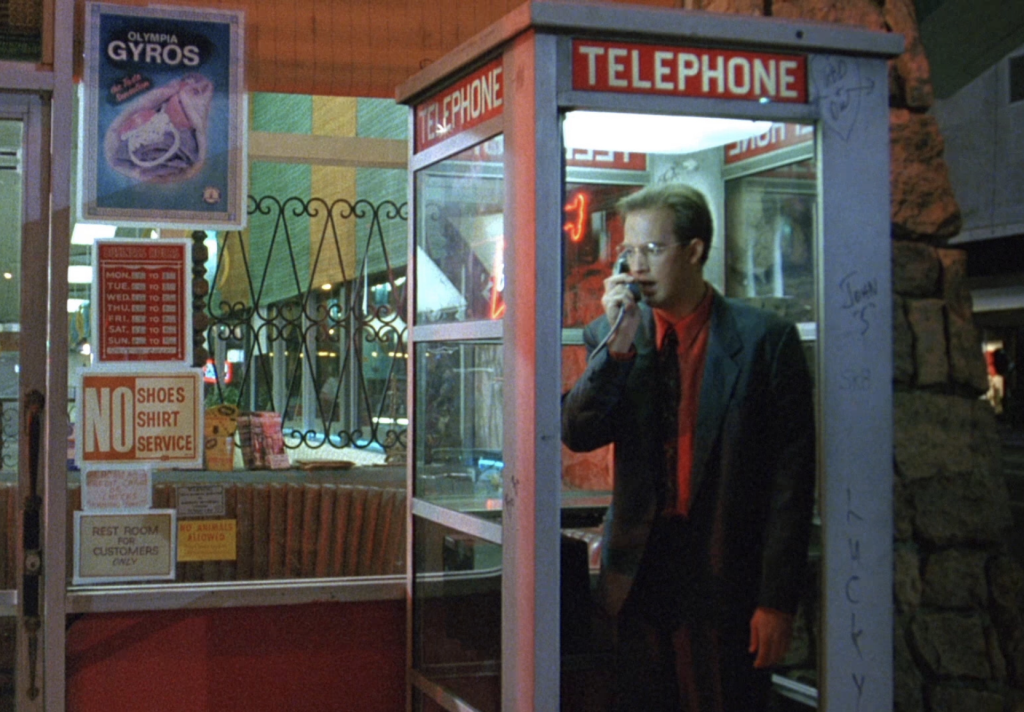
However, the notion of Julie being “out of time” has a double meaning. Julie, Harry, and everyone else in Los Angeles—and maybe even on the planet—are soon to be literally out of time, staring down a mass extinction event. After accidentally waking up at 3:45 AM due to a power outage in his building—one that his own carelessly discarded lit cigarette may have caused, no less—Harry rushes to Johnie’s, where Julie is nowhere to be found. Instead, he receives an accidental call from a nearby phone booth, alerting him to the fact that nuclear missiles will be fired by the U.S. military in “fifty minutes and counting.” In all likelihood, the United States will be hit by return fire in exactly one hour. Suddenly, we find ourselves in a very different type of movie: nuclear war is on the imminent horizon, and this is not a drill. Time, once again, is of the absolute essence, because there just might not be much of it left. Humanity is on the clock.
Miracle Mile’s central race-against-time plot—a quest to spread the word, find Julie, and escape Los Angeles—kicks in shortly after Harry receives this call. Of course, when you enter a coffee shop in the middle of the night and claim that the sky is falling, some skepticism might be in order. A patron at Johnie’s sneers that it’s “the witching hour, all the weirdos come out” as Harry paces the restaurant, instinctively dismissing him as one of the various vagabonds that we see wandering Hollywood at night in the film. Yet as the low hum of Tangerine Dream’s synthy score re-enters the soundscape, the palpable terror expressed by Harry grows contagious. Soon, everyone at Johnie’s is ready to abandon the city, believing that the end is near.
Produced by Hemdale Film Corporation, Miracle Mile was only De Jarnatt’s second directorial effort. Despite its enduring cult popularity, the film remains his final feature, a minor tragedy considering the idiosyncratic specificity of the director’s cinematic sensibility, on full display here. While it contains significant romantic and comedic streaks that differentiate it from its predecessors, Miracle Mile still fits snugly within the robust cycle of films grappling with anxieties about nuclear war in the tension-filled final days of the Cold War, including Mick Jackson’s Threads (1984), Nicholas Meyer’s The Day After (1983), and Lynne Littman’s family drama Testament (1983). A highly regarded script in the industry for years prior to its production, De Jarnatt nonetheless struggled to make Miracle Mile on his own terms. As he noted in an interview with critic Paul Rowlands, regardless of the success of Meyer and Littman’s films, studios “still wanted [Miracle Mile] to have a happier ending.” As such, the filmmaker held out to direct the film himself, refusing to ever soften the blow of a conclusion that is downright apocalyptic.
Far more than just a chilling real-time evocation of impending nuclear doom, Miracle Mile, named after a neighborhood in the heart of Los Angeles, stands as one of the great movies set in the City of Angels, equal parts acidic and affectionate. For the contemporary viewer familiar with the city, there is a time capsule-like charm to the film, ranging from the sight of the Mayco Building prior to its renovation into the Academy Museum of Motion Pictures to the scenes set in the late-night diner haven of Johnie’s, long dormant on Fairfax Avenue. De Jarnatt’s coup as a director is his keen ability to condense contradictory attitudes towards LA into emblematic and evocative frames. When Harry pulls into the sparkling parking lot of Johnie’s in search of Julie, he bumps into a palm tree—at which point three rats fall out, scurrying onto the hood of his car. In Miracle Mile’s vision of Los Angeles, something unsavory is always hiding under a pleasing surface.
A similar negotiation of opposing impulses occurs with the film’s unique tonal high-wire act. Though Black Mirror creator Charlie Brooker’s statement that the film contains the “biggest lurch in tone” in cinema history is widely cited and accepted, it is somewhat misleading. Even after the film’s characters—and its viewers—have accepted the plausible reality that nuclear missiles are coming, De Jarnatt revels in observing the absurdity of the responses to the impending crisis. Tasked with assembling a list of world luminaries to rescue while frantically fleeing to the airport, a waitress from Johnie’s and a patron debate possible options, including, without a hint of irony, basketball coach Pat Riley, a suggestion that only could have been made in Los Angeles at the height of the showtime Lakers. Regardless of its humorous local flavor, Miracle Mile’s temporal pressure cooker ultimately brings out the worst in its milieu, crafting a convincing vision of hell on Earth. “People are going to help each other, won’t they?” asks Julie as the missiles close in, clinging to hope that some sort of future still exists for the planet and pleading that there will be a chance to rebuild. Nothing we have seen in the preceding minutes, from the brutal killing of a reporter on live television to the sudden deaths of minor characters upon their unexpected return to the narrative, offers any reason to believe Julie’s plea. In a statement of nearly unfiltered despair, Harry can only softly reply: “I think it’s the insects’ turn.”
From the moment Harry receives the news, there is not much time left in Miracle Mile: our characters spend the film desperately trying and routinely failing to outrun the reality of the situation, fighting to accept that their world is ending in front of their eyes. “All your life you think you have time to do everything,” Julie softly cries to Harry near the film’s conclusion, her sentence trailing off as she comes to grips with the fact that there is nowhere left to go. Yet amidst the harrowing bleakness, one senses a faint feeling of comfort at the conclusion of Miracle Mile, augmenting the romanticism inherent to finding true love at the final buzzer of humanity. The clock has run out for Julie and Harry, but that just means that every minute together matters even more. Time to stop running and confront the end—together.