The following notes on Madam Satan were written by Samantha Janes, PhD candidate in the Department of Communication Arts at UW – Madison. Part of our Owen Kline Presents! series, a 35mm print of Madam Satan will screen on Sunday, March 1 at 7 p.m., in the Cinematheque’s regular screening space, 4070 Vilas Hall, 821 University Ave. The screening will be preceded by a short introduction by our weekend’s guest programmer, filmmaker Owen Kline. Admission is free!
By Samantha Janes
Due to the film’s odd blend of risqué bedroom farce, operetta style musical numbers, and flamboyant disaster thrills, Cecil B. DeMille’s pre-code musical comedy Madam Satan (1930) is often labeled as an oddity or outlier in his prolific career. Though this was DeMille’s first and only foray into musicals, the plot of Madam Satan draws on his earlier success with marriage comedy films like Don’t Change Your Husband (1919) and Why Change Your Wife? (1920). Both of these pictures follow a similar story: discontented spouses who temporarily leave their current partners for new loves, only to see the error of their temptations and return to their original spouses. These issues of temptation, sin, and redemption are prominent throughout DeMille’s filmography, both in his later marriage dramas like The Affairs of Anatol (1921) and Adam’s Rib (1923) and his biblical epics The Ten Commandments (1923) and The King of Kings (1927). For Madam Satan, DeMille serves up familiar moral conundrums around illicit extramarital affairs and their possibly disastrous results—all posed against the magnificent backdrop of a masquerade ball occurring on an airship anchored over Central Park.
Written originally as a screenplay by Jeanie Macpherson, DeMille’s longtime collaborator, Madam Satan was set to be DeMille’s second picture for MGM. He asked vaudeville writer Elsie Janis to write the film’s script, but after Janis left due to creative difference, Broadway playwright Gladys Unger stepped in to edit the film’s dialogue. After the film underwent numerous edits over its year-long development, it was finally ready to be evaluated for censorship concerns. Though the film pre-dates the more rigorous enforcement of the production code, DeMille agreed to send his script to the office of Jason Joy, head of the Studio Relations Committee (SRC) which served as the precursor to the Production Code Administration (PCA), to receive feedback on issues that censors might find objectionable. A film based on adultery, debauchery, and scandalous parties was bound to be found unacceptable thematically or practically due to staging and costumes. However, since Joy did not have the authority to force DeMille into script changes, he recommended that state censors might object to the very revealing costumes planned for the female characters. After cutting the backless dress planned for Madam Satan and other masquerade ball costumes, an agreement was reached and production on the film swiftly began.
Madam Satan begins as a comedic marital drama that follows Angela Brooks (Kay Johnson), a devoted wife who initially makes excuses to herself and her household staff to justify her philandering husband Bob’s (Reginald Denny) suspicious activities. Her excuses are shattered when a newspaper reports Bob’s outing with another woman, leading Angela to question Bob’s devotion to her. With increasing difficulty, Bob and his loyal friend Jimmy (Roland Young) attempt to keep secret Bob’s affair to young singer Trixie (Lillian Roth), with one incident resulting in a lie that Trixie is Jimmy’s new wife. This ruse leads to hilarious scenes of mistaken identity and, ultimately, the reveal of Bob’s infidelity. In an attempt to save her marriage and teach Bob a lesson on temptation, Angela transforms herself into the seductive and mysterious “Madam Satan” when she attends an elaborate masquerade ball thrown by Jimmy on a zeppelin. Angela’s elaborate entrance as Madam Satan and subsequent battles with both Trixie and Bob demonstrate her willingness to fight for her marriage, but her eventual unmasking—and Bob’s reactions—leave audiences further questioning their relationship.
The shift from domestic spaces to the futuristic Art Deco-inspired party occurs halfway through the film. While initially jarring, the transition ultimately works to showcase DeMille’s talent for juxtaposing spaces of intimacy and outrageous spectacle, aided by the first ensemble musical number of the film, “The Cat Walk.” The chorus, many of whom are dressed as cats, sing and dance as they use the mooring tower and cat walks to board the airship. As the number continues, DeMille cuts to a long shot inside the zeppelin to reveal an opulent dance floor and large set designs that gesture towards the futuristic theme of the party. The narrative never directly addresses this theme, but since the zeppelin serves as a symbol of modern, high-tech travel in the early 1930s, the stylized sets and costumes of the dancers echo this industrial style.
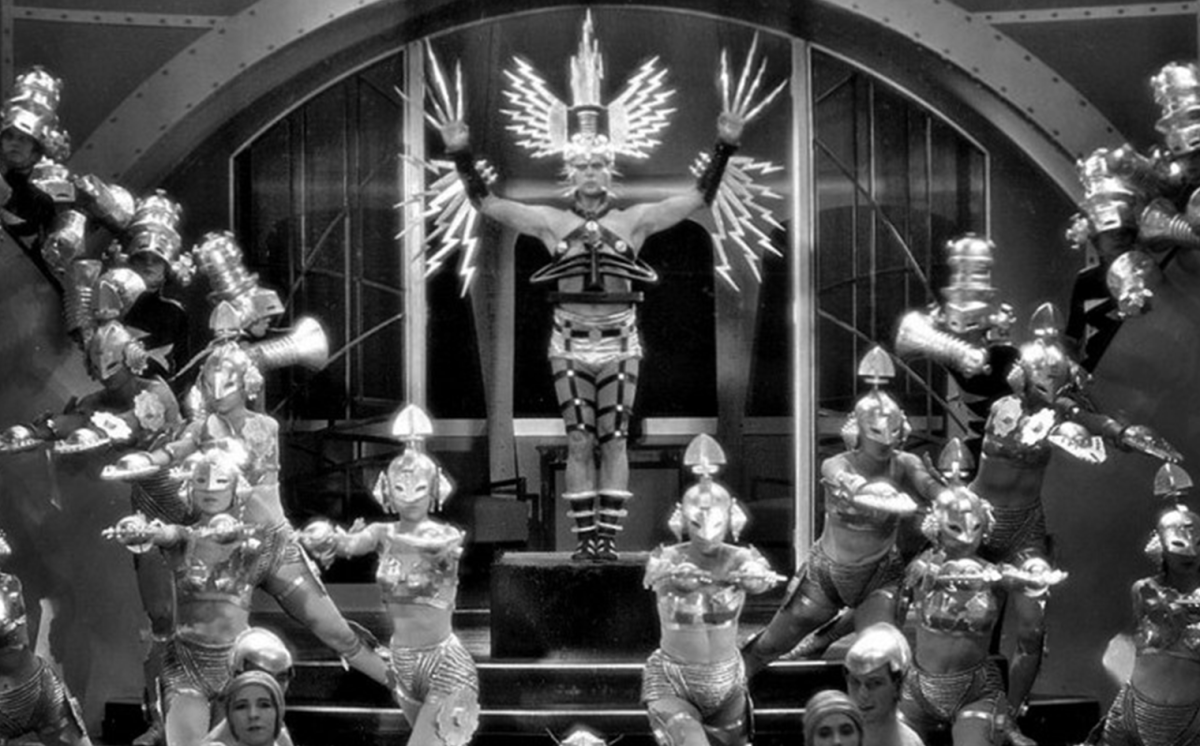
DeMille further invokes these images of machinery and technology in the film’s main dance sequence, the “ballet mécanique.” Paying homage to the wonders of electricity, Theodore Kosloff, a veteran Russian ballet dancer and long-time friend of DeMille, dances in the number as “The Spirit of Electricity” in an outfit with dozens of lightning bolts emerging from his body. Kosloff was originally set to be the dance specialist of Madam Satan, as he had often choreographed scenes in DeMille’s films, such as the Babylonian flashback sequence in Why Change Your Wife? (1920). However, Kosloff was in Dallas with his Imperial Russian Ballet company during the beginning stages of production and had also expressed hesitancy about DeMille’s focus on jazz for the zeppelin musical numbers. With the position open, DeMille set his sights on young choreographer LeRoy Prinz. It is still unclear whether Kosloff or Prinz choreographed the intricate “ballet mécanique” sequence, but no matter the choreographer, the number remains one of the most eccentric yet unforgettable scenes in the film. As the narrative picks up speed with Madam Satan’s initial appearance, Bob’s immediate infatuation, and her ultimate unmasking, the tone of the film rapidly shifts again when a thunderstorm hits the zeppelin. By incorporating higher stakes into the otherwise playful plot, DeMille adds weight to character’s choices as they decide whether they want love or a parachute.
After Madam Satan’s premiere in September of 1930, mixed reviews flooded in: some critics praised the picture’s set design, costumes, and more risqué elements, while more dour reviews suggested that the film was an expensive yet hollow comedy. Regrettably for DeMille, the film premiered in a market already oversaturated with musicals (the film was one of seventy-five released that year), resulting in Madam Satan fading into the background after its initial premiere. Though Madam Satan was one of DeMille’s few box office disappointments, after the film’s rediscovery in the 1990s, DeMille’s musical extravaganza gained cult status for its offbeat style and striking sequences, such as the highly elaborate parachute escape from the zeppelin. Unfortunately, the current version of the film is missing multiple scenes on the zeppelin which were shot in “Multicolor” and is rumored to have lost a musical number as well. Nonetheless, even in black-and-white, Madam Satan remains one of the most lavish and outlandish spectacles DeMille ever produced for the screen.