The following notes on Jacob’s Ladder were written by Sarah Mae Fleming, PhD candidate in the Department of Communication Arts at UW–Madison. A new 4K DCP restoration of Jacob’s Ladder will screen in the Cinematheque on Friday, February 20 at 7 p.m. Location is 4070 Vilas Hall, 821 University Ave. Admission is free!
By Sarah Mae Fleming
When star Tim Robbins and other principal cast members received probing questions from the press regarding Adrian Lyne’s Jacob’s Ladder (1990), such as “What is it about?”, their response was to emphasize ambiguity above all. Jacob’s Ladder exists, appropriately, between categories. It has been called a PTSD-centered Vietnam war film, a psychological horror film, and a spiritual allegory that dives into both Christian doctrine and Eastern philosophies. This liminality is imbued in the film’s history as a script once stuck in limbo. Screenwriter Bruce Joel Rubin’s script was named in a 1983 American Film magazine piece as one of the ten best unproduced scripts in Hollywood (alongside The Princess Bride and Total Recall), with the article describing it as one of the few screenplays with “the power to consistently raise hackles in broad daylight.”
Jacob’s Ladder follows Vietnam War veteran Jacob Singer (Robbins) as he navigates his life post-war in New York City. As his grip on reality begins to shake, Jacob is haunted by visions and struck by traumatic wartime memories. When Jacob receives a call from a former army comrade, and people in his life start to die in mysterious car explosions, a government conspiracy about secret-drug testing unfolds. What begins as a story of trauma and paranoia gradually takes on a more metaphysical dimension deeply rooted in Rubin’s lifelong preoccupation with death and spiritual transition. Rubin, best known for his Oscar-winning script of the same year’s Ghost (directed by Jerry Zucker), staked an interest in the process of dying. Jacob’s Ladder takes inspiration from a near-death experience Rubin had as a child involving an ice-bath and a 108-degree fever, an accidental 10-hour LSD trip he took in college, and his many years living in Indian ashrams and monasteries in Nepal.
The most significant catalyst, though, was a nightmare Rubin experienced in 1981. He later recounted the dream in his memoir: “I’m in a subway late at night, traveling through the bowels of New York. There are very few people on the train. A terrible loneliness grips me. The train pulls into the station and I get off onto a deserted platform. I walk to the nearest exit and discover the gate is locked. I hike to the other end of the platform but that exit is also chained shut. I am trapped and overwhelmed by a sense of doom. My one hope is to jump onto the tracks and enter the tunnel, the darkness. The only possible direction is down. I know that the next stop on my journey is Hell.”
Upon waking, he decided that he needed to try and write his way out of hell. Rubin claims that Jacob’s Ladder was the first movie he wrote that was “delivered.” In his words, he had “nothing to do with” writing it, and instead merely took dictation. The story poured out of him. After the script received some industry buzz from the American Film write-up, Rubin held out. He received a lot of offers from “Nightmare on Elm Street” types that aimed to make the movie happen on the cheap, but he waited for an offer that would come with a healthier budget. It was tossed around for a while, at points attached to both Sidney Lumet and Ridley Scott, but despite the admiration felt toward the story by many in Hollywood, every studio had decided that it was too big a risk.
Director Adrian Lyne, known for erotic thrillers like 9 ½ Weeks (1986) and Fatal Attraction (1987), eventually accepted the challenging screenplay. What attracted him was not just the script’s metaphysical ambition but its demand that spectators participate actively in constructing meaning. Lyne explains that he loves movies that really put you through it and “give you your seven bucks’ worth.” Lyne and Rubin collaborated—and argued—together for a year about how to bring Jacob’s Ladder to the screen. Rubin leaned more toward recognizable Biblical imagery that haunted him in his dreams, but Lyne pushed the film into a more understated vision of hell, inspired by Francis Bacon, William Blake, and Diane Arbus.
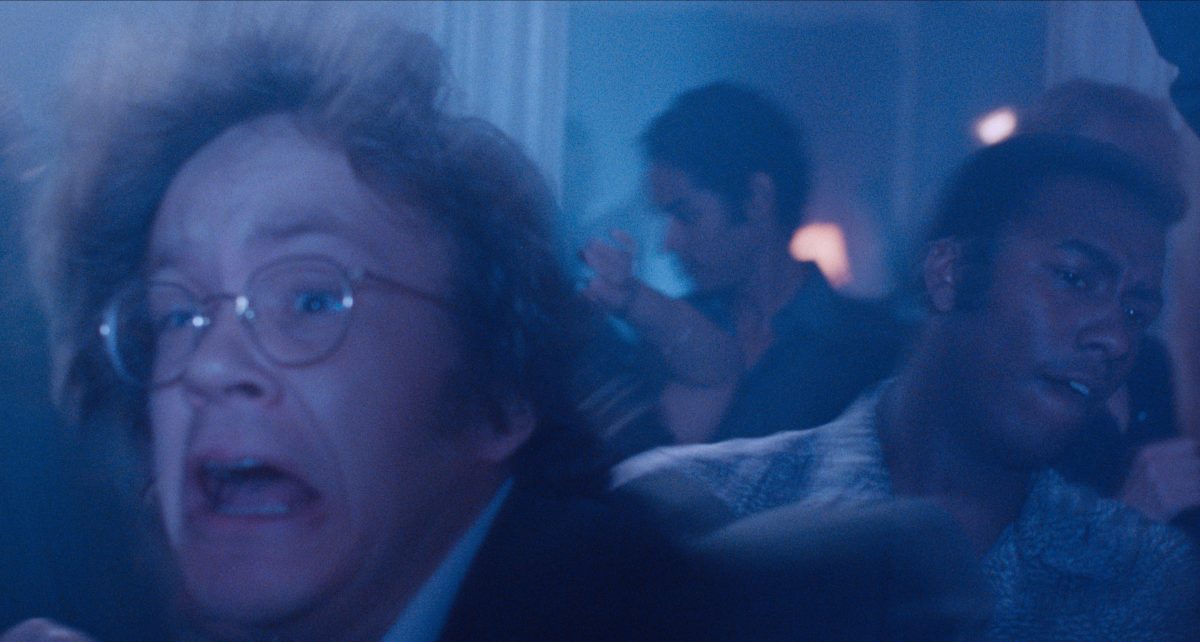
One of the most well-known images from the film is a whirring, vibrating head that Jacob begins to see. Heavily influenced by Bacon’s unsettling portraits, Lyne was committed to translating that eeriness with only in-camera effects. This was accomplished by filming performers violently shaking their head at a low frame rate, then playing it back at normal speed. As Lyne shepherded Rubin’s vision away from literal images of heaven and hell, he grounded the film’s imagery in practical effects and the lingering physical trauma of the Vietnam war. Instead of placing pitchforks in the hands of characters meant to portray demons, Lyne suggested something more akin to body horror: devil horns and serpent-like tails appearing as organic deformities, recalling the devastating legacies of Agent Orange and thalidomide.
In theaters, Jacob’s Ladder was a modest box office success, debuting at the top spot before being knocked off by the Chucky sequel Child’s Play 2. Indeed, Lyne recalls test audiences scratching their heads after focus group screenings, arguing about what they had just watched and wondering what the point of it all was. After its home video release, the film steadily acquired its cult classic status. The narrative’s structure rewards rewatching and audiences embraced the ability to pause, rewind, and retrace its disorienting turns, discovering new patterns each time.
Ultimately, Jacob’s Ladder isn’t really concerned with solving a mystery. Its fractured structure, shifting realities, and questionable perceptions point us toward questions about consciousness and passage from one world to the next. Rubin has often explained that his preoccupation with death is not rooted in morbidity but in making life legible. When asked why he writes stories about dying, he answered: “Because it’s only through embracing death that you get to know life. When you understand that death can come at any moment, then you see life for what it really is—totally, remarkably, unendingly precious.” Jacob’s Ladder is a war story, a spiritual fable, and an act of imagination of what dying might feel like—and what dying might tell us about living.