The following notes on Masaki Kobayashi’s Harakiri (1962) were written by Josh Martin, the Cinematheque’s Project Assistant and a PhD candidate in the Department of Communication Arts at UW – Madison. A 35mm print of Harakiri will screen at 4070 Vilas Hall, 821 University Ave, on Saturday, February 21 at 7 p.m. Admission is free!
By Josh Martin.
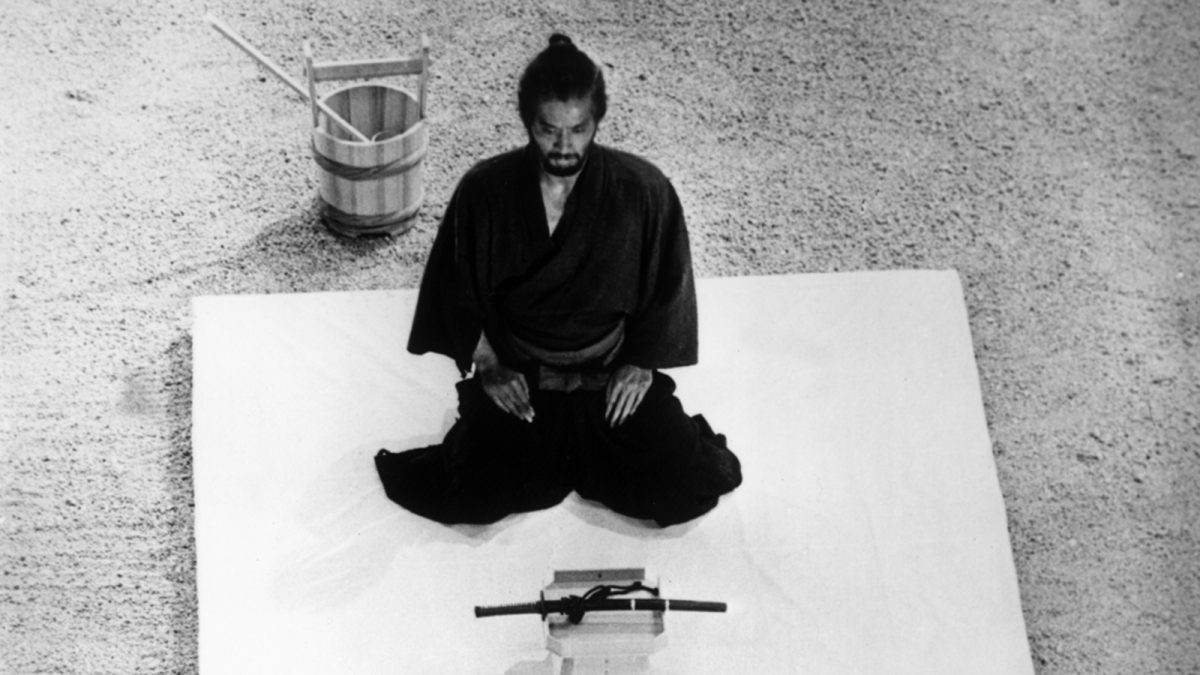
In the year 1630 in feudal Japan, it is a time of great peace, marked by the disbanding of once-formidable samurai clans. As Masaki Kobayashi’s Harakiri (1962) begins, a stranger arrives at the gates of the still-powerful Iyi clan, the camera slowly pushing in as he steps forward. The stranger is the samurai Hanshiro Tsugumo (Tatsuya Nakadai), who introduces himself as a former retainer of the Fukushima clan, now relegated to life as a down-and-out ronin. Clad in old rags, his face defined by deep, sunken eyes and a scruffy beard, Tsugumo moves in a nearly zombie-like fashion. Instead of “idly waiting for death,” Tsugumo has come to the Iyi clan with a request: he would like to use their court to commit hara-kiri, the ritual form of suicide completed by grisly disembowelment.
Kageyu Saito (Rentarô Mikuni), Iyi’s representative, is impressed by Tsugumo’s fortitude and honorable ambitions, but he holds some skepticism. Saito tells Tsugumo that, recently, many wandering ronin have requested the use of courts to commit hara-kiri with no intent of actually doing the deed, instead using such a request as a pretense for a job—or, more dishonorably, indirectly begging for a few coins to leave quietly. Saito asks Tsugumo if he knows the tale of Motome Chijiwa (Akira Ishihama). Much like Tsugumo, Chijiwa came to the Iyi clan requesting to commit hara-kiri. Instead of indulging him with money or a position, Iyi’s leaders called Chijiwa’s bluff, in the hopes of turning the young man into a cautionary tale. They accepted his request, immediately preparing the courtyard. Even when it was revealed that Chijiwa only possessed a sword made of bamboo—a weapon that “wouldn’t cut tofu”—the ritual continued, forcing the young ronin to complete this exercise in sheer cruelty and suffer a vicious, protracted demise. Tsugumo listens to the story, still insisting that his desire to die is honest, honorable, and true. Yet he also offers makes an important note: far from an anonymous stranger, Chijiwa is “a man of some acquaintance to” him. Indeed, Tsugumo’s visit has much to do with his former “acquaintance”—and the horrific fate he endured at the hands of the clan.
Produced at Shochiku and written by Shinobu Hashimoto, the veteran writer responsible for many of Akira Kurosawa’s classic films of the 1950s, Harakiri is widely touted as a masterful milestone of Japanese cinema—and a landmark in the career of director Kobayashi. It is a film of contrasting stories and sudden reveals, of thoughtful ruminations on the constructed narratives that form the bedrock of this faulty code of honor. Indeed, what Tsugumo argues throughout the film is that, far from ironclad and immovable, samurai honor is “a façade,” able to be molded and distorted when it benefits the men enforcing the code. By virtue of his intense protest against this system, Tsugumo becomes the vessel through which Kobayashi makes his central political argument. As Joan Mellen, the scholar of Japanese cinema, notes in her Criterion essay on the film, Harakiri is an example of the jida-geki, a type of “period film, in which the historical past becomes a surrogate for modern Japan.” For Kobayashi, then, Harakiri’s “condemnation of the Iyi clan” signifies both a critique of the endurance of “individual submission to the group” and “the giant corporations that recapitulated feudalism” in mid-twentieth-century Japan. The horrors of Chijiwa’s needless death remain potent, even centuries removed from the film’s setting.
In pursuing this argument against such systemic ills, Kobayashi mobilizes filmic space and the dynamism of his camera with an effortless and accomplished sense of precision. The film is stylistically deliberate and at times glacial in its approach, capturing the steady stasis of its mannered milieu. However, even with intrinsic limitations in terms of setting—much of Harakiri takes place in the Iyi clan’s courtyard, with members of the clan carefully positioned around Tsugumo—Kobayashi’s geometrically satisfying compositions and dazzling camera moves enliven the experience. At some key moments, crash zooms punctuate shocking revelations. More often, the camera slowly tracks through the courtyard, moving closer or further away from Tsugumo depending on the tenor of the scene, destabilizing the film’s carefully ordered world.
Harakiri is also a showcase for the late, great Tatsuya Nakadai, who passed away in 2025. A versatile performer equally capable of channeling upstanding moral authority (Kurosawa’s High and Low) and extraordinary malevolence (Kihachi Okamoto’s The Sword of Doom), Nakadai brings a little something of each extreme to his multi-faceted turn as the weary Tsugumo. Throughout his dealings with Saito and the Iyi clan, Tsugumo’s dry vocal delivery is often drained of much affect or emotion, characterized by a flat, monotone intonation indicative of a man at the end of his rope, already on the verge of becoming a ghost. As his intricate plan unfolds, that blank expression slowly dissipates, with a trickster-like spirit emergent in tandem with the film’s offbeat and playfully bleak sense of humor. Tsugumo often cackles as his mastery of this situation grows more evident, indulging a willingness to throw the wanton cruelty of the Iyi clan back in their faces. However, as the film’s melodramatic web of flashbacks expands, Nakadai offers yet another side of Tsugumo, finding a paternal caretaker thrust to the brink by the heartless conditions of his era.
Despite its genre and subject, there is a relative paucity of action in Harakiri—the thrilling sword fights one might associate with the genre are few and few between—yet the promise of horrific violence is constantly felt in the atmosphere, continually delayed and deferred by the film’s series of escalating narrative wrinkles. By the conclusion, the dam holding back the film’s deep well of impassioned anger finally erupts. Though grisly carnage abounds, there is little sensationalism in Tsugumo’s battles against the Iyi swordsmen. Kobayashi does not entirely deny the viewer the catharsis of these conflicts, but he often prefers to let his camera hover in nearly empty spaces, leaving the screams, grunts, and wails of pain audible to the audience but eliding the spectacle of brutality.
In the aftermath of Tsugumo’s visit, the Iyi clan finds itself in shambles. The clan’s once-proud crest has been splattered with streaks of blood; the beautiful, elaborate armor housed in their forecourt is strewn across the floor. But as time marches forward, the blood is wiped away. The armor is reconstructed to its pristine condition. The wounds and flaws exposed by Tsugumo are obscured and papered over, kept out of sight. Rather than admit that this code of honor is faulty, Saito opts to keep the lie going, rebuilding it from the ground up and reconstructing a sense of normalcy. The Iyi clan closes the book on an unsavory chapter in their proud history, yet the words of Tsugumo haunt these spaces (and linger in the minds of the viewer). This spectacular fortress—held together by a purportedly noble code of honor—is merely a mirage, a façade, waiting for its empty lies to be exposed once more, perhaps this time for good.