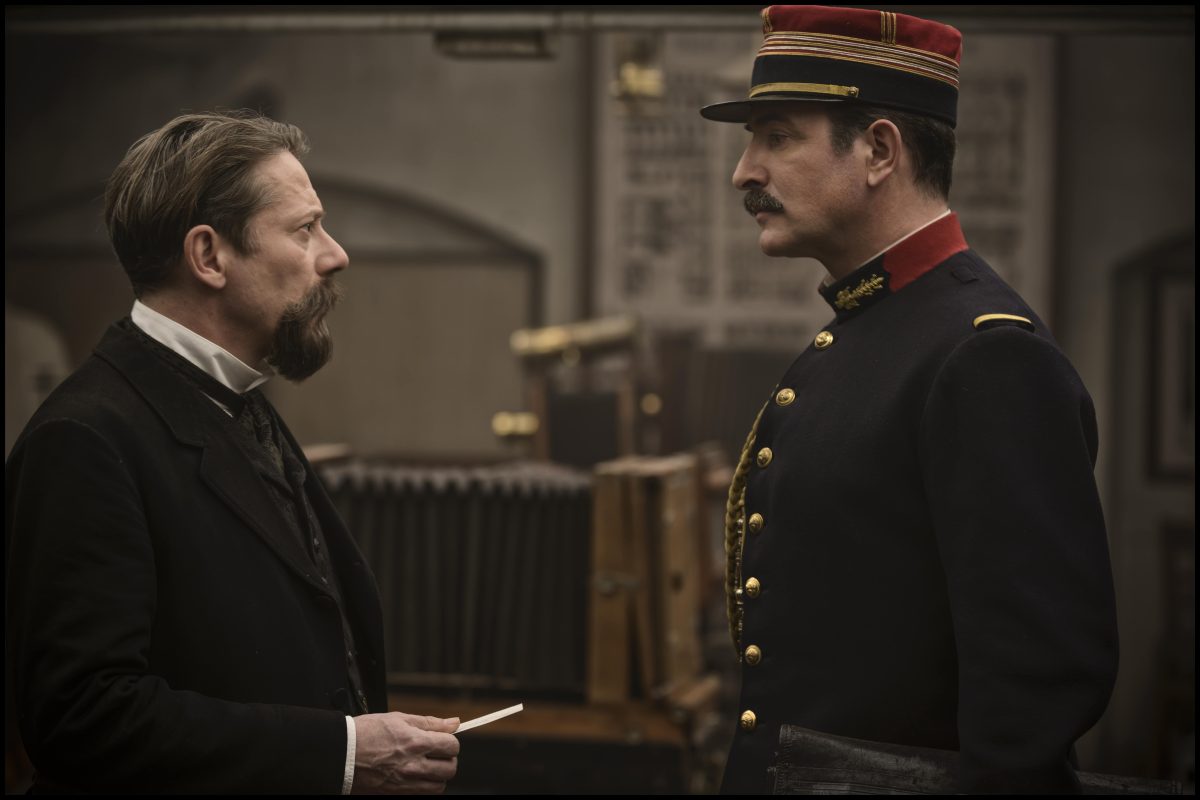
The following notes on Roman Polanski’s film An Officer and a Spy (J’accuse) were written by Will Quade, PhD candidate in the Department of Communication Arts at UW – Madison. An Officer and a Spy will have one showing only on Saturday, January 24, at 7 p.m., at the Cinematheque’s regular screening space, 4070 Vilas Hall, 821 University Ave. Admission is free.
By Will Quade
It has been a long, strange trip indeed for Roman Polanski’s studious recreation of the Dreyfus Affair, An Officer and a Spy (J’accuse), to reach American theatres. Originally premiering at the 2019 Venice Film Festival, the film received high praise and was awarded the Grand Jury Prize at its conclusion, but not before controversy predictably erupted. When Polanski was asked by a reporter if the film’s plot—a true story about Jewish French military officer Alfred Dreyfus’s spurious conviction of treason and the progressive political forces in fin-de-siècle France who came to his defense—had any personal significance to him, he responded: “I am familiar with many of the workings of the apparatus of persecution shown in the film… I can see the same determination to deny the facts and condemn me for things I have not done. Most of the people who harass me do not know me and know nothing about the case.”
This ambiguous statement, which might appear to combine Polanski’s childhood experiences as a Jewish Holocaust survivor and his 1977 conviction in the U.S. for the statutory rape of 13-year-old Samantha Gailey (now Geimer), came in the wake of renewed public conversation regarding the director’s criminal history and subsequent evasion of justice in Europe. While An Officer and a Spy received 12 César Award nominations (the French equivalent of the Academy Awards) and won three awards, including Best Direction for Polanski, its success prompted mass protests in France and walkouts during the awards show itself. With Polanski once again a source of consternation and anger, no American distributor purchased the film for release stateside after these developments.
Positioned as a potentially inflammatory, highly regarded, high-budgeted, unfindable work from one of cinema’s most influential and controversial artists, An Officer and a Spy can finally be shown to English-speaking audiences for what it is: the most definitive cinematic distillation of the Affair ever produced. Polanski joins George Méliès, Richard Oswald, José Ferrer, and Ken Russell as auteurs who have put their own mark on the story. As the Affair was coincidentally occurring during the birth of cinema itself, Méliès filmed his 11-part fictionalized serial in 1899 as Dreyfus’s second-court martial was concluding. Never once mentioning Dreyfus’s Jewish heritage, this aspect of the French officer’s identity began to be more appropriately foregrounded in later depictions of the Affair from the 1930s and after the Hollywood blacklist. Polanski’s film is the first to most prominently situate antisemitism as the issue of the entire Affair.
Surprisingly, Officer’s protagonist is not Dreyfus (Louis Garrel), but rather his former professor and Affair co-conspirator Marie-Georges Picquart (a remarkable Jean Dujardin). Steadfast in his duty to the army, the gentile Picquart is given a promotion as head of military intelligence for his work in the Affair only to quickly uncover the real spy and find himself in hot water for it. Based on long-time friend and novelist Robert Harris’s book, Polanski and Harris’s script dutifully follows the documentation and paper trail that led to both Dreyfus’s false conviction and the discovery of the true culprit. But more importantly, it shows a material chain of evidence in which Dreyfus’s guilt was jerry-rigged on the basis of his Jewishness alone. One of the film’s most exemplary illustrations of this is Picquart’s tense exchange with the State’s handwriting expert (Mathieu Amalric) whose shoddy work is quickly exposed as fraudulent. When asked for an explanation, Picquart receives a chilling reply: it’s a Jewish conspiracy.
As Picquart begins to uncover the rot at the heart of the French system, Polanski’s Paris is far from the glamorous stills painted by Toulouse-Lautrec. Lensed by trusted cinematographer Paweł Edelman in disconcerting digital sharpness, this Moulin Rouge is inhabited by lechers and traitors, can-can girls remaining blurry while a drunken patron urinates outside the door. Churches harbor priests, but they are also ports for spies and treachery. Romantic affairs are commonplace, but they end with a whimper instead of a bang. For as striking as the deep reds and velvety blues of the French military uniforms look, they are digitally tinged with a knowing reminder of their artificial, superficial nature, indicative of the hypocritical conspirators who wear them.
However, Polanski’s panache for crackerjack set-pieces and narrative economy makes for a gripping watch with nary a wasted moment. Editor Hervé de Luze binds the first half with somber, subtle spycraft, while the second is an unending barrage of action-packed consequences and courtroom outbursts. Similar to Costa-Gavras’s Z (1969), the exposure of the conspiracy gives the film a relentless pace, featuring a swordfight duel in a crisp, wintery barn reminiscent of Powell and Pressburger’s The Life and Death of Colonel Blimp (1943) along with several public fights. Filmed in Polanski’s dispassionate, multilayered framing, the Affair becomes so all-consuming that the barriers of the silver screen seem to melt away.
The film’s factual basis, scholarly assessment, and formidable craft could obscure its more bittersweet perspective. Indeed, An Officer and a Spy’s ending may be the most poignant of Polanski’s many ironic anticlimaxes. If, in the narrative of the film, justice is served (somewhat), it may not feel quite as triumphant as expected, especially with the specter of Nazi Germany on the horizon. Polanski himself was a Holocaust survivor, but he became a fugitive, evading justice after his conviction by the American legal system. Does Polanski then identify with the persecuted Dreyfus? Would such persecution be that of the Nazis or by the American government of the 1970s?
For some viewers, these questions will naturally arise over the film’s duration and can only be answered by a spectator concerned with such matters of personal autobiography. But after seven years of cultural repression, American audiences can finally confront the other questions and issues raised by An Officer and a Spy. Indeed, a film detailing a real-life fight against the lies of a corrupt “democratic” government—while an innocent individual endures military intimidation—may even be more politically resonant in 2026 than in 2019. Regardless, An Officer and a Spy arrives with its complexities intact despite, or perhaps because of, the man in the middle of it.