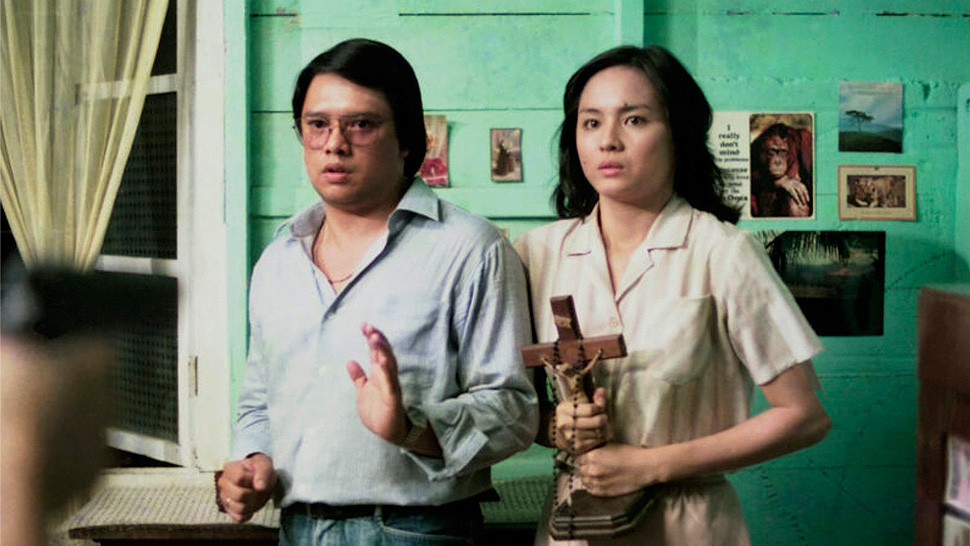
The following notes on Kisapmata were written by Marianne Nacanaynay, PhD student in the Department of Communication Arts at UW – Madison. A recent 4K restoration of Kisapmata will screen on Friday, December 12 at 7 p.m., our final screening of the year at 4070 Vilas Hall, 821 University Ave. Admission is free!
By Marianne Nacanaynay
“Walang ulo, nakanganga; walang mata, nasisilaw,” Dadong Carandang (Vic Silayan) says as he shows his daughter’s fiancé his retirement project: an earthworm farm. “No head, but mouth open wide; no eyes, but afraid of the light.” While the entire film serves as a potent allegory for the Philippine dictatorship of Ferdinand Marcos from 1965 to 1986, this early line in Mike de Leon’s Kisapmata (In the Wink of An Eye, 1981) reveals Dadong’s (and Marcos’) cardinal impulse: a totalizing rule over subjects rendered thoughtless and undiscerning—yet knowing enough to fear.
What makes Kisapmata terrifying is not a cunning villain nor a particularly clever protagonist—rather, it is the reality of a seemingly innocuous yet brutal and incestuous patriarch, who emanates such fear that it brings others to cower to him within days. Kisapmata begins with Mila (Charo Santos-Concio), Dadong’s daughter, confessing that she plans to marry her co-worker and implied boyfriend, Noel Manalansan (Jay Ilagan), because she’s pregnant. Dadong erupts in fury, but eventually meets Noel, allowing the two to marry once Noel meets his ludicrous dowry demands. Despite their marriage, Dadong compels the newlyweds to abide by his rules. They are made to live in the Carandang household, are expected to comply with a strict curfew, and must tell Dadong their comings and goings. While Mila tentatively attempts to rationalize such control, she admits no love for her father. It is heavily implied he sexually assaults her, with Mila bearing much guilt for such abuse as evidenced by her fervid and frequent prayer at an altar in her room. Eventually, Mila and Noel attempt to escape.
Though merely inspired by the real-life events documented by Nick Joaquin in the 1977 literary journalism piece, “The House on Zapote Street,” Kisapmata carried scenes so similar to the actual incident that Joaquin was under the impression de Leon had access to unreleased police reports. However, all the details de Leon derived from the story were limited to the original reporting’s approximately 12 pages, further substantiated by archival research. The entire film was completed in about three months, during a forced break in the production of de Leon’s Batch ’81 (1982), another renowned critique of martial law, which Marcos instituted in 1972. Though martial law’s effect on the media is often regarded for its role in television and newspaper censorship, films were also subject to increased censorship. De Leon’s resentment for the Marcoses intensified when Kisapmata was reviewed by government censors. The chief inquisitor claimed she phoned Ferdinand Marcos directly, who was appalled by the film’s depictions of incest. In order for Kisapmata to show at the Metro Manila Film Festival, de Leon was forced to cut a scene.
However, when submitting Kisapmata to the Cannes Film Festival, de Leon made a second version, which was used for the film’s 2020 restoration. The restoration in and of itself is a feat. An initial restoration of Kisapmata turned out to be the censored version, and the legal copyright holders of a print of the Cannes version refused to sell their rights or restore Kisapmata themselves. De Leon had an original print in Singapore’s Asian Film Institute, but the prints were already falling victim to vinegar syndrome. Though the work was difficult, L’Immagine Ritrovata salvaged Kisapmata for the version that screens today.
Kisapmata’s restoration and renewed screenings internationally is arguably timely, with its political resonances continuing to ring loudly throughout the decades. Its original release is considered part of the “second golden age” of Philippine cinema—movies first distributed between the mid-1970s to mid-1980s and regarded as responses to the Marcos regime. De Leon had long been critical of the Marcos regime, but Kisapmata is arguably one of his most pointed critiques of Ferdinand Marcos himself. Though Marcos began his presidency regarded as charismatic and well-liked, upon his declaration of martial law, it increasingly became clear that Marcos’ ambitions were to secure an unequivocal power and mass control of all Filipino people. His initial claims that martial law was to fight communist and Muslim “insurgencies” quickly unraveled as reports and allegations of human rights abuses ballooned. By 1976, Amnesty International found that Marcos had grossly violated international standards of human rights, predominantly through the mass detention and murders (both proven and alleged) of political dissenters. Beyond direct violence, the Marcos family has stolen billions of dollars from the Philippine people via the embezzlement of government funds, laundering them in overseas bank accounts, shell companies, and real estate. The total amount stolen is estimated by NPR to be about $10 to $30 billion—a fact further problematized when considering that about 40% of Filipinos survive on less than $2 daily, per The Guardian reports. Though Kisapmata is not about such explicit harms, its patriarchal themes and use of an abusive figurehead reveal broader ideas of a nation under tight control. Dadong controls Mila (and Noel’s) movements, contacts, and funds in ways difficult to separate thematically from Marcos’ control of the Filipino people.
When Kisapmata was restored and re-screened in 2020, funded by de Leon, it fell during former President Rodrigo Duterte’s rule, who was similarly accused of extensive human rights violations—he remains under investigation at the International Criminal Court for these crimes against humanity. Much like Dadong, Duterte carried a public air of casualness and informality, but sparked much fear when he declared his “War on Drugs,” which claimed to mitigate drug use but permitted large-scale extrajudicial violence as well as falsified police evidence in such efforts. In the 2019 short film Kangkungan, de Leon accused Duterte of supporting the return of the “sociopathic” Marcos family. Thus, it is no surprise that when Bongbong Marcos, Ferdinand Marcos’ son, and Sara Duterte, Rodrigo Duterte’s daughter, were respectively elected president and vice president of the Philippines in 2022, de Leon was similarly horrified. Though the re-election of two dynasties does not guarantee the reiteration of crimes (and sins) past, de Leon’s reactions and filmography divulge the extent of fear and harm embedded in such families, imploring us to remember these histories.
In his book, Mike De Leon’s Last Look Back (2022), de Leon recalled that he “naively” thought the nation “would start healing itself” after deposing Marcos through the 1986 People Power Revolution. That de Leon did not stop making such political critiques in his filmography suggests there was—and is—still more to mend. Regardless, Kisapmata maintains its relevance throughout time, whether specific to a Filipino context or ambiguously speaking to the kinds of abusers that may be running a house of fear. Despite its horrors, Kisapmata leaves us with a lingering question: Can things be different? Though Kisapmata does not offer an answer, it does show us what happens if we do not change, milling through the same soil Dadong’s earthworms have toiled.