The following notes on Who’s Afraid of Virginia Woolf? were written by Dr. John Bennett, PhD, graduate of the Department of Communication Arts at UW – Madison, and a former Cinematheque staff member. A 35mm print of Who’s Afraid of Virginia Woolf? from the vaults of the Wisconsin Center for Film and Theater Research (WCFTR) will screen at 2 p.m. on March 22 at the Chazen Museum of Art, part of the Cinematheque’s series of new acquisitions from the WCFTR. The Chazen is located at 750 University Ave. Admission is free!
By John Bennett
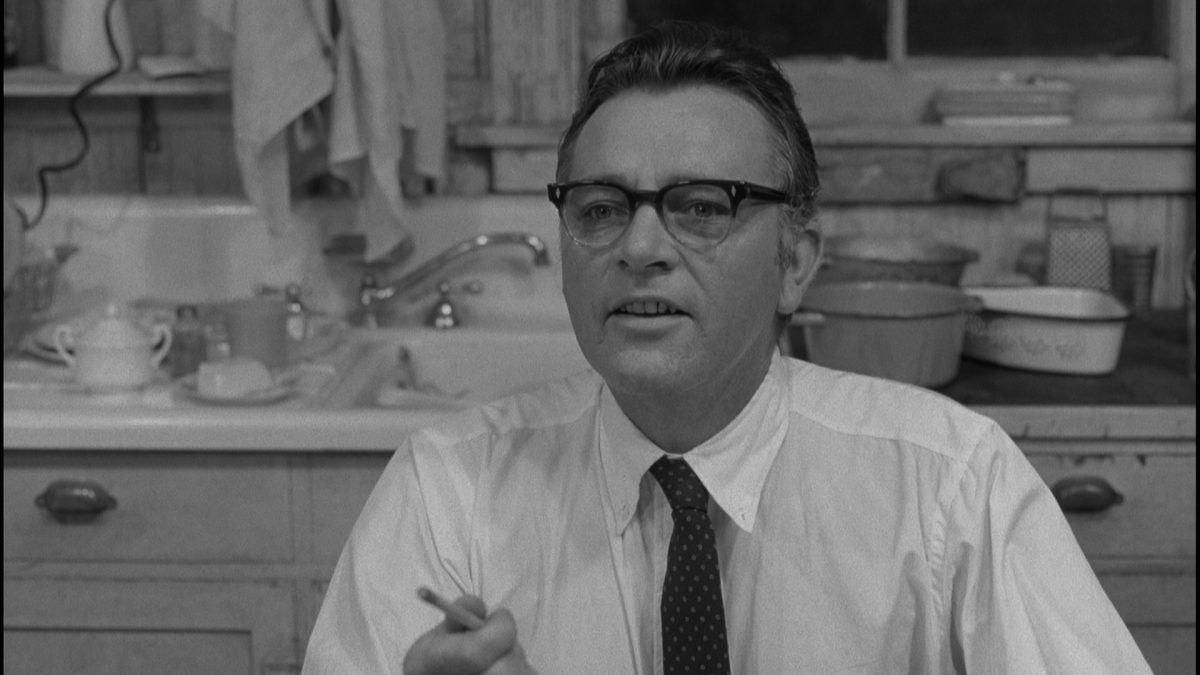
To those first encountering Edward Albee’s play or Mike Nichols’ eponymous 1966 film adaptation, the title Who’s Afraid of Virginia Woolf? may seem rather inscrutable. It, in fact, has virtually nothing to do with British modernist writer Virginia Woolf. Instead, it is an academic pun told at an academic cocktail party, sung to the tune of “Who’s Afraid of the Big Bad Wolf.” This is the song that idly knocks around in the heads of George (Richard Burton) and Martha (Elizabeth Taylor) as they drunkenly stagger back late at night from the party to their small, cluttered home near the campus of a New England college. George is an associate professor of history; Martha, his wife, is the daughter of the college’s president. At the outset of the film, one can already sense bitter acrimony bubbling between the couple. Martha informs George that she has invited a younger couple—a biology professor, Nick (George Segal) and his wife, Honey (Sandy Dennis)—for a nightcap. When the younger couple arrives, the boiling acrimony between George and Martha erupts in spectacular fashion as the two perform for the younger couple a no-holds-barred blood sport of mutually assured humiliation. The night progresses, the liquor flows; the venomous insults become more and more stinging, Nick and Honey become more and more ensnared in the older couple’s elaborate and destructive parlor games. This viciousness culminates in the revelation of a secret shared between George and Martha that is as sad as it is strange.
One cannot discuss Who’s Afraid of Virginia Woolf? without lingering on the enormous achievements of Elizabeth Taylor and Richard Burton. Throughout the mid-1960s, the pair, in the midst of their own tumultuous marriage, established themselves as a preeminent screen couple. They first worked together in the glitzy sword-and-sandal epic Cleopatra (1963), a mammoth film followed by the frothy dramedy The V.I.Ps (1963) and The Sandpiper (1965), a crimson-colored romance. None of these films, however, could have adequately prepared audiences for the performances both unleash in Who’s Afraid of Virginia Woolf?. As George, Richard Burton is slippery and needling yet defeated in the face of Martha’s brutal ritual of humiliation. He counters her relentless onslaught of insults with sly, darting counterpunches that paper over a depressive self-loathing resulting from a marred marriage and a curdled career. As Martha, Elizabeth Taylor abandoned her glacial glamour to play an unkempt, lusty, and terrifying force of nature. She snaps, she snarls, she seethes. She tosses back her messily coiffed head to explode in cackles of vicious victory and cries of deep despair. At times, her bawdy, braying demeanor is funny; at others, she is quietly agonized. Together, Burton and Taylor take the complex and oblique text of Albee’s play and masterfully color it with a wide range of the extremes of human emotion. Rounding out the cast, George Segal suitably plays the all-American Nick, who becomes a threat to George’s masculinity and a pawn in Martha’s games of revenge. Alternately, as Honey, Sandy Dennis’ gradually growing inebriation endows her with the bizarre affect of an alien.
The performances of Who’s Afraid of Virginia Woolf? are towering in large part thanks to the strength of the source material. Though Edward Albee’s play was adapted by screenwriter Ernest Lehman, the film largely keeps the text of Albee’s 1962 play intact. With Who’s Afraid of Virginia Woolf?, Albee crafted a work that manages, with engrossing, intelligent deftness, to be both acerbically funny and despairingly sad. In subsequent years, Albee’s plays would become more abstract and less easily adaptable for the screen; his Seascape explores an older couple’s encounter with humanoid lizard people, and his Three Tall Women features three characters referred to only as A, B and C—all different versions of the same character at different ages. Though Albee’s work was not adapted as often as, say, the plays of Tennessee Williams, those who recognize Who’s Afraid of Virginia Woolf? for the masterpiece that it is may seek out 1973’s A Delicate Balance, a lesser known work adapted by Albee from his Pulitzer Prize-winning play and helmed by British director Tony Richardson, in which Katharine Hepburn and Paul Scofield play a stuffier, WASPier iteration of an embittered middle-aged couple.
When it arrived on screens in 1966, Who’s Afraid of Virginia Woolf? helped usher in profound changes to how Hollywood handled mature content and themes. For over thirty years, Hollywood had self-censored its output in the form of the Production Code, which forbade much of the foul language that froths from the mouths of the film’s characters. Over the course of the 1960s, films like Hitchcock’s Psycho (1960) and Lumet’s The Pawnbroker (1964) had caused fissures in this system of self-censorship that was beginning to seem increasingly parochial to a liberalizing public. Still, the coarseness and vulgarity of the language of Who’s Afraid of Virginia Woolf? posed challenges for its distribution. According to Mark Harris’ Pictures at a Revolution, studio head Jack Warner developed a workaround in order to release a salacious film with bankable stars without the Code’s approval. The film was released with the designation “for adults only,” a designation that Warner Bros. enforced by having exhibitors sign contracts stipulating that minors would not be admitted. “Warner’s maneuver,” wrote Harris, “…effectively created the ‘R’ rating two years before a rating system existed.” This maneuver, along with the inherent quality of the film and its performances, paid off handsomely. Who’s Afraid of Virginia Woolf? was a critical and commercial powerhouse, becoming one of the top grossing films of 1966 and netting thirteen Academy Award nominations, with Taylor and Dennis winning for their performances.
Who’s Afraid of Virginia Woolf? also anticipated the arrival of the New Hollywood through the direction of Mike Nichols. Nichols had come up in theater, finding success for his comedy work with Elaine May as well as his stage direction of several Neil Simon hits. Burton and Taylor advocated for Nichols to lead the production of Who’s Afraid of Virginia Woolf?, which the first-time director tackled with a claustrophobic visual rigor. His subsequent films, such as The Graduate (1967) and Carnal Knowledge (1971), explored knotty relationships and frank sexuality in much the same way as Who’s Afraid of Virginia Woolf?. Nichols was assisted by a production team who helped to maximize the force of Albee’s text. On top of the film’s stunning performances, Haxwell Wexler’s crisp yet shadowy cinematography allows us to see every grimacing furrow and every stray lock of hair that slash across George and Martha’s faces as they stalk, clutching cocktail after cocktail, among the shadowy recesses of their home. Richard Sylbert’s production design transforms that modest home into a slovenly viper’s den, crowded with stacks of worn books and depleted liquor bottles. Composer Alex North’s strikingly gentle, thrumming string leitmotif teases out the film’s undercurrent of pained tenderness that might otherwise be obscured by the spitting vitriol of the dialogue. Together, along with the towering and resourceful performances of Burton and Taylor, these contributions make Who’s Afraid of Virginia Woolf? a biting, bitter, achingly sad masterpiece of American cinema.