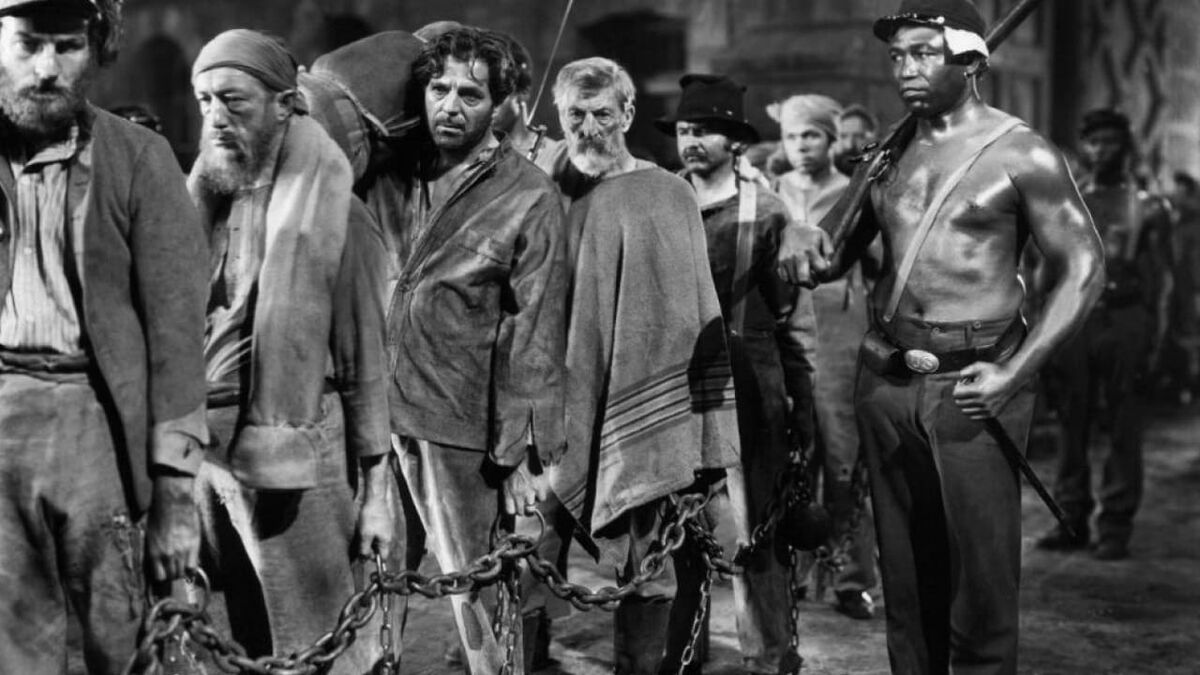
The following notes on John Ford’s The Prisoner of Shark Island were written by Professor Lea Jacobs, Professor Emeritus in the Department of Communication Arts at UW-Madison. A rare 35mm print of Shark Island will be screened on Friday, March 20 at 7 p.m. in the Cinematheque’s regular screening space, 4070 Vilas Hall, 821 University Ave. The screening is the third in the Cinematheque’s “John Ford At Work” series, presented in conjunction with the publication of Lea Jacobs’ new book, John Ford at Work. Professor Jacobs will discuss The Prisoner of Shark Island before and after the screening and books will be available for sale ($25). Admission to the screening is free!
By Lea Jacobs
The Prisoner of Shark Island was the first of many collaborations between Ford and producer Darryl F. Zanuck. The film went into production in November 1935, a few months after the merger of Fox and Zanuck’s 20th Century was finalized. Many accounts of the relationship between Ford and Zanuck have emphasized the director’s resistance to the producer’s executive oversight and his almost fanatical concern to protect his autonomy and control during shooting. Screenwriter Philip Dunne remarked: “When he worked for Zanuck, they had a few clashes, because Ford, after all, was a very temperamental feisty character, he’d flare up over any kind of criticism. That happened with Darryl, but he didn’t win any arguments with Zanuck. There was no question who was the boss.” Nevertheless, cameraman Arthur C. Miller recalled that when a studio executive came on the set of Wee Willie Winkie to inquire why the company was “behind”, Ford ripped pages out of the script, claiming to have thereby “caught up.” And Ford biographer Joseph McBride reports that Ford did not show up to watch the dailies for The Prisoner of Shark Island in the producer’s company despite Zanuck’s instructions to the contrary. Moreover, as has been frequently discussed, Ford consistently limited the number of camera positions on a scene as well as the number of takes that he turned over to the studio.
While the standard account of the conflicted relationship between producer and director is revealing in many ways, it does not do full justice to the nature of the collaboration that contributed to the excellence of their films. Ford did generally shoot films for Zanuck as scripted, while Zanuck, a gifted producer who was adept at assessing and exploiting the talent available to him, leaned into Ford’s strengths. The example of The Prisoner of Shark Island gives an indication of how their collaboration worked.
Zanuck came up with the idea for the film inspired by a February 4, 1935 piece in Time magazine. The article recounted the story of Samuel Mudd, the physician who treated John Wilkes Booth’s broken leg after the assassination of President Lincoln and, widely reviled, was sentenced to life imprisonment as a co-conspirator. The article also gave a compelling account of the place where Mudd served his sentence: Fort Jefferson on the Dry Tortugas reef off Key West in the Gulf of Mexico. During the Civil War, the previously abandoned fort had been repurposed as a military prison and surrounded by a shark-filled moat. Zanuck and screenwriter Nunnally Johnson worked intensively on creating the film’s storyline in February and March 1935, before the merger with Fox. Zanuck commissioned an analysis of Nettie Mudd’s The Life of Dr. Samuel A. Mudd, originally published in 1906, largely a collection of her father’s prison correspondence. Raymond Griffith made the first attempt at a narrative continuity in a set of notes dated February 21, 1935. A week later, Zanuck responded with two memos that together provided a rough outline of the story as it was eventually filmed. Johnson wrote two more detailed treatments, one in April and a lightly revised version in June. All of this work was done at 20th Century and without any anticipation of Ford’s participation as director.
However, the script drafts of August and October were written after the merger and with the expectation that Ford would direct. These scripts indicate familiarity with Ford’s work and his directorial strengths. The draft of August 12, 1935 refers to Ford’s Arrowsmith (1931) which, like Shark Island, recounted the story of a heroic doctor fighting a yellow fever epidemic. The October drafts call for the production of a miniature of the prison including a lighthouse with a revolving light that then motivates periodic illumination of the grounds during the prison escape sequence. This recalls the use of the beautifully lit night-time miniatures in Air Mail. There is a possibility that the lighthouse effect was suggested by Ford himself in early discussions with the producer, but in any event, the fact that construction of the miniature was called for in the scripts makes clear that screenwriter and producer were onboard with Ford’s ideas and expected low-key illumination and effects lighting during the escape scene.
There are other indications that Zanuck was cognizant of Ford’s experimentation with low-key lighting and atmospheric effects. In an interview near the end of his career, Zanuck praised Ford’s visual style generally and The Informer specifically: “He won his first Oscar with The Informer which was a visual masterpiece almost unparalleled in cinema history.” Zanuck gives a much less enthusiastic description of Ford’s style in a memo to Elia Kazan and John Steinbeck written during preparation of Viva Zapata: “I am wondering … if it may not seem as if we are trying to make an art or ‘mood’ picture. The kind of thing John Ford does when he is stuck and has run out of plot. In these cases, somebody always sings and you cut to an extreme long shot with slanting shadows.” But despite the retrospective irony, in 1935 Zanuck was apparently looking for a little of that mood magic for the scenes in Fort Jefferson. Ford’s own characterization of The Prisoner of Shark Island in a January 1936 interview as having “some of the qualities of The Informer but more Hollywood”, may have reflected his understanding with Zanuck.
Despite constant tension in their working relationship, it should be clear that from their first film together Zanuck and Ford collaborated productively. Their teamwork developed through three principal avenues. First, despite screenwriter Johnson’s repeated claims that Ford had nothing to do with the script, the six-week lag between Ford’s start date and the commencement of production on The Prisoner of Shark Island suggests that Zanuck took on Ford’s suggestions for the final drafts. This supposition is supported by examples of the director’s later films for Twentieth Century-Fox for which story conference notes survive. Second, Zanuck knew Ford’s films, and he built off what the director had done in the past. Hence the references to Arrowsmith and what seems to have been a deliberate reworking of set design and lighting strategies in The Informer for the Shark Island prison escape. Finally, on Ford’s part, it seems clear that along with his colleagues, set designer William Darling and cinematographer Bert Glennon, he took the script, and especially Nunnally Johnson’s tautly written account of the prison escape, as an inspiration and springboard for further invention. Darling’s monumental set, beautifully lit for both night and day, became the arena for the director’s imaginative staging and powerful images.