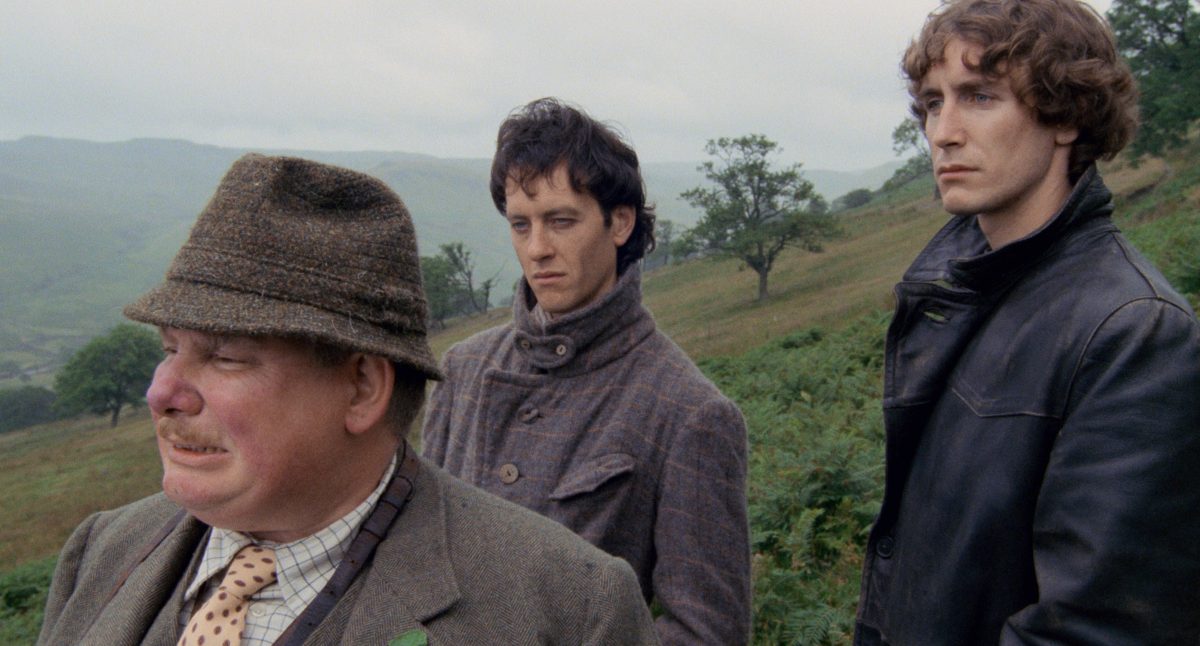
The following notes on Withnail and I were written by Max Kaplan, PhD candidate in the Department of Communication Arts at UW – Madison. A new 4K DCP of Withnail will screen on Saturday, February 28, at 7 p.m., in the Cinematheque’s regular venue, 4070 Vilas Hall, 821 University Ave. Part of our Owen Kline Presents! series, the screening will be preceded by a brief introduction from our weekend’s guest curator, filmmaker and actor Owen Kline.
By Max Kaplan
For all that is made of Withnail and I as the ‘ultimate British cult film’—one that has inspired annual screenings, stage adaptations, and yes, even drinking games—it begs to be added that Bruce Robinson’s 1987 classic is undoubtedly the ultimate hangover film as well. Unfolding like the worst days-after rolled into one, it throbs, gurgles, and winces into a magnificent tapestry of hapless discontent. One look at the sweaty, jaundiced faces of its protagonists, the out-of-work actors Withnail (Richard E. Grant) and Marwood (Paul McGann), is enough to convey the wooly desperation that accompanies the aftermath of unmitigated excess. Or as Withnail puts so nicely, “I feel like a pig shat in my head.”
Originally penned as an autobiographical novel before being reimagined as a screenplay, Robinson’s reminiscence of bohemian London in the late 1960s strives for a particular sort of universal experience: “All of us in a sense have had these kind of six months or a year intense relationships with someone when you’re on destruct,” he remarked in an interview, continuing, “I certainly lived through that and I’m pleased I got through it.” Unlike the rosier American brand of nostalgia-tinted autofiction—as seen in American Graffiti (1973), Dazed & Confused (1993), and Almost Famous (2000)— Withnail and I paints the past in much starker, patently English colors, implying that this time gone by is less something to reflect whimsically on, and more something to be thankful to have gotten through.
Abandoning his own fledgling acting career for one in screenwriting, Robinson found a breakthrough with his screenplay for the widely acclaimed feature The Killing Fields (1984) about the Cambodian genocide. With this newfound cachet, he returned to his dream project of Withnail. Thanks to the financial assistance of ex-Beatle George Harrison, whose production company Handmade Films had found enormous success with Monty Python’s Life of Brian (Jones, 1979), Robinson was able to explore his comic range with free latitude. Despite favorable reviews, the film failed to strike a commercial chord in a Thatcherite Britain which had soured on the idea of the 60s. It was only later, upon the arrival of home video, that Withnail and I achieved its cult status. Taking ‘kitchen sink realism’ to literal new heights, Robinson’s dream project made alluding to Shakespeare, Keats, and Wordsworth cool—while making the late 1960s appear decidedly passé.
The film’s ambling plot adheres to a hangover logic in its own right. Throughout, Withnail and Marwood flee the dire straits of their London flat, constantly beckoned forth by the next most pleasurable option, which, unsurprisingly, turns out to be not very pleasurable whatsoever. And yet, there’s a grotesque beauty to it all. Through Peter Hannan’s subtly striking cinematography, Withnail and Marwood’s ill-fated adventures assume a whimsy which belies their utter destitution. The muted hues evoke England’s dampness at a visceral level, to the point where one can almost smell the manure and gasoline wafting through the air as the pair trudge across the Lake District landscape, or feel the stale, sticky ale coating the ratty counters of the Crow and Crown pub.
But beyond all the lurid imagery, Withnail’s lasting cult appeal relies largely on its unforgettable characters and the searing hilarity of Robinson’s script. Withnail himself is something to behold. At once debonair and downright filthy, Grant’s titular role has become a British icon, even enshrining the “Withnail Coat” in the annals of film jacket history alongside Jim Stark’s red Harrington in Rebel Without a Cause and Neo’s long black trench coat in The Matrix. Film scholar Tim Smith chalks Withnail’s plight down to his “uncompromising quest for authenticity,” yet he goes on to point out that his “invective and hyperbole, his rhetoric and histrionics are at once a smokescreen and a defense mechanism to keep the world at bay, and a means of ordering things so as to engage with reality obliquely.” The results of this oblique engagement with reality often manifest in riotously drunken altercations, whether at a quaint rural teahouse, or on the side of the freeway after being pulled over by the police. As much as we squirm and recoil alongside Marwood, we can’t help but be drawn in by Withnail’s strange magnetism, and ability to conjure comic mayhem out of thin air.
Beyond Grant’s electrifying performance, McGann exceeds in his duties as the consummate straight man, as his own physicality acts as a proxy onto which the audience can project their bewilderment. But two of the film’s most enduring characters come from the supporting cast: Ralph Brown as the beyond spaced-out drug dealer Danny, and Richard Griffiths—known to many as Vernon Dursley in the Harry Potter series—as Withnail’s Uncle Monty. While Danny is a caricature of the disillusioned bohemia that Withnail and Marwood are so pointedly escaping, Monty is something of a more complex and baffling creation that writer and critic Olivia Laing sums up best: “He ought to be a dodgy, homophobic caricature—Withnail and I ought to have dated in that respect—but the reality of the character, of Griffiths’s cherubic sweetness, and of the grace notes the script gives him skips over all those possible pitfalls.” Griffith’s line deliveries, replete with a dandified cadence and anachronistically rolled-r’s, are often scene-stealers, no matter if he’s waxing poetic about true beauty or making grand claims about the mystery and certain ‘je ne sais quoi’ about a firm, young carrot.
Like The Big Lebowski—another cult comedy centered on a wholly different sort of schlub— Withnail has become one of those endlessly quotable films that is downright unbearable to watch alongside one of its devotees. Withnail also shares with the Coen Brothers’ slacker classic a skewering eye at the remains of the countercultural idealism that the 1960s left in its wake. While it may outwardly reject notions of 60s nostalgia, Withnail and I has nevertheless become one of the defining films about the decade. From its needle drops of Jimi Hendrix classics—an artist who would make it but nine months into the next decade—to its strung-out poster designed by Hunter S. Thompson collaborator Ralph Steadman, the film stands as a monument to the impending hangover from 60s psychedelia. As Danny puts it, “They’re selling hippie wigs at Woolworth’s, man. The greatest decade in the history of mankind is over…we have failed to paint it black.” Danny and his baritone mate Presuming Ed, however, are the film’s only avatars for the counterculture. Withnail and Marwood may be hedonists, winos, speed freaks, and eccentrics, but they’re no hippies. Through their bleary eyes, we’re taken through a changing world that no longer makes sense, especially without a drink in one’s hand. Allegorizing the hangover that is history, Withnail and I is an anarchic reminder that comedy is tragedy plus time.