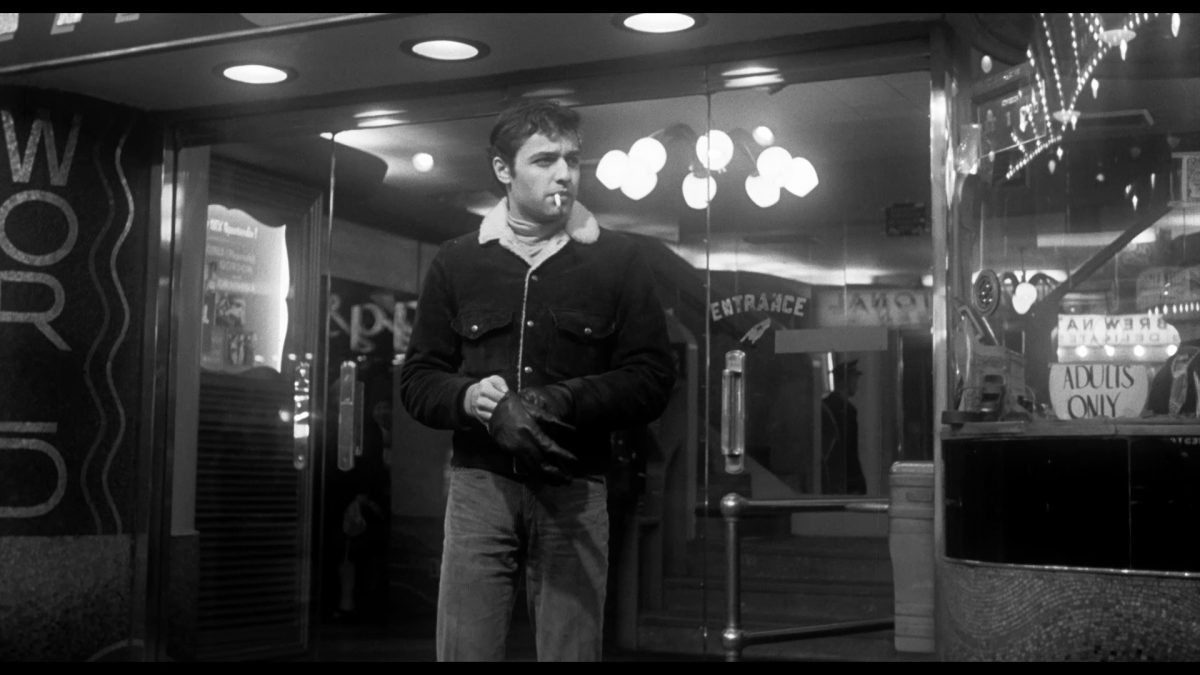
The following notes on Who Killed Teddy Bear? were written by Josh Martin, the Cinematheque’s project assistant and a PhD candidate in the Department of Communication Arts at UW – Madison. A recently struck 35mm print of Teddy Bear‘s uncensored version will be screened at the Cinematheque’s regular space, 4070 Vilas Hall, 821 University Ave, at 4:45 p.m. on Saturday, February 28. Part of the Cinematheque’s Owen Kline Presents! series, this screening will be preceded by an introduction from filmmaker and actor Owen Kline, grandson of Who Killed Teddy Bear?’s director, Joseph Cates. Admission is free!
By Josh Martin
In an early scene in Joseph Cates’ NYC shocker Who Killed Teddy Bear? (1965), police lieutenant Dave Madden (Jan Murray) rattles off a litany of sexual disorders to Norah Dain (Juliet Prowse), a young woman besieged by the breathless, frightening lewd phone calls of an unknown degenerate. Amused by the detective’s near-encyclopedic knowledge of the “sadomasochists” and “necrophiliacs” haunting the city, Norah remarks that the detective “[seems] to know a lot about these things.” Madden offers a short, grimly humorous retort: “Someone should.” We later come to understand the motivations for Madden’s plunge into perversity: his wife was raped, mutilated, and murdered, leaving him a single father to a precocious young daughter (who has sadly absorbed some of her father’s morbid knowledge). However, Madden’s insistence on grappling with the grisly, psychologically twisted crimes occurring across the city is not framed as some kind of righteous pursuit of justice. Instead, Teddy Bear finds something chilling and unnerving about the morally dubious habits of men of all stripes, whether it is the repressed trauma of disturbed busboy Lawrence Sherman (Sal Mineo), the chauvinistic glances of the male patrons of a discotheque, or, yes, the single-minded, almost obscene obsessiveness of a police detective.
Who Killed Teddy Bear? has gained a reputation for its transgressive nature, functioning as an unflinching look at the sexual underbelly of 1960s Times Square. Indeed, Cates’ film revels in the pleasure of the filth, its irresistibly seedy mode of realism gaining verisimilitude by gazing upon the cheap pornographic magazines littered throughout the nocturnal neon-lit streets. With the earworm “Born to Be Bad” routinely playing on the soundtrack as the film’s discotheque denizens twist the night away, it’s not difficult to walk away feeling some illicit pleasure in its exploration of deviancy. Yet what makes Teddy Bear so striking—and what allows it to remain even more slippery and charged today—is its more ambiguous attitude to this material, its refusal to function merely as easy exploitative sensationalism. In its deep dive into a Freudian paradise of fetishes and complexes and neuroses, the film also discovers something repulsive and terrifying about its subjects and its cityscape, the way that every man seems to be struck by some permutation of perversion. “I think there’s a little bit of this jerk in every guy, including the cops,” sneers Marian (Elaine Stritch), Norah’s lesbian boss at a local disco joint, “Maybe they’ve all got a guilty conscience.” With Norah at its center, Who Killed Teddy Bear? ultimately captures the terribly sad reality of being a woman caught in the middle of a sick world with no easy way out.
Even if Teddy Bear goes to lengths that other classics of the era would not, it is far from the first film of its time to chronicle the sexual dysfunction and violent impulses of troubled young men. In an oft-cited review, employed to promote the film for its Anthology Film Archives run in 2010, the critic Anton Bitel suggests that Who Killed Teddy Bear? calls to mind both Peeping Tom (Michael Powell, 1960) and Psycho (Alfred Hitchcock, 1960). For a viewer familiar with Powell and Hitchcock’s films, the comparison will no doubt seem evident. Mineo’s busboy, reserved by nature despite his imposing physique, shares plenty of warped DNA with Mark Lewis (Karlheinz Böhm) and Norman Bates (Anthony Perkins), respectively. Like his boyish, innocent-until-proven-murderous predecessors, his relationship to sex is permanently broken by the aftershocks of his youth. After an obscuring of this primal scene in the film’s opening salvo, we later learn that Lawrence’s sister became disabled after running away and falling when she saw him in a sexual tryst with a woman. Blaming himself and wracked by guilt, Lawrence is now a paragon of intense repression, turning all of his sexual energy inward until it bursts forth in increasingly deranged ways.
Perhaps even more potently, Bitel suggests that Teddy Bear is the “missing link” between those landmarks and key films of the 1970s, notably Bob Clark’s stalker chiller Black Christmas (1974) and Martin Scorsese’s Taxi Driver (1976), featuring Robert De Niro as God’s lonely man, Travis Bickle. Of course, for a reader familiar with the history of the Production Code, which governed the limits of Hollywood’s content from the early 1930s to the late 1960s, all this talk of sexually charged material—and the comparisons to four extraordinarily controversial classics—will inevitably raise the question of censorship. Even with the Code fading by the mid-1960s, it should come as no surprise that Teddy Bear long existed in a censored version, losing four of its most objectionable minutes. However, in an accompanying essay written for the film’s 4K Blu-Ray release, John Charles notes that the truth is slightly more complicated than a simple Code rejection. The film did not receive a Production Code seal of approval, but it also did not necessarily seek one out. Instead, the producers initially released the uncensored version in a few theaters, only to turn around and quickly re-cut the film, perhaps without Cates’ approval or even his participation. In Charles’ description of the cuts, the picture painted is one of a film with its most prickly, discomforting edges inelegantly sanded off: some language toned down here and there, pornographic images obscured or blurred, an allusion to necrophilia elided, and so on. Limited to this censored version for the better part of six decades, a recent restoration of the original cut of Teddy Bear, initiated and funded by filmmaker Owen Kline, Cates’ grandson, fills in the gaps and completes Cates’ unabridged vision. Thus, the new 35mm print screening at the UW Cinematheque—as well as the restored Blu-Ray release—allow viewers to see the definitive version of Teddy Bear.
What audiences will find is a film that, decades later, still possesses the ability to rattle and shock. In another essay for Teddy Bear’s home media edition, Kyle Turner describes the film “as a Venus flytrap of a masterpiece,” eager to “[turn] its gaze back onto an audience ‘sick’ enough to want to watch it in the first place.” He also sharply notes that “the word ‘lurid’” is employed as a descriptor for Teddy Bear “so often that the term might as well show up in the main credits.” Turner is right to call attention to this linguistic overreliance, in part because the promise of a lurid trip dupes the audience into expecting something purely trashy or thrillingly gratifying. The sleaze no doubt shines through, captured by Cates’ accomplished direction: it is impossible not to be dazzled when Lawrence runs home after his first kill, with sudden cuts to flashes of lingerie, mingling bodies, and skin flicks providing snapshots into his guilty mind. But if there is some illicit pleasure in this walk on the wild side, there is also abject horror to be found in the film’s destination: sickening sexual violence presented in a matter-of-fact manner, perpetrated by a man whose traumatic past papers over what is, for all intents and purposes, garden-variety misogyny. As the film concludes, a feeling of profound helplessness sets in, a sense that there’s little chance of stopping the harms of this salacious depravity. Despite Lt. Madden’s belief that “someone should” know about this hidden world of perversion, Who Killed Teddy Bear? suggests that knowledge itself might not always be so powerful.