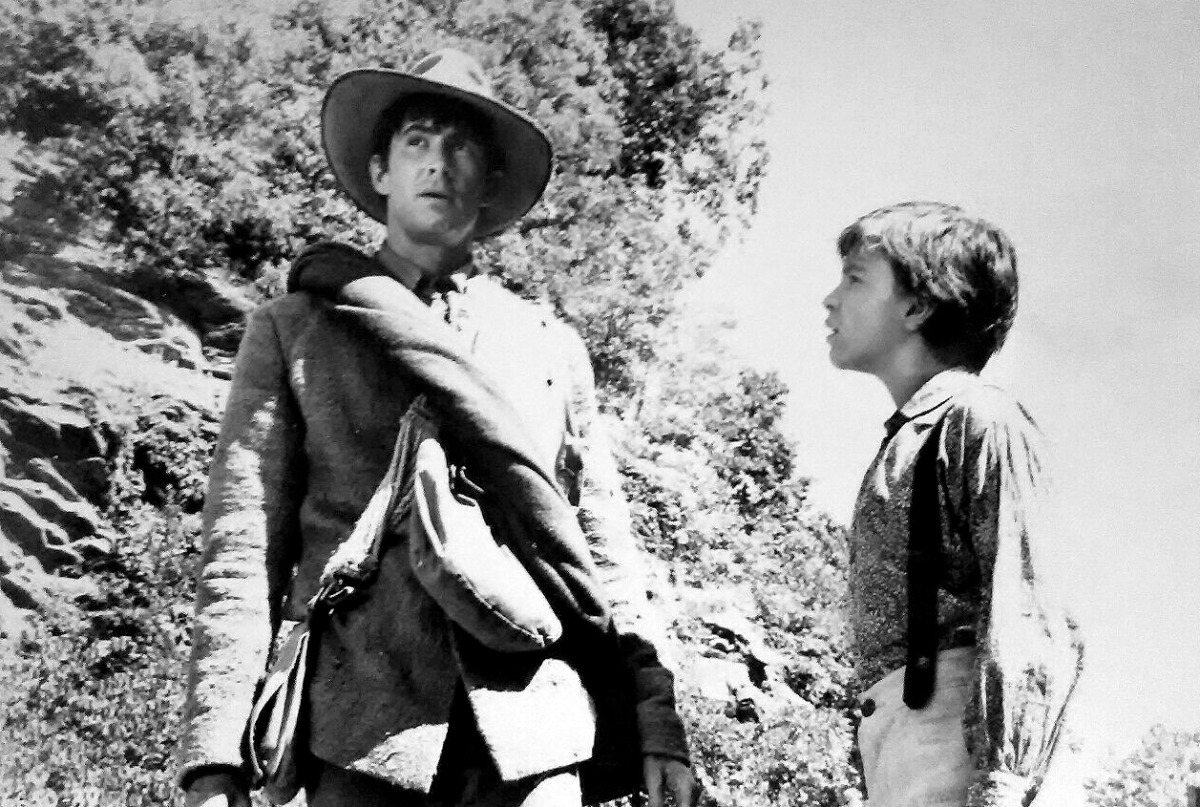
The following notes on The Fool Killer were written by Ashton Leach, PhD candidate in the Department of Communication Arts at UW – Madison. A very rare, 16mm print of The Fool Killer will screen as part of our Owen Kline Presents! series on Saturday, February 28 at 12 noon, preceded by an introduction by filmmaker Owen Kline. The screening will be at 4070 Vilas Hall, 821 University Ave. Admission is free!
By Ashton Leach
Directed by the Mexican filmmaker Servando González and featuring a post-Psycho performance from Anthony Perkins, The Fool Killer came and went without receiving much attention in 1965. Adapted from Helen Eustis’ 1954 novel of the same name, it is a methodical combination of Southern Gothic folk tales and a coming-of-age adventure. The film closely follows Eustis’ episodic structure, resisting the temptation to streamline the story into conventional narrative beats. While it did not receive much recognition upon initial release, it clearly reflects many of the themes from the era, including the loss of innocence and the question of morality in the age of social instability. In its challenge to the status quo, González’s film anticipates the dissolution of genre boundaries popularized by the New Hollywood movement of the late 1960s and early 1970s.
Shot on location in Tennessee, the film achieves a transportive quality in its depiction of the vastness of the post-war rural southern landscape. Though faced with logistical challenges during filming (including the unpredictability of weather and a modest budget), cinematographer Alex Phillips Jr. captures the roughness of the land with overcast skies and barren fields with a melancholic beauty; it harnesses both the danger of the wild and the excitement of movement and continuation. The setting becomes significant as it mirrors the life of young George Mellish (the debut role of Edward Albert). The story begins as George escapes his foster father’s belt in a claustrophobic rural household. The violence is not stylized, instead retaining a bluntness that augments George’s humiliating surroundings. The young boy flees by hopping onto a freight train, casting himself into the uncertain expanse of the Reconstruction-era South, vulnerable in the face of this formidable landscape.
Early on during his journey, George meets Dirty Jim Jelliman (Henry Hull), a drifter who talks of a roaming vigilante—or perhaps just a madman with an axe—who punishes the foolish. The man is known as the “Fool Killer,” and from that moment on, curiosity and fear of this figure loom large in George’s mind. For a child who has already been brutalized by adults, the idea that his inexperience might be construed as a type of foolishness that merits annihilation is terrifying and feels incredibly real. The world, George learns again and again, runs on harsh reckonings.
Enter Anthony Perkins as Milo Bogardus. Having already exhibited his ability to play both the pitiful and the fearsome in his role as Psycho’s Norman Bates, Perkins balances this mix of fragility and threat once again as a Civil War veteran suffering from amnesia. Milo seemingly drifts through the countryside with no memory of his past and little direction in his future. George struggles to figure out if Milo is just damaged, or is he dangerous? Is he a reincarnation of the Fool Killer legend, or is he just another casualty of a merciless war?
George and Milo travel together, both unsure of their place in the world. Though Milo offers more paternal guidance than the boy has known, George remains hesitant about who Milo really is. His hesitations are justified when a preacher from their travels is murdered, leading George to question if the Fool Killer he has been worried about is indeed real—and closer than expected. Such episodic experiences lead the rest of the film, highlighting the extensive worry plaguing the young orphan.
Even with the excitement of a righteous killer and the structure of an odyssey, The Fool Killer struggled to find its place. It was neither a rousing Western nor a clear-cut family drama. Its pace and deliberately fragmented narrative structure contrasted expectations of action and resolution. Despite these criticisms, many were impressed by Albert’s emotionally sincere role, praising the moody visual design that aligned so perfectly with the experience of George in this post-war Bildungsroman. González had a vision for the film and worked to re-edit the picture for a re-release just four years after its initial run, in an attempt to capitalize on the shifting tastes of the late 1960s. Even after this attempt at reengineering, The Fool Killer still remained largely obscure.
That obscurity is not entirely unsurprising: in conventional terms, The Fool Killer is uneven, its episodic encounters occasionally feeling more illustrative than cumulative. However, its refusal to resolve its central ambiguity is one of the film’s strongest features. Its determination in not forcing George into any set narrative crafts an overwhelming sense of authenticity, reminding the viewer that, unlike the movies, life rarely concludes with a satisfying resolution and explanation. The true “fool killing” may be less about axe-wielding justice than about the loss of innocence of a young man slowly forced to confront the complexities of the world.
With its moral stakes and linear progression, The Fool Killer retains elements of the classical storytelling that Hollywood perfected in the studio era. Yet González’s film simultaneously gestures toward the psychological complexity and tonal ambiguity that would later define later New Hollywood cinema. Just over six decades after its initial release, viewers can now adopt a retrospective gaze, approaching The Fool Killer for what it is: a bridge between disparate eras of storytelling, ripe for a fresh critical appreciation.