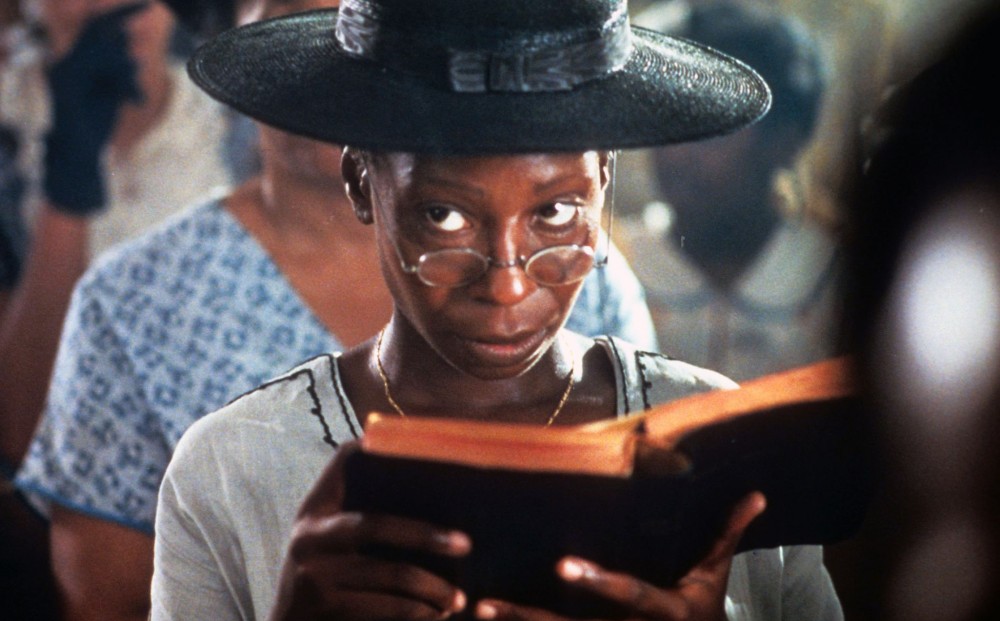
The following notes on The Color Purple (1985) were written by Nicole Pacelli, PhD student in the Department of Communication Arts at UW – Madison. A 35mm print of The Color Purple, courtesy the Wisconsin Center for Film and Theater Research, will screen at the Chazen Museum of Art on Sunday, February 22 at 2 p.m. Admission is free!
By Nicole Pacelli
In 1985, Steven Spielberg’s The Color Purple entered United States theaters as both a major cultural event and an immediate site of debate. Adapted from Alice Walker’s Pulitzer Prize winning novel, the film sits at the meeting point between literary adaptation, studio filmmaking, and changing public conversations around race, gender, and representation. A significant change in scope for Spielberg—at the time Hollywood’s most successful blockbuster filmmaker, best known for hit genre films like E.T. (1982) and Raiders of the Lost Ark (1980)— The New York Times reported that Spielberg earned only the Directors Guild of America required minimum wage of $40,000 for directing the historical drama. Its release brought major awards attention: the film received eleven nominations at the Oscars, including nods for stars Whoopi Goldberg, Oprah Winfrey, and Margaret Avery, while Spielberg also earned his first DGA Award for the feature. Simultaneously, critics and community organizations argued over the film’s contentious authorship and depiction of Black life, at a time when very few stories centered on Black women were reaching audiences at this scale.
Spielberg’s visual approach drew from the classical style of directors such as John Ford and William Wyler. With the aid of cinematographer Allen Daviau and production designer Michael Riva, the film developed a visual language grounded in natural light and tactile environmental texture. To help the North Carolina locations visually register as rural Georgia, the production design team modified the landscape using red clay soil, supporting geographic accuracy while also shaping how natural light interacted with skin tones and surfaces within the frame. Location manager Kokayi Ampah secured a site near Wadesboro, North Carolina, that matched the environmental and lighting conditions the production required. As Daviau explained in American Cinematographer, Spielberg consistently emphasized spatial clarity, noting that he was “always concerned about the audience understanding the geography” of a space.
Novelist Walker stayed actively involved as the project moved into production. The AFI Catalog notes that her contract gave her script approval and required that 50% of the production team outside of the cast be African American, female, or “people of the Third World.” She also drafted an early screenplay version before Menno Meyjes became the credited screenwriter, whose work on the film marked his first theatrically produced feature script. Walker pushed for lesser-known actors in principal roles, working directly with cast members on Southern speech patterns and dialect.
In her 1998 book The Same River Twice: Honoring the Difficult, Walker describes the difficulty of seeing her work adapted for the screen. When she first saw the finished film in a theater, she questioned multiple creative decisions, including Quincy Jones’ music as well as the softening of Celie (Goldberg) and Shug Avery (Margaret Avery)’s lesbian relationship. In the film, the relationship exists but remains largely implied. Spielberg later reflected on his decision to reduce the sexual explicitness present in Walker’s novel. In an interview with Entertainment Weekly, the director said his own “shyness,” along with rating concerns, led him to reduce what he described as an “extremely erotic” relationship to a single kiss, an emotional element that Walker insisted remain intact. Despite her reservations, Walker noted that she trusted Jones’ recommendation that Spielberg direct because she wanted the story to reach audiences who might never read the novel. As she put it, “Steven is white, and a man. But he is more than that. As I am more than black and a woman.”
Public response to The Color Purple extended beyond the confines of film criticism. Many argued that the film reinforced stereotypes of Black men as aggressive or abusive. Civil rights organizations, activist groups, and scholars debated the film’s depictions of Black masculinity, domestic violence, and queer intimacy, exposing deeper tensions within 1980s Black cultural politics. The Hollywood Beverly Hills chapter of the NAACP raised concerns about representations of Black men and later filed a complaint against the Academy of Motion Picture Arts and Sciences. The term “black-out” circulated to describe the industry’s suppression of African American projects. A major thread running through these debates was representational scarcity. Gender differences also shaped reception, with many Black women describing feeling seen on screen for the first time. Winfrey addressed the pressure of representational totality directly when she said, “This movie is not trying to represent the history of Black people in this country any more than The Godfather (1972) was trying to represent the history of Italian-Americans. In this case, it’s one woman’s story.”
In the years since the film’s release, the story of The Color Purple has continued to circulate across stage and screen long after the original film’s release. A Broadway adaptation ran from 2005 to 2008 and returned in 2015 in a revival starring Cynthia Erivo and Jennifer Hudson. A musical film adaptation released in 2023 drew from both stage and earlier screen versions, featuring an ensemble cast led by Taraji P. Henson and Fantasia Barrino. Rather than remaining tied to one historical moment, the story continues to shift as conversations around gender, sexuality, and historical memory evolve. In a conversation with author Salamishah Tillet, film scholar Racquel Gates suggests that the endurance of The Color Purple comes less from any single version and more from how audiences continue to engage with it over time.
As Tillet argues in her book In Search of The Color Purple, the story is structured around memory rather than resolution. The novel’s letter structure becomes voiceover and subjective visual perspective in the film, placing viewers inside Celie’s interior experience. The past operates as a structural force. Memory here is unstable: it is something Celie moves through rather than something she can live safely inside. Trauma appears physically, through silence, posture, and the ways bodies learn to exist around threat. The film sits inside gendered historical frameworks where some lives are documented while others are minimized or erased. What emerges instead is a search for sanctuary—not simply safety, but recognition. Recognition that these lives carry value even when dominant history refuses to treat them that way. The maternal and the feminine operate as complex sites of origin, belonging, and survival. Celie exists in layered vulnerability, first through gender and then through race, while still being expected to sustain community, to build a world inside those conditions. Yet rootlessness, longing, and circumstance do not only produce loss. They produce searching. Searching for origin, for memory, for somewhere to stand. In The Color Purple, sanctuary becomes transitional, something you move through while trying to become legible to yourself.