The following notes on Rollercoaster were written by Ashton Leach, PhD candidate in the Department of Communication Arts at UW—Madison. Rollercoaster will be shown in “Sensurround” on a restored DCP on Saturday, February 7, at 7 p.m., in the Cinematheque’s regular venue, 4070 Vilas Hall, 821 University Ave. Admission is free!
By Ashton Leach
Like coaster cars inching up a lift hill, director James Goldstone builds tension slowly in Rollercoaster (1977) as bombs are methodically planted on amusement rides across the United States. Unlike the more outrageously apocalyptic entries in the disaster film cycle, Rollercoaster harkens back to the suspense exemplified by Airport (1970), in which the anticipation of catastrophe is almost as consuming as the catastrophe itself. In doing so, the film operates less as a conventional disaster movie and more as a procedural thriller, exploring how danger can be meticulously crafted, rather than merely sudden and random.
Shot on location at functioning amusement parks across the country, including Ocean View Amusement Park and King’s Dominion in Virginia and Magic Mountain in California, Rollercoaster intersperses this footage of gliding coasters throughout the film. These are not studio approximations or rear-projections: the film features real crowds and real larger-than-life machines operating at full scale, creating the authentic sensation of excitement and unease that is often experienced at amusement parks, even without the threat of an unknown terrorist. By embedding its narrative of sabotage within spaces audiences recognized—and on rides that many people have ridden—Rollercoaster collapses the distance between spectacle and everyday life.
The film centers on Harry Calder (George Segal), a ride safety inspector tasked with anticipating any mechanical failures and stopping them from becoming newsworthy human tragedies. He is not your standard hero, initially coming across as slightly irritable and emotionally monotonous. Calder is seemingly burdened by his own expertise as he spends his days thinking about the impending destruction that can be brought on by something as inconspicuous as a loose bolt. However, how he goes about protecting the park attendees is significantly altered when a mysterious young man begins placing bombs on roller coaster tracks. Calder is forced into the role of citizen-sleuth not because he seeks heroism, but because it is his responsibility to make sure the rides are safe for everyone.
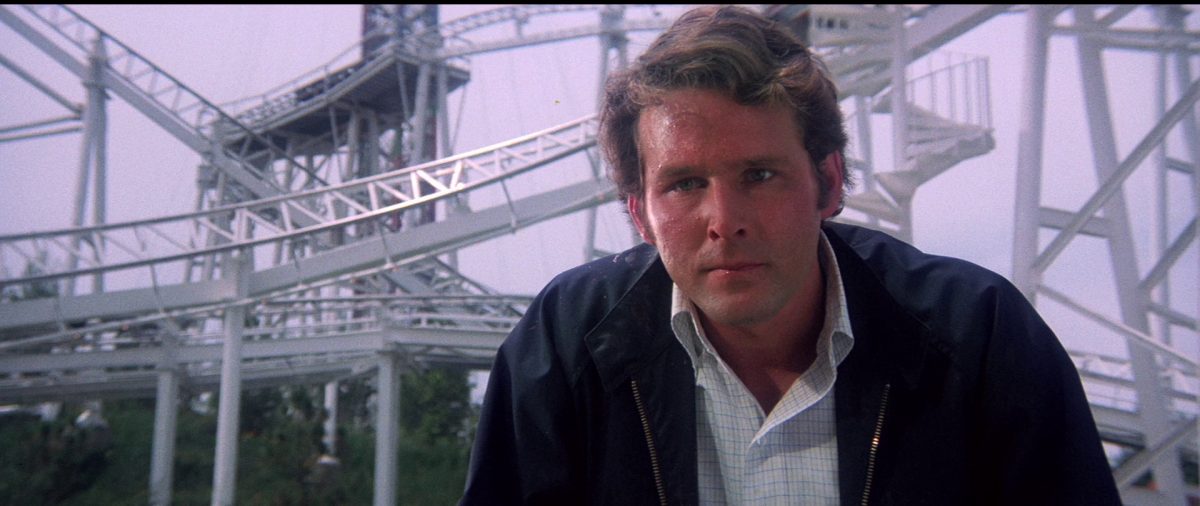
Timothy Bottoms plays our unnamed criminal, and the young man’s demands are strictly financial. Throughout conversations and glimpses in the crowd at the park, his demeanor is so innocuous that he almost seems polite while threatening to kill innocent people if he does not receive a sum of a million dollars. Unlike the ideologically motivated villains who would come to dominate later thrillers, this bomber offers no grandiose manifesto and little explanation; a scene hinting towards any explanation was cut from the film completely. The absence of a clear motive transforms him into an abstract threat, terrifying precisely because audiences can see him in any anonymous face they pass the next time they visit any amusement park.
In 1977, that anxiety was amplified by the film’s famous technological experiment: Sensurround. Universal Pictures’ short-lived attempt to turn movie-going into a bodily experience, Sensurround used low-frequency sound to physically vibrate the theater during moments of heightened danger. Earthquake (1974) and Midway (1976) were the only other films to use Sensurround up to that point, making it a sonic technology that had already become closely associated with the disaster genre. In Rollercoaster, those rumbles come out during the rides themselves, allowing audiences to hear and feel the tracks shudder and the cars accelerate beneath them. In this way, the effect once again works to collapse the distance between spectator and spectacle, aligning the audience’s physical vulnerability with that of the riders onscreen.
While most disaster movies create an atmosphere of chaos, Rollercoaster forgoes disorderly panic for gradually intensifying anxiety. Long stretches unfold as Calder investigates the crimes. The pacing resists the speedy escalation typical of disaster cinema, instead taking time to focus on the ambience of the crowds milling around the park and rides (safely) cycling through. Though this leisurely summer mood is indulged, the film favors a steady accumulation of unease as viewers wait for the drop: like any great coaster, these stretches of waiting and nervous anticipation along the way only add to the ride’s fun. One of Rollercoaster’s most pleasurable detours comes from its music, particularly the presence of pop duo Sparks, whose contributions inject a distinctly off-kilter, disorienting energy into the proceedings. Sparks’ bright, ironic pop invigorates the promise of fun that amusement parks sell so effortlessly, even as danger is lurking within the crowd in the film.
What ultimately makes Rollercoaster so nerve-shredding (and thrilling), however, is not the spectacle of explosions. Instead, it is the idea that the threat comes from nowhere in particular—from the everyman. By refusing to explain the reasons for the young man’s actions, the film denies the audience the comfort of difference and distance. There is no extreme ideology to argue with, no anger to contain. There is only the chilling suggestion that someone who blends seamlessly into the crowd can cause destruction in places meant for pure recreation and pleasure. Like the coasters it so lovingly documents, Rollercoaster remains exhilarating precisely because it reminds us how thin the margin is between thrill and catastrophe.