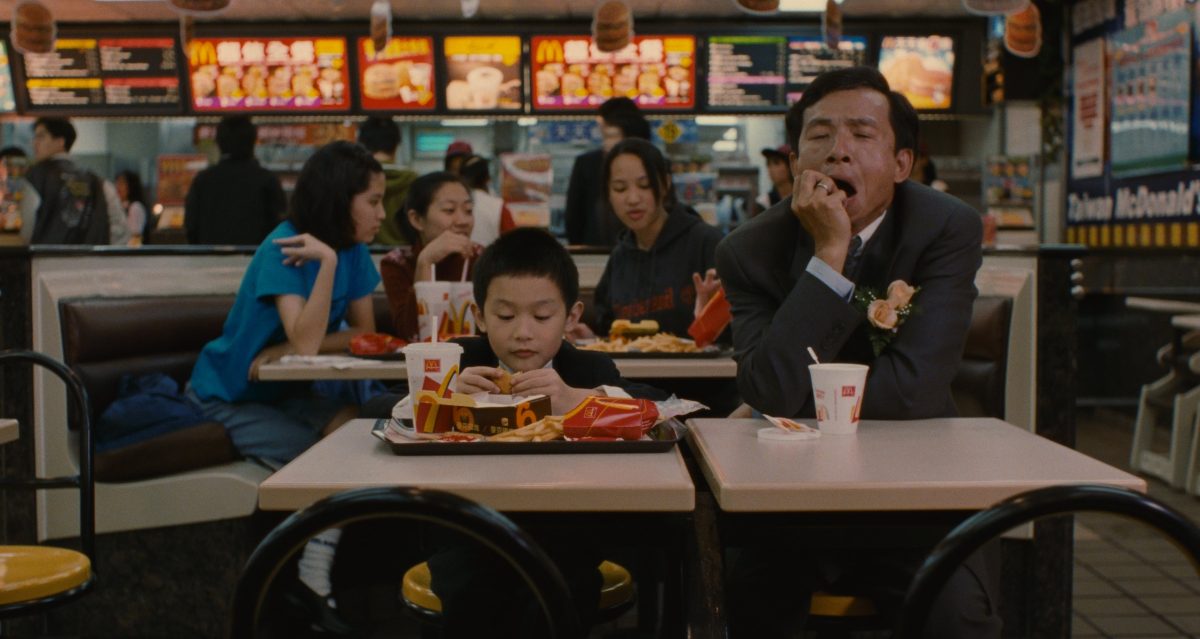
The following notes on Edward Yang’s Yi Yi were written by Steph Chung, PhD student in the Department of Communication Arts at UW – Madison. A new 4K restoration of Yi Yi will screen in the Cinematheque’s regular space, 4070 Vilas Hall, 821 University Avenue, on Friday, January 30, at 7 p.m. Admission is free!
By Steph Chung
Near the beginning of Edward Yang’s Yi Yi (2000), young Yang-yang (Jonathan Chang) asks his father NJ (Wu Nien-Jen) a simple question: “Daddy, I can’t see what you see and you can’t see what I see. How can I know what you see?” NJ responds, “Good question. I never thought of that. That’s why we need a camera. Do you want to play with one?”
The subjects Yang-yang goes on to capture, however, feel trivial. He tiptoes around his apartment building with his camera in search of an elusive subject. When a passing neighbor, stunned by the brilliant white light of Yang-yang’s camera flash, questions him, Yang-yang reveals, “I want to show Mummy the mosquitoes…. Daddy said [to snap them], or people won’t believe me.”
Later, Yang-yang slips out during class to pick up his developed film negatives. After rummaging through his pockets to drop a fistful of coins (along with crumpled wrappers and miscellaneous candies) on the counter, Yang-yang intently examines his photographs. A convincingly serious artist at work, indeed. A teacher later catches Yang-yang sneaking back into class and nabs his photo prints, revealing to us Yang-yang’s artwork: shadowy corners of ceilings, indiscernible close-ups of colorful signs, and blurred shots of chipping paint revealing grey concrete.
To the teacher these photographs seem mindless and worthy of mockery—and, in a different world, perhaps they would to us as well. However, we know the intentionality behind each photograph. We were there at every step; the film makes sure to guide us through each quiet moment of their capture. While these photographs could be passed off as an eight-year old’s impulsive, trigger-happy shots, within Yang-yang’s interior world, they hold significance, whether as proof of experience or an attempt to let others see what he sees. Edward Yang’s Yi Yi exemplifies this attention to the latent depth of the seemingly mundane world. What’s remarkable about Yang’s filmmaking here is the restraint and patience he exercises in telling the stories of his characters.
Yi Yi follows the Jian family as they navigate the highs and lows of life, including a contentious wedding and the deterioration of their grandmother’s health. Training his eye on three family members specifically—the father NJ, the daughter Ting-ting (Kelly Lee), and the son Yang-yang—Yang explores the joys and troubles across three age groups. Despite the focus on distinct generations, the lives of these three family members overlap at critical thematic junctures (such as the experience of first love), making Yi Yi a variegated yet cohesive family saga that Yang further enhances through his attention to the simpler parts of life.
While he would go on to become one of the fixtures of the Taiwan New Cinema movement alongside directors like Hou Hsiao-hsien and Tsai Ming-liang, Edward Yang’s turn to filmmaking took a meandering path. Yang first studied electrical engineering in Taiwan and eventually earned an American master’s degree in computer science in 1974. After earning his degree, Yang enrolled in USC’s film school in hopes of fulfilling his lifelong aspirations for filmmaking, yet he promptly dropped out, feeling unfit for the program’s commercial focus. Yang then spent seven years in Seattle working as a computer designer until one fateful night when he watched Werner Herzog’s Aguirre: The Wrath of God at a theater. In an interview with Cineaste, Yang explains that he emerged from the theater a “different person” with a new, fiery resolve to become a filmmaker.
Despite his heart lying with filmmaking, Yang’s time as an engineer stuck with him. In interviews with Cineaste and Hollywood.com, Yang credits his work as an engineer for not only training his “psychological readiness” as a filmmaker but also opening his eyes to cherishing the hidden joys in life: “Earlier, when I wasn’t a filmmaker, [when] I was regularly employed, I noticed that a lot of people take for granted a lot of things that were happening around them. I think our work [as filmmakers and artists] is to remind them that there are so many fun things happening, and those are the things you put in your stories.” This kind of attention to the hidden vibrance of daily life dominates Yang’s ethos as a filmmaker. He maintains a grounded faithfulness to representing life while simultaneously folding in brilliant little moments where the quotidian takes on a magical quality.
Yang primarily explores these ideas in films about urban life. His films showcase much of the city, but Yang departs from the usual dramatic bustle of the landscape. Instead, his vision of Taipei is inflected with a tinge of subdued melancholy. His last three films—A Confucian Confusion (1994), Mahjong (1996), and Yi Yi (2000), collectively called the New Taipei Trilogy—all spotlight characters against a complicated cultural backdrop, weaving in themes like the pressures of capitalism on personal lives, the friction between cultural traditions and metropolitan ideals, and the loneliness that can pervade these crowded cityscapes. Yang’s characterization of the urban landscape undergirds his patient portraits of characters riding through the throes of life.
Yi Yi, Yang’s final film before his tragic passing in 2007 and perhaps his strongest evocation of the living, breathing dynamism of Taipei, captures the ever-present buzz of the city through reflections. Yang often observes his characters through glass windows: a closing glass office door reveals rows of cubicles and employees; red and yellow dots of distant car lights dance across apartment windows as we peer into characters suspended in evening solitude; swaths of building faces slide across car windshields as characters crawl through street traffic. All these reflections—and the superimpositions they create—fuse our views of the characters with a simultaneous view of the urban. Together, it creates a seamless vision where the city and the people who live in it bleed together.
In an audio commentary track recorded for the Criterion Collection, Yang describes Yi Yi as a “film about everyday life,” which is “perhaps the simplest subject matter, but sometimes… the most complicated.” Maybe this line best captures the comforting poeticism of Yi Yi: with his trademark attention to detail and quiet storytelling, Yang reveals the complex, beautiful layers hidden under the supposedly mundane.