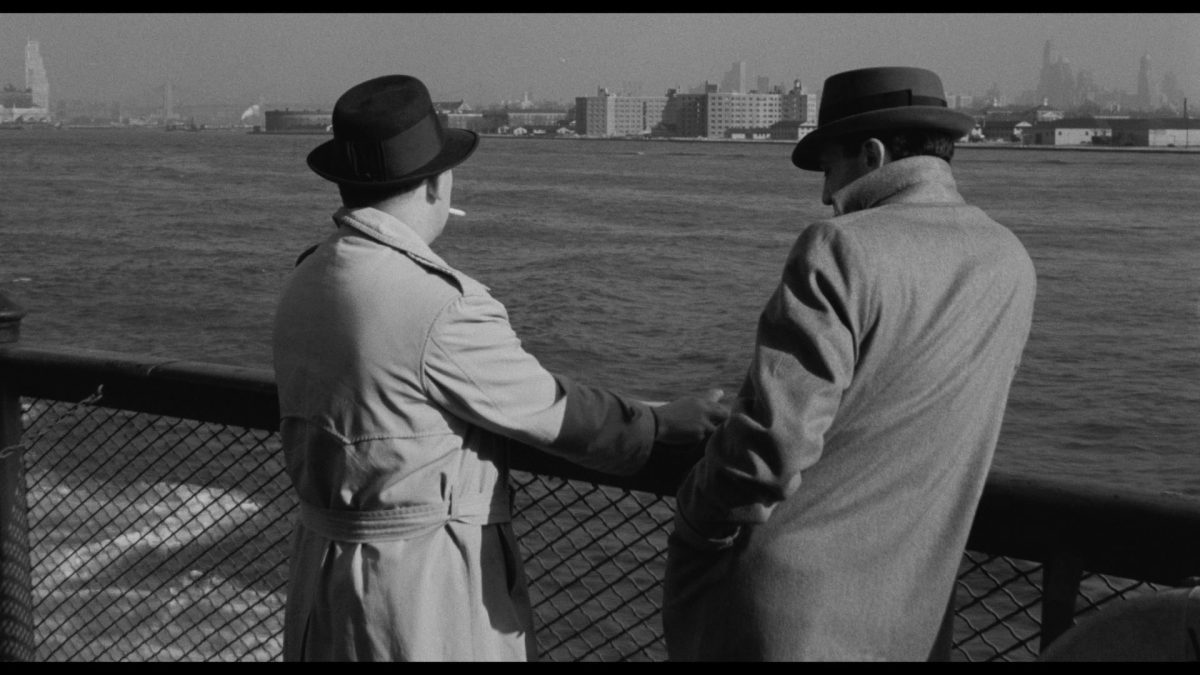
The following notes on Blast of Silence were written by Josh Martin, the Cinematheque’s Project Assistant and a PhD candidate in the Department of Communication Arts at UW-Madison. A 35mm print of Blast of Silence will screen at the Chazen Museum of Art on Sunday, December 7 at 2 p.m. The Chazen is located at 750 University Avenue. Admission is free!
By Josh Martin
In Blast of Silence (1961), Allen Baron’s unfailingly bleak New York noir, the first words we hear come from the booming, gruff voice of Lionel Stander, the film’s uncredited narrator. “Remembering, out of the black silence,” he portentously intones, “you were born in pain.” It is fitting that Stander’s invisible narrator gets the first word—and, for that matter, the last—in Blast of Silence. As critic Terrence Rafferty notes in his essay for the Criterion Collection’s home video release of the film, Blast features a notable idiosyncrasy in its soundscape: “it is among the very few works in the history of cinema to boast a voice-over narration in the second person.” In between dialogue exchanges and the occasional jolt of Meyer Kupferman’s jazzy score, this haunting, indeterminate voice defines the film, matter-of-factly describing the cruel inner workings of its protagonist’s mind. The central character in question is Frankie Bono (also played by Baron, a last-minute replacement for Peter Falk), a cynical, world-weary orphan from the Midwest who grew up to become a professional contract killer. Bono is a man of action and process, laconic by nature and resistant to emotions or even basic pleasantries. He has arrived in New York from Cleveland to kill a man (the mobster Troiano, played by Peter H. Clune), and that is all he intends to do.
To make matters worse for the perpetually antisocial Frankie, it is Christmas Eve, and the snow-covered streets of the city are abuzz, a mood of joy and goodwill for all humankind palpable in the air. Yet Frankie is allergic to such hopeful notions of charity and generosity, remaining positively Grinch-like in his disposition, resistant to the ambience of the season. He doesn’t care for the New York of bright lights and beautiful Christmas trees; he prefers to remain in his miserable milieu of seedy hotels and village bars, away from people who might disturb the lone wolf persona he has crafted for himself. As such, in an almost perversely comic fashion, Baron’s film proceeds to routinely put the bitter Bono in situations that further discomfort and frustrate him. He needs a gun with a silencer to do the job—to acquire that, he’ll have to deal with Ralphie (Larry Tucker), a paragon of grotesquerie who keeps sewer rats for pets and lives in a decrepit apartment. But these are business dealings (in his essay, Rafferty quips that this is a film about a “really bad business trip”), and ultimately, such encounters come with the territory. What Bono does not account for is a holiday reunion with two key acquaintances from his ho-hum past in sleepy Chillicothe, Ohio: the almost sickeningly ebullient Petey (Danny Meehan) and his sister Lori (Molly McCarthy), a former source of Frankie’s affections and seemingly the only person capable of chipping away at Bono’s icy exterior.
Blast of Silence is many things—an expertly economical slice of B-movie excellence, yes, as well as a deliciously demented sort of Christmas movie—but it is, at its core, a study of loneliness. Bono is a character mired in a life of hatred, pain, and violent ugliness, a man who seems to be at home in seclusion, accepting of the fact that he will one day die on his lonesome—if you believe what our voiceover narrator tells us. “You’re alone,” Stander’s narrator observes as Frankie arrives in New York, “But you don’t mind that. You’re a loner. That’s the way it should be. You’ve always been alone… You like it that way.” The narration repeatedly reinforces this sense of loneliness: when Frankie is able to wriggle his way out of a social situation, the voice will dutifully offer a reminder that he is “alone, again,” almost like an exhale from the tension of another tiresome encounter. Stander’s hard-boiled screeds are nearly excessive in their adoption of a nihilistic attitude, raging against Christmas music, romance (“If you want a woman, buy one”), and the memories of unhappy holidays past with unrestrained rancor. If we accept the voiceover as an accurate projection of Frankie’s psyche, what we see is a hideous portrait of a soul-sick man living in a self-imposed exile from the world.
However, the ambiguity of the source of this voiceover—Rafferty attributes to it a sense of “godlike” power, while Dave Kehr describes it as a tool of alignment, closely linking us to Frankie’s mental state—hangs over the film. By a certain point in Blast of Silence, the narration starts to feel less like an accurate portrait of the totality of Frankie’s mind and more like the embittered, malevolent voice of a metaphorical devil perched on his shoulder, the voice of someone who knows the evil rotting inside him and wants to further exploit it, pushing him to retreat further into his fury. Yet what the film presents to us, visually and narratively, often tells a different story, one of a man hoping for an escape from this life of violence, praying for a rescue from the prison he has created for himself. Of course, the tragedy of the film is that Frankie’s desire for connection and companionship does not ultimately redeem him. In the film’s most subtly harrowing sequence, Frankie hesitantly accepts Lori’s offer to come over for dinner, his heart beginning to thaw at the reappearance of a woman from his past. Yet as Lori presses him on the failures of his life, the roads thwarted and the paths not taken, Frankie can only impotently rage, sputtering excuses for his failings. To make matters worse, a gentle dance quickly turns violent, as Frankie forces himself upon Lori and attempts to sexually assault her. In this disturbing moment, that venomous voice we’ve heard throughout the film begins to feel like an accurate diagnosis of an irredeemable monster. In the end, Frankie really deserves his lonely, sad fate.
While Stander’s narration dominates the picture, it is by no means Blast’s only stylistic flourish of note. New York City location shooting, captured by cinematographer Merrill Brody (who also served as producer and co-editor), adds to the verisimilitude of the film’s desolate wintry atmosphere, while striking close-ups and occasional first-person point-of-view shots further immerse the viewer in Frankie’s world of violence and internal turmoil. The film’s unique style of storytelling and almost experimental formal choices are surely a reflection of Blast of Silence’s equally unusual mode of production. The rookie director Baron helmed the film independently on a paltry budget: as Turner Classic Movies noir expert Eddie Muller recounts, much of the location shooting was done without a permit, with the aim of stretching the $20,000 budget as far as it would go. Upon completion, Blast found a distribution home with Universal Pictures and embarked on a brief tour of the international film festival circuit, most notably at the Locarno Film Festival in Switzerland.
To call Blast of Silence a one-hit wonder is undeniably reductive—after all, Baron carved out a productive career in television, directing several episodes of The Love Boat and Charlie’s Angels, among others. But despite a few additional forays into feature directing, Baron’s subsequent films have languished in total obscurity, receiving virtually no critical attention. However, Blast of Silence endures as a perennial favorite, no doubt aided by the novelty of its Christmas setting. Without ever exculpating Bono for his actions, the film suggests a certain universality to his depressing experience of the holiday season, the frustrating feeling of being stuck in pervasive solitude at a time of jubilation. The tragedy of Blast of Silence is that there is no Ebenezer Scrooge-style redemption awaiting Frankie, no way to fundamentally change himself or his course of action. In the process, Frankie punches a one-way ticket to a demise as brutal and meaningless as his life, a return to that “cold, black silence” where perhaps he always belonged.