The following notes on L’Argent were written by Pate Duncan, PhD Student in the Communication Arts department at UW-Madison. The last of a three film series highlighting Bresson’s final works, a restored DCP of L’Argent will screen Friday, December 6, at 7 p.m., in the Cinematheque’s main venue, 4070 Vilas Hall, 821 University Ave. Admission is free.
By Pate Duncan
It’s tempting to read Robert Bresson’s final film, 1983’s L’Argent, as a kind of capstone or swan song to the French director’s career of precisely stylized austerity. The film follows Yvon Targe (Christian Patey), a working-class Parisian who enters the narrative as the result of a chain of exchanges of counterfeit bills. Two school children use a counterfeit bill at a photo store; the store owners realize too late that they’ve been cheated only, but respond by literally passing the buck onto Yvon, paying him with the counterfeit bills. From this follows a network of complicity, corruption, and murder all linked back to that single forged note. The film is typical of Bresson’s mature career in several ways. Like his earlier masterpieces, it is one of Bresson’s many literary adaptations, taken from Leo Tolstoy’s The Forged Coupon. Following the director’s own ascetic intrinsic norms, L’Argent features the Bressonian “model” in casting its protagonist with a non-actor, capitalizing off the gaunt, impenetrable mien of Christian Patey as the film’s central figure, Yvon. The film is an elaboration of the curious style bressonien, developing his parametric depersonalization of figures and patterned compositions, particularly as he adapted to finally using color in his films. Lastly, L’Argent features a scathing indictment of the contemporaneous capitalist French culture of the 1980s, using a counterfeit bill to catalyze a network narrative of interconnected misfortunes. The film’s title emphasizes this broad critique, changing from Tolstoy’s specific forged object to l’argent, or “money,” more generally. Materialism, the material world, and human weakness are shown to be easily corruptible elements in Bresson’s last work. While these formal and thematic concerns find some earlier antecedents in Bresson’s work, to hail L’Argent as a simply a précis summarizing earlier ideas is to potentially miss its defamiliarizing qualities and historical character, especially against the backgrounds of both Bresson’s oeuvre and against French cinema at the time.
L’Argent culminates a particularly bleak triptych of color films, following Lancelot du lac (1974) and The Devil, Probably (1977). Lancelot features the disillusionment, betrayal, and bloodshed that unravels the Knights of the Round Table after their quest for the Holy Grail, while The Devil, Probably rehearses political agitation and its pessimistic malaise following the uprisings and protests of May ‘68, which shook French culture and politics to the core. The six intervening years between The Devil, Probably and L’Argent—Bresson had not taken that long between feature films since Les Dames du Bois de Boulogne (1945) and Diary of a Country Priest (1951)—saw the French film industry adjust to a variety of earlier industrial changes, implement new policies, and adapt to changing audience tastes and expectations. Though there were prominent post-New Wave auteurs like Bertrand Blier and Maurice Pialat, as well as a new generation of feminist female filmmakers like Diane Kurys, the 1970s saw the fizzling out of the original Nouvelle Vague’s élan, with auteurs like Jean-Luc Godard and Agnès Varda seeking alternative production models and financing sources. France’s state monopoly on television broadcast with the Office de radiodiffusion-télévision française or ORTF was legally dissolved in 1975 and de facto petered out in 1981, paving the way for competitive television programming and television as a space for film exhibition. Around the same time, Alan Williams notes that the transition from Georges Pompidou’s presidency to Valéry Giscard d’Estaing saw the removal of French cinema censorship mechanisms, causing an uptick in hardcore pornographic films and, in mainstream films, increased nudity and sexuality, exemplified by the wildly popular Going Places (1974) and the more explicit Emmanuelle (1974), Maîtresse (1976), and, at the extreme end of this, Catherine Breillat’s banned film A Real Young Girl (1976). Complicating this, the 1980s saw the emergence of two larger aesthetic trends: the heritage film (historical costume dramas, often adapted from canonical French literature) and the nascent cinéma du look (owing to new television reforms, a kind of global aesthetic influenced by Hollywood, neon lighting, and busy, bravura visual style). Against the changing aesthetic backgrounds and audience expectations of the late ‘70s and early ‘80s, Bresson’s commitment to his distinctive style and anti-consumerist themes in L’Argent is especially striking.
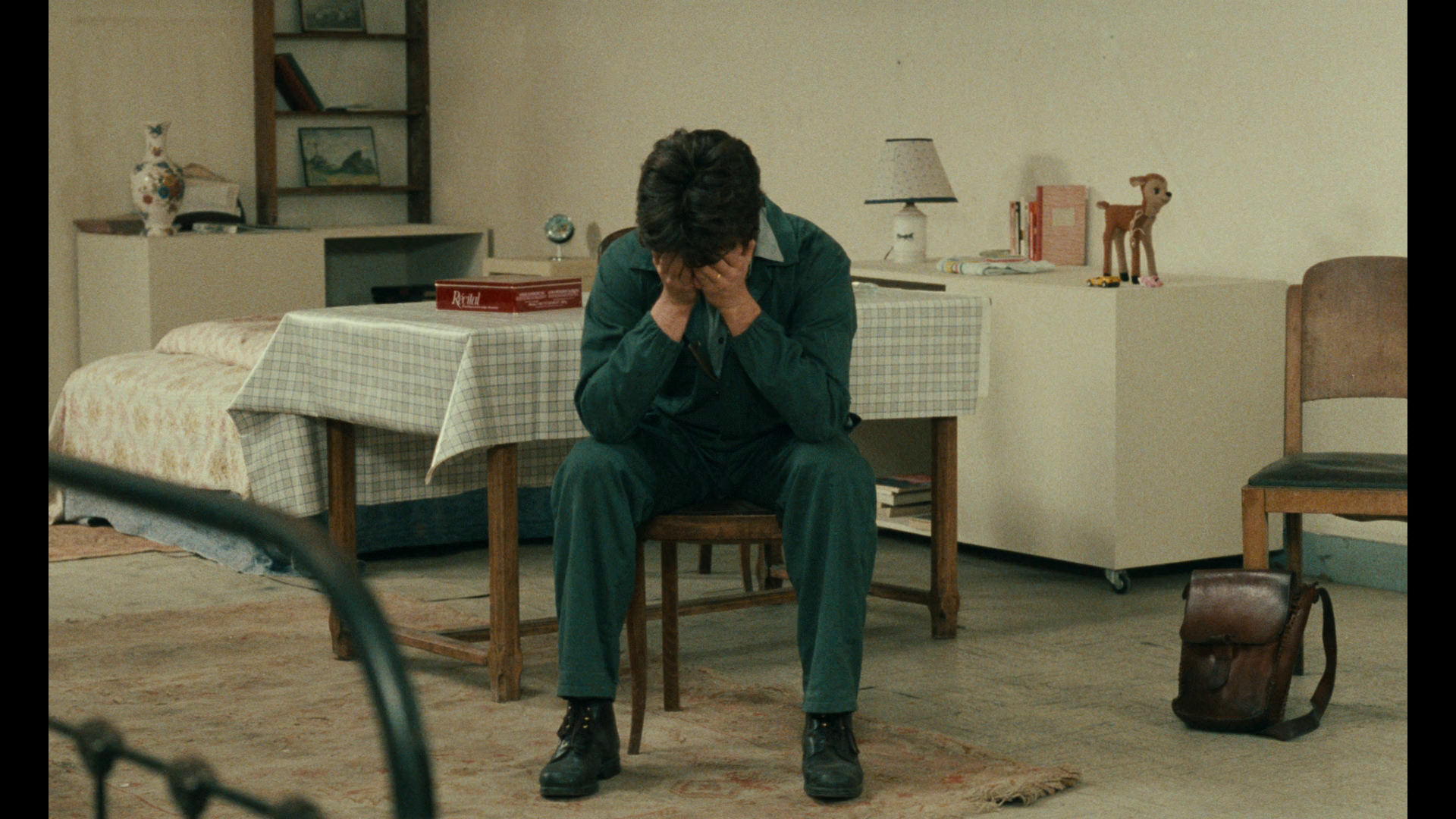
L’Argent, despite its grim thematic concerns, is a visually stunning work. Locating French consumer culture of the 1980s as an object of thematic critique also has the added benefit of exploiting its visual pleasures: much of the film’s first half features the kinds of sartorial delights of pleated trousers and light-wash denim that one finds in films from Éric Rohmer or Woody Allen from around the same period, while Bresson’s refusal to provide establishing shots often sees him take high-angle, three-quarter viewed close-ups of consumer objects like telephones, cameras, and bicycles as introducing and characterizing locations and characters throughout. These just-so compositions constitute a parameter of Bresson’s formal system and, at the same time, index his early career photographing luxury fashion and jewelry ads. An additional parameter, specific to Bresson’s work in color, is what Colin Burnett identifies as the film’s “variations on red-yellow-blue primary triad [that] give[s] the images a harmonious commonality that structures our experience of the plot and… a sense of modulation when the triad is intensified and dispersed in time.”
Additionally, the film’s narrative moves quickly—and often with unmarked, jarring ellipses in the narration—away from metropolitan Paris. Bresson returns to the prison mise-en-scène environments that gained him international renown in A Man Escaped (1956), Pickpocket (1959), and The Trial of Joan of Arc (1962) before following the narrative to the rural environments and tactile, natural elements that characterize Au hasard Balthazar (1966) and Mouchette (1967). These moments showcase Bresson’s powerful aestheticization of material as diverse as Renault cars, holes in prison mattresses, and agricultural equipment in a barn.
L’Argent is a tragic, bitter work with little of the transcendental or eternal character that many critics find in his earlier films. Bresson’s final work ends with a brutal sequence of senseless violence, a sequence whose impact throughout French film can be felt, years later, in its explicit quotation in Catherine Breillat’s film Fat Girl (2001). While this hopeless sequence and its quick aftermath make up the final set of images in Bresson’s filmography, it seems too easy to read the film’s austere pessimism as its most important parting gift. Rather, as a work of fastidious form and a commitment to a personal style despite changing norms, L’Argent is a generous film that rewards careful viewing and the kind of enthusiastic cinephilia that nourished Bresson’s career as an auteur.